Om Rangoli Design: 15 Beautiful & Easy Ideas for Home
There is something special about drawing an Om rangoli at the entrance of a home. It is not only the colors or the pattern that make it beautiful. For many families, the simple Om symbol carries a feeling of prayer, peace, and tradition.
I grew up in Kolkata watching my mother and grandmother draw Rangoli at our doorway every morning before sunrise. I would sit on the steps and watch them work slowly, placing each dot and guiding every curve with their fingers. Sometimes the design was only a few simple lines. Other mornings, it became a larger pattern filled with flowers and color.
Those mornings stayed with me.
For the past eight years, I have been drawing, trying, photographing, and documenting Rangoli designs. During that time, I have learned that a beautiful Rangoli does not always need to be complicated. A carefully drawn symbol, a clean border, and two or three well-chosen colors can be enough to make a doorway feel completely different.
That is especially true with an **Om rangoli design**.
The Om symbol is widely recognized in Hindu traditions and is also associated with spiritual practices in several Indian religions. It can be used as a central motif in a Rangoli, surrounded by flowers, diyas, dots, geometric shapes, or simple decorative borders.
In this guide, I’m sharing **15 beautiful and easy Om rangoli design ideas** that you can try at home. Some are simple enough for everyday practice, while others work beautifully for Diwali, puja, Navratri, or other festive occasions.
What Is an Om Rangoli Design?
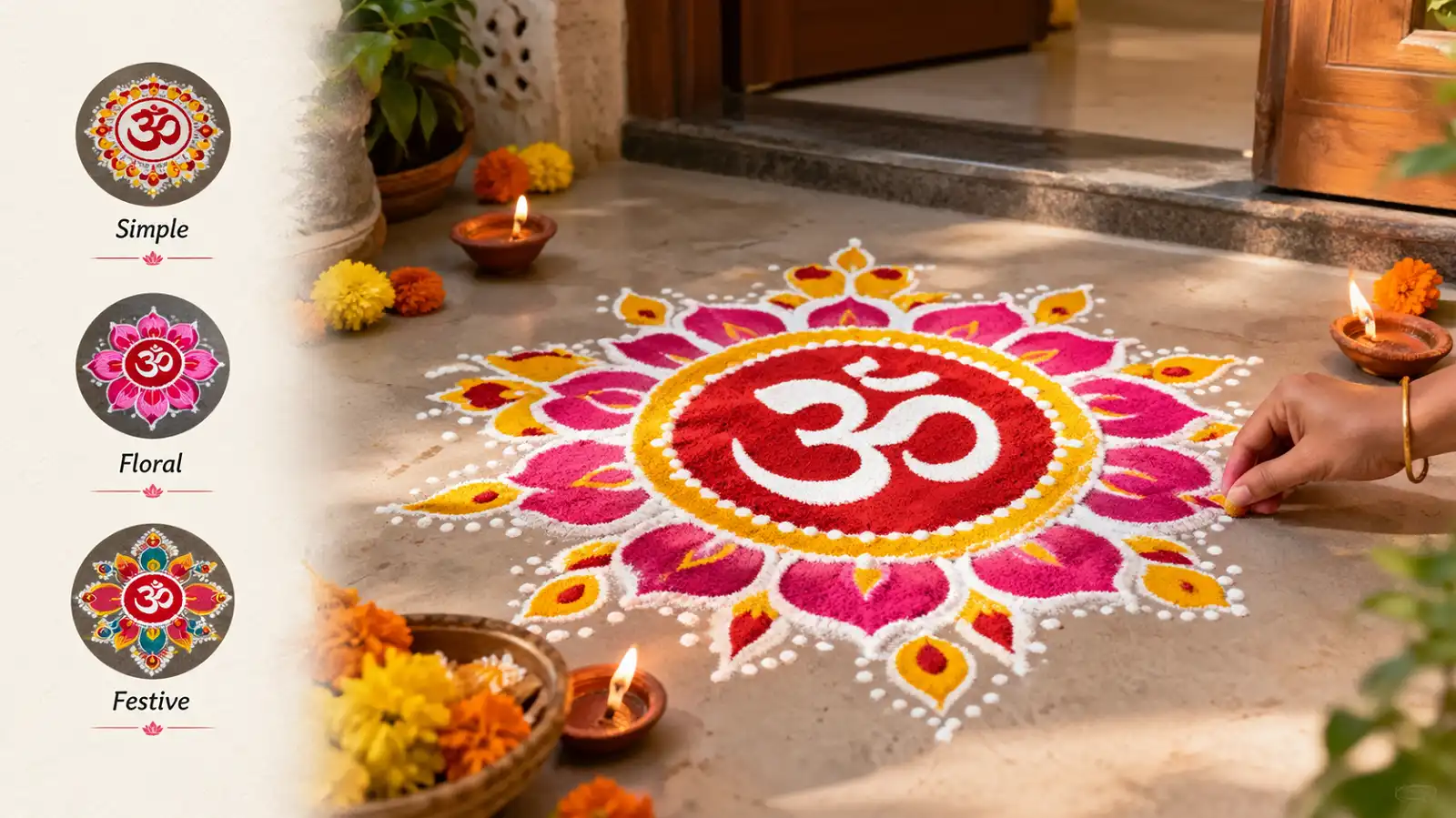
An Om rangoli is a floor decoration that uses the **ॐ (Om)** symbol as the main element of the design.
The Om symbol can be drawn by itself or placed inside a larger Rangoli composition. Around it, you can add lotus petals, flowers, dots, diyas, leaves, geometric borders, or circular patterns.
What I particularly like about Om Rangoli is its flexibility. You can make a design only 10–12 inches wide for a small doorway, or create a much larger circular pattern when you have more space.
Traditional Rangoli can be made with materials such as colored powder, rice flour, flower petals, sand, or other natural materials.
If you are new to the art, you may also want to start with some simple Rangoli designs for beginners before moving on to more detailed patterns.
15 Beautiful Om Rangoli Design Ideas
1. Simple Om Rangoli Design
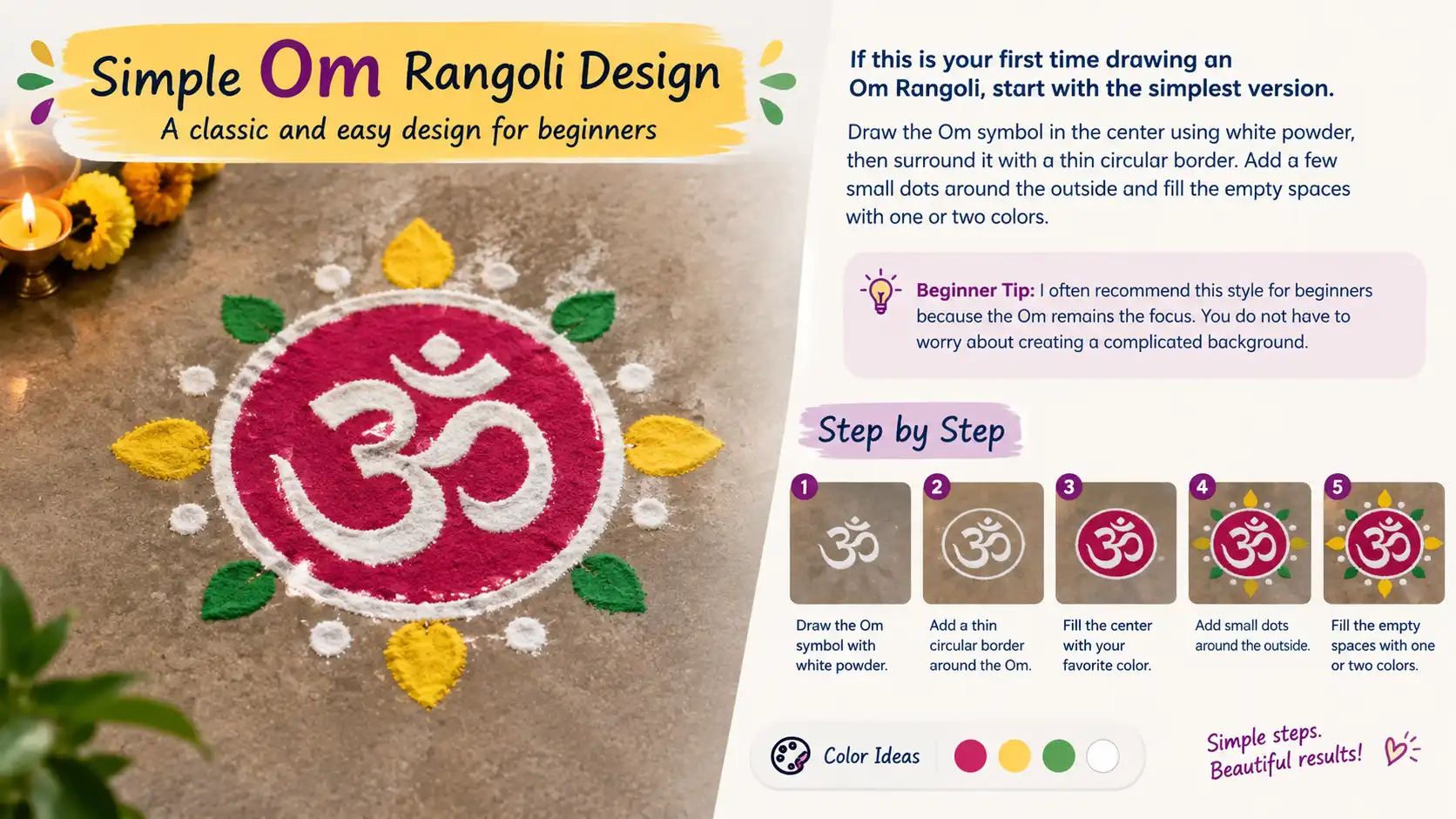
If this is your first time drawing an Om Rangoli, start with the simplest version.
Draw the Om symbol in the center using white powder, then surround it with a thin circular border. Add a few small dots around the outside and fill the empty spaces with one or two colors.
I often recommend this style to beginners because the Om remains the focus. You do not have to worry about creating a complicated background.
**Best for:** Everyday decoration, puja rooms, and small entrances.
**Color idea:** White, red, and yellow.
2. Colorful Om Rangoli with Flower Border
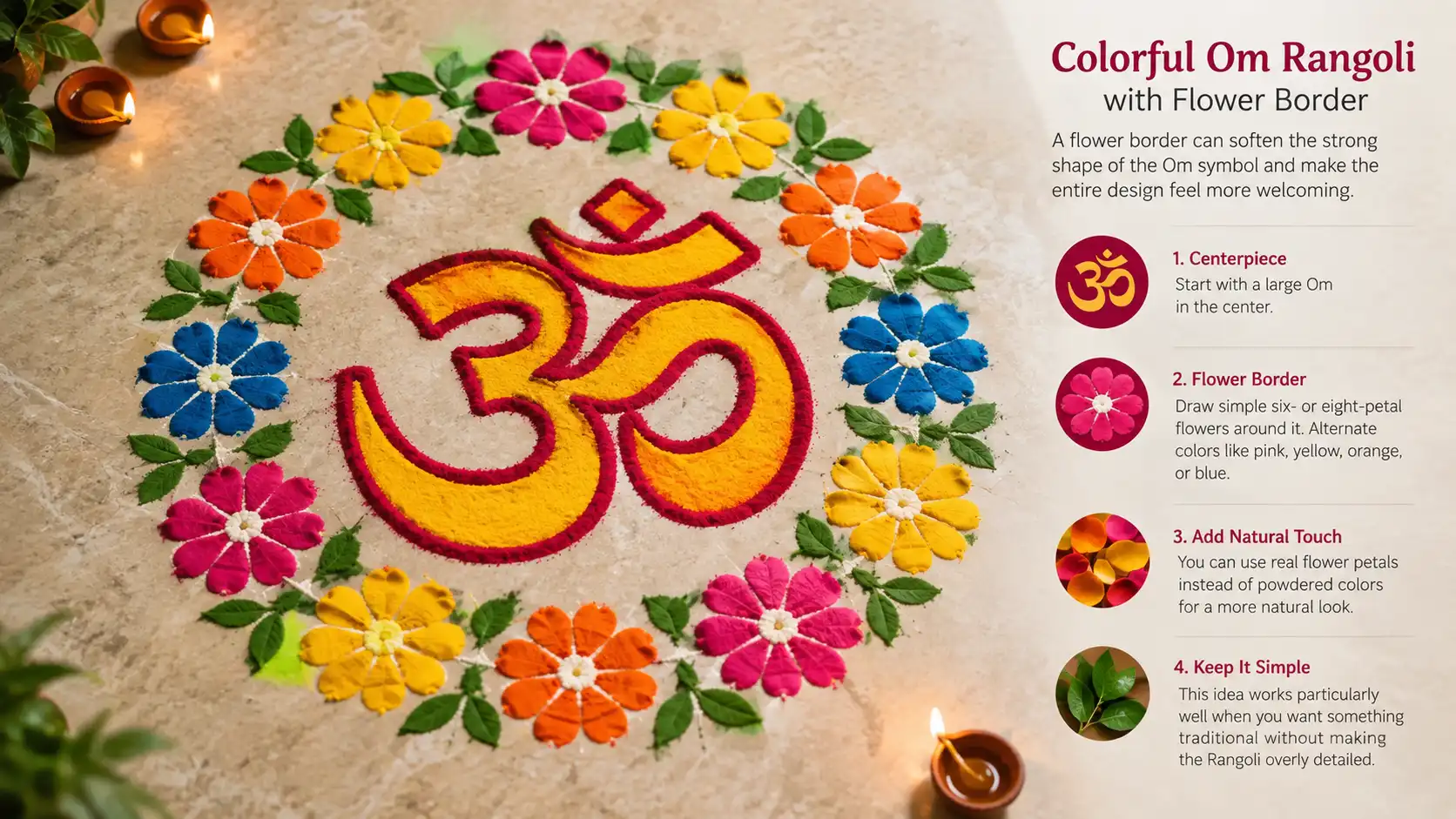
A flower border can soften the strong shape of the Om symbol and make the entire design feel more welcoming.
Start with a large Om in the center. Around it, draw simple six- or eight-petal flowers. Fill alternate flowers with pink, yellow, orange, or blue.
You can also replace the powdered flowers with real petals if you want a more natural look.
This idea works particularly well when you want something traditional without making the Rangoli overly detailed.
For more floral inspiration, explore these beautiful flower Rangoli designs.
3. Om Rangoli Design with Lotus
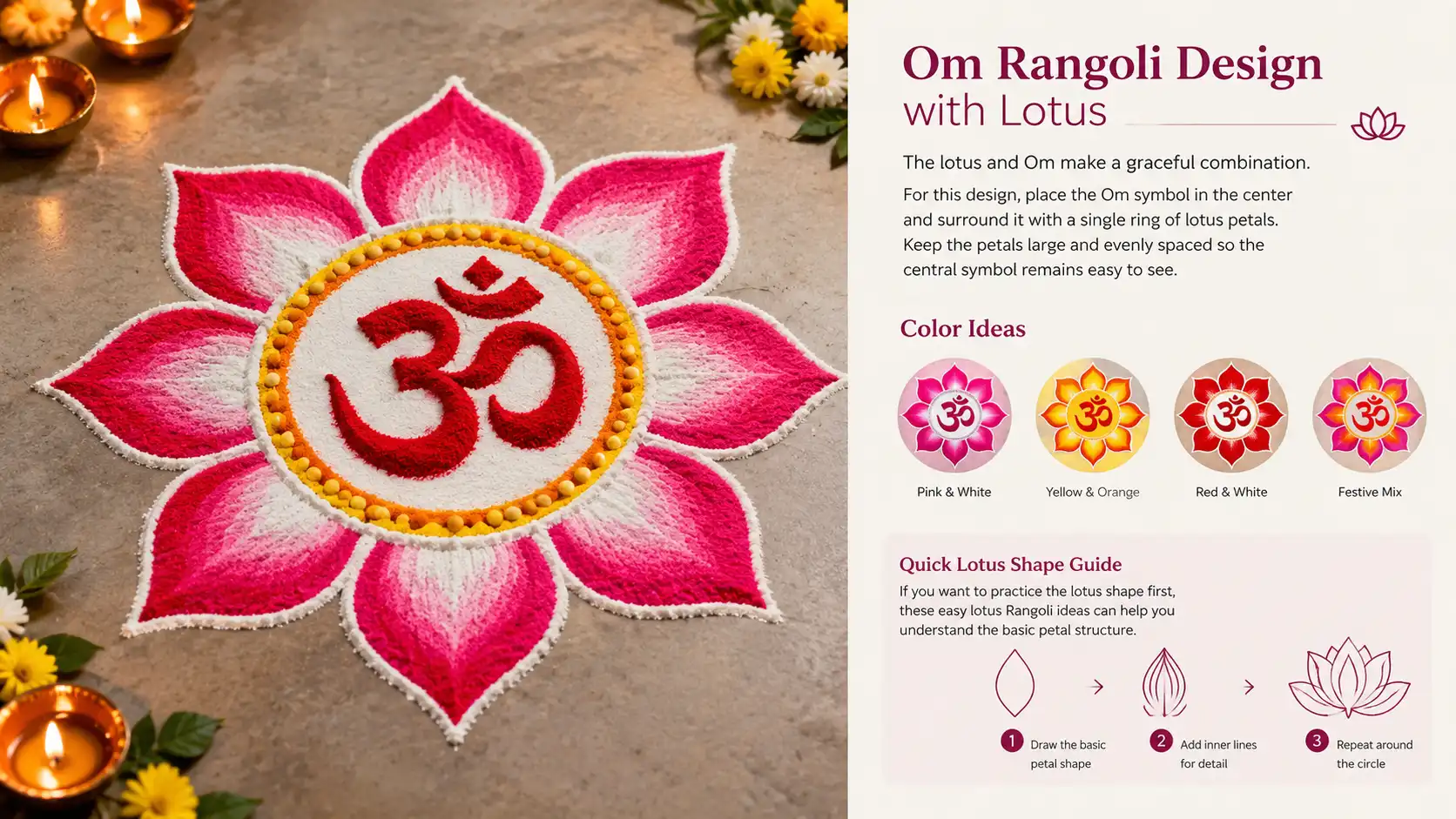
The lotus and Om make a graceful combination.
For this design, place the Om symbol in the center and surround it with a single ring of lotus petals. Keep the petals large and evenly spaced so the central symbol remains easy to see.
Pink and white are an obvious choice, but I also like yellow, orange, and red for festive occasions.
If you want to practice the lotus shape first, these easy lotus Rangoli ideas can help you understand the basic petal structure.
**Best for:** Puja, festivals, prayer spaces, and special family occasions.
4. Small Om Rangoli for Doorsteps
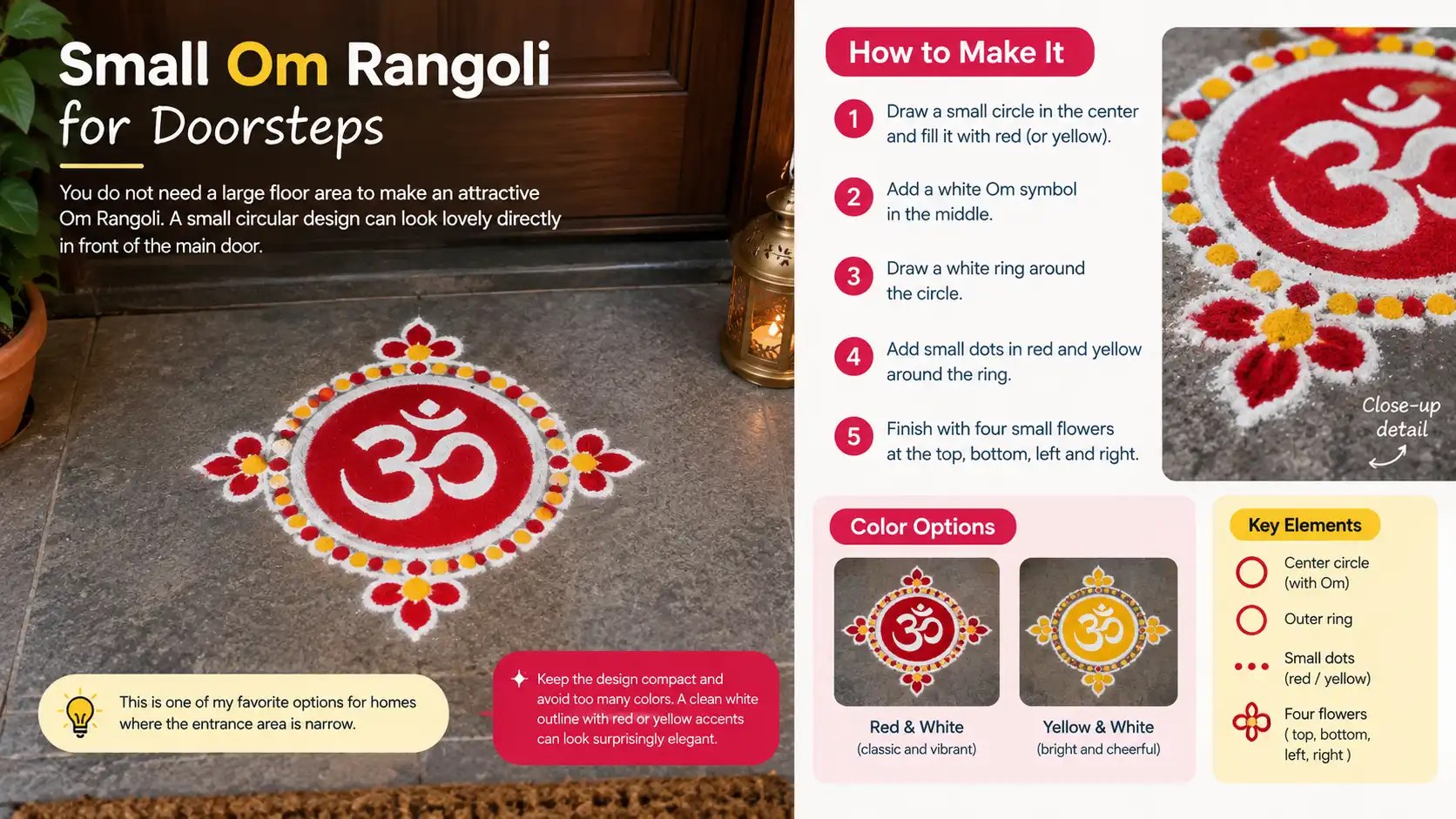
You do not need a large floor area to make an attractive Om Rangoli.
A small circular design can look lovely directly in front of the main door. Draw the Om in the center, add a simple ring around it, and finish with tiny dots or four small flowers.
This is one of my favorite options for homes where the entrance area is narrow.
Keep the design compact and avoid too many colors. A clean white outline with red or yellow accents can look surprisingly elegant.
5. Om Rangoli with Diya Motifs
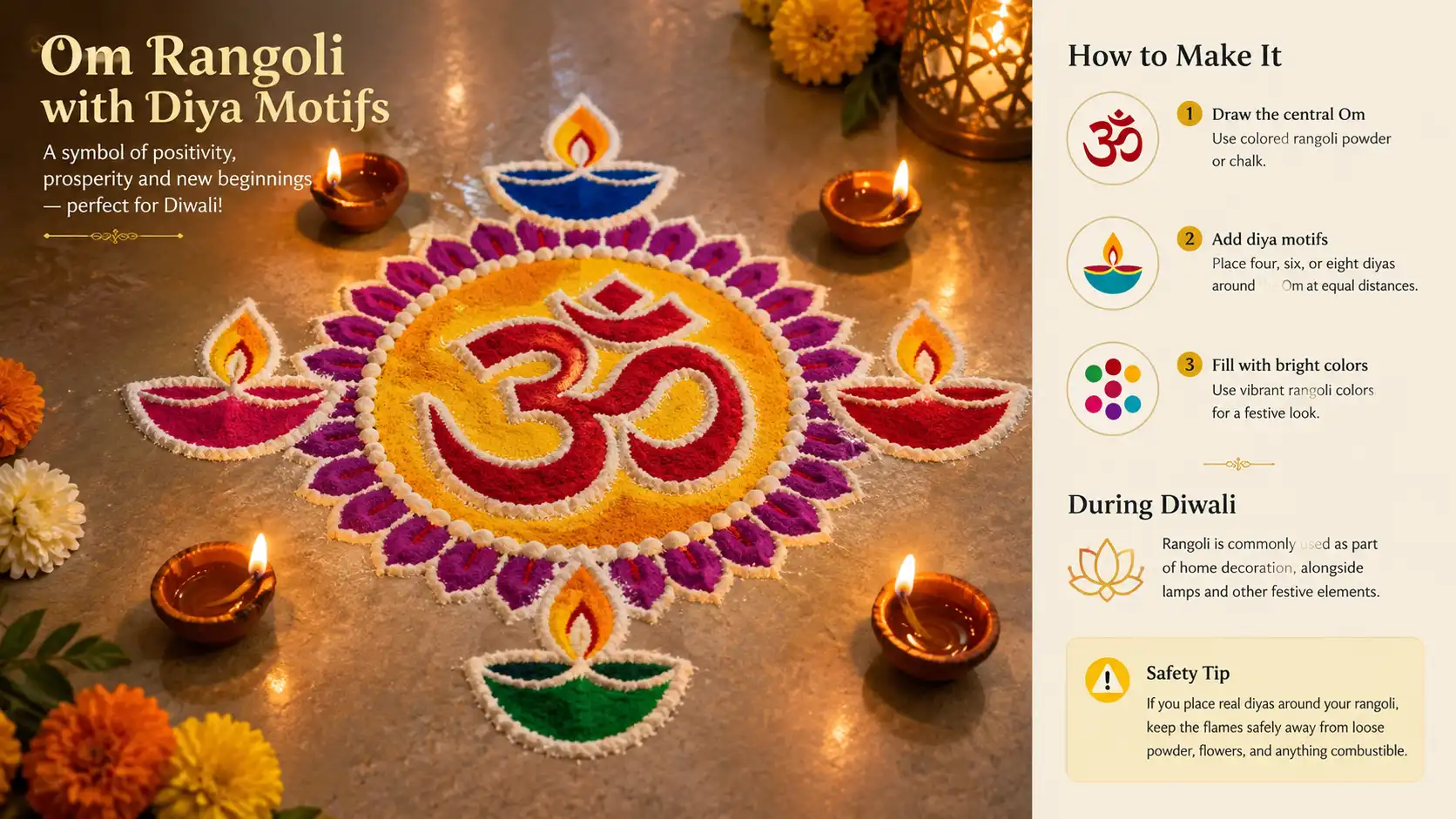
An Om Rangoli surrounded by diyas is especially suitable for Diwali.
Draw the central Om first. Then place four, six, or eight small diya shapes around it at equal distances. Fill the diyas with bright colors and add small flame shapes above them.
During Diwali, Rangoli is commonly used as part of home decoration, alongside lamps and other festive elements.
For a more complete festive arrangement, you can place real diyas around the finished Rangoli—but keep flames safely away from loose powder, flowers, and anything combustible.
6. Easy Om Rangoli with Dots
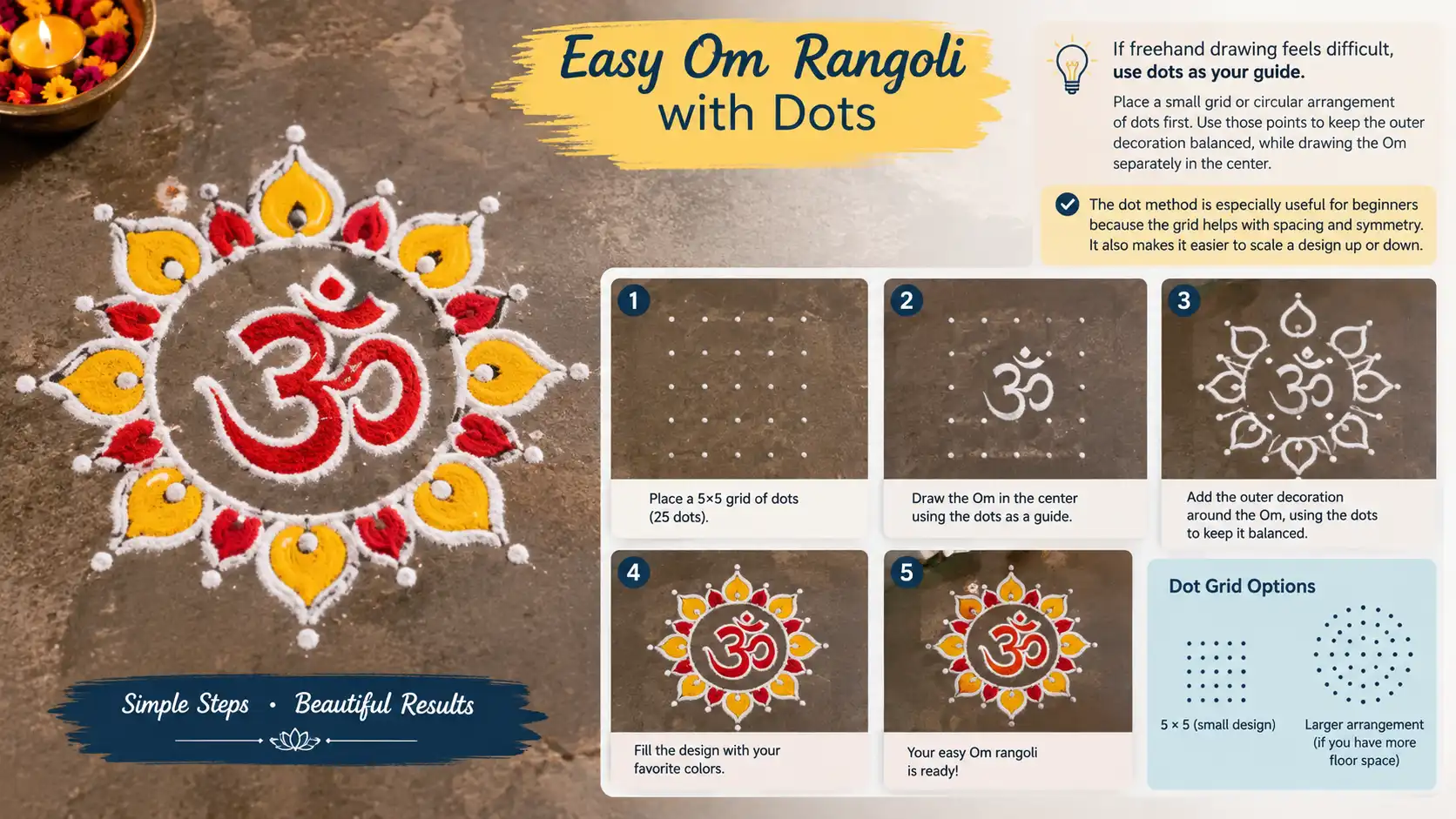
If freehand drawing feels difficult, use dots as your guide.
Place a small grid or circular arrangement of dots first. Use those points to keep the outer decoration balanced, while drawing the Om separately in the center.
The dot method is especially useful for beginners because the grid helps with spacing and symmetry. It also makes it easier to scale a design up or down.
Try a 5×5 grid for a small design or a larger arrangement if you have more floor space.
7. Om Rangoli with Geometric Border
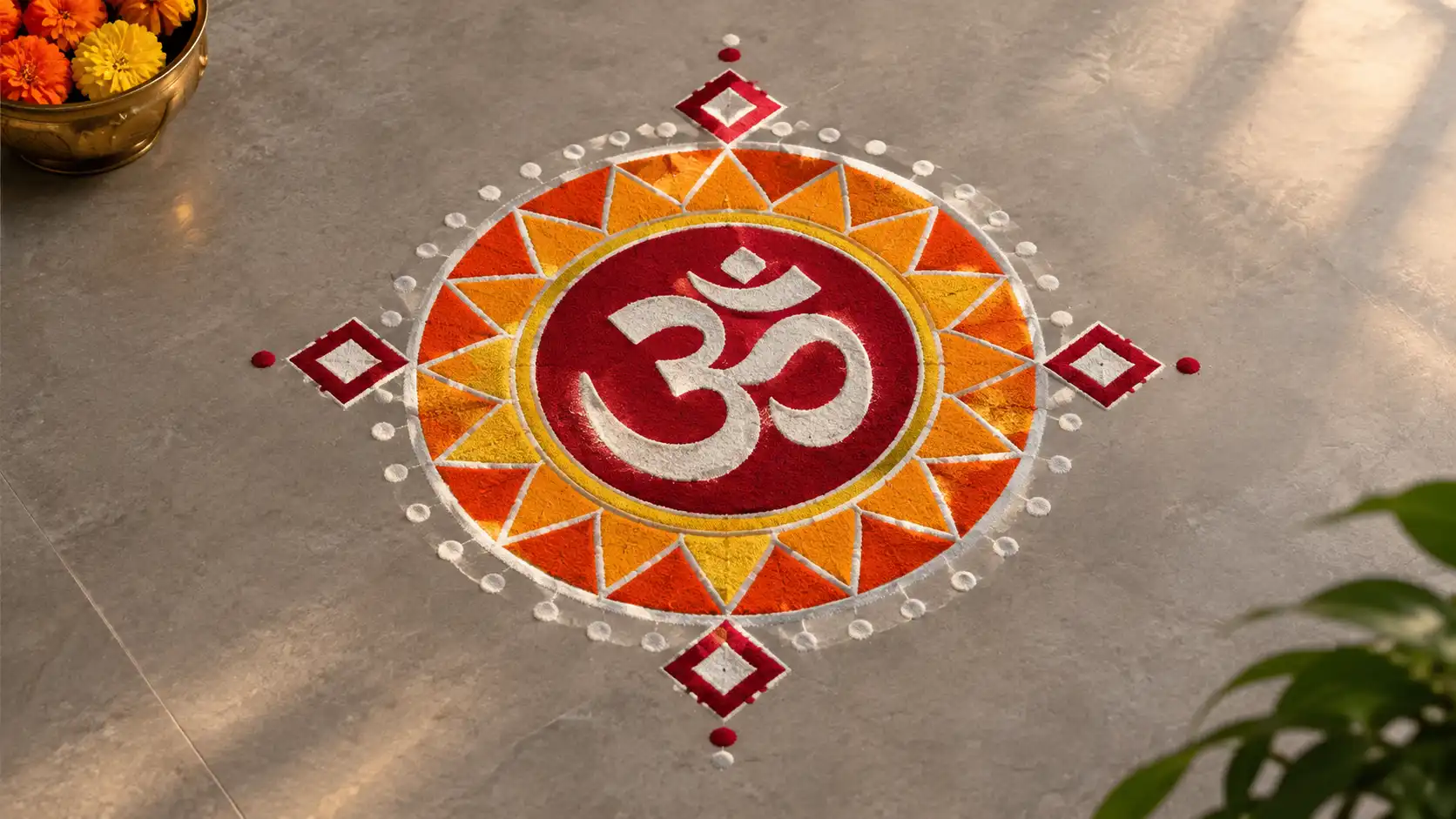
For a more modern appearance, combine the traditional Om symbol with geometric shapes.
You can create a square, diamond, or circular border around the central Om. Add triangles, small diamonds, dots, or repeated curves around the edges.
The trick is not to overfill the space.
When I work on geometric Rangoli, I usually choose one main shape and repeat it rather than introducing too many different patterns. Repetition makes the design feel organized.
**Good color combination:** White + red + yellow.
8. Om Mandala Rangoli
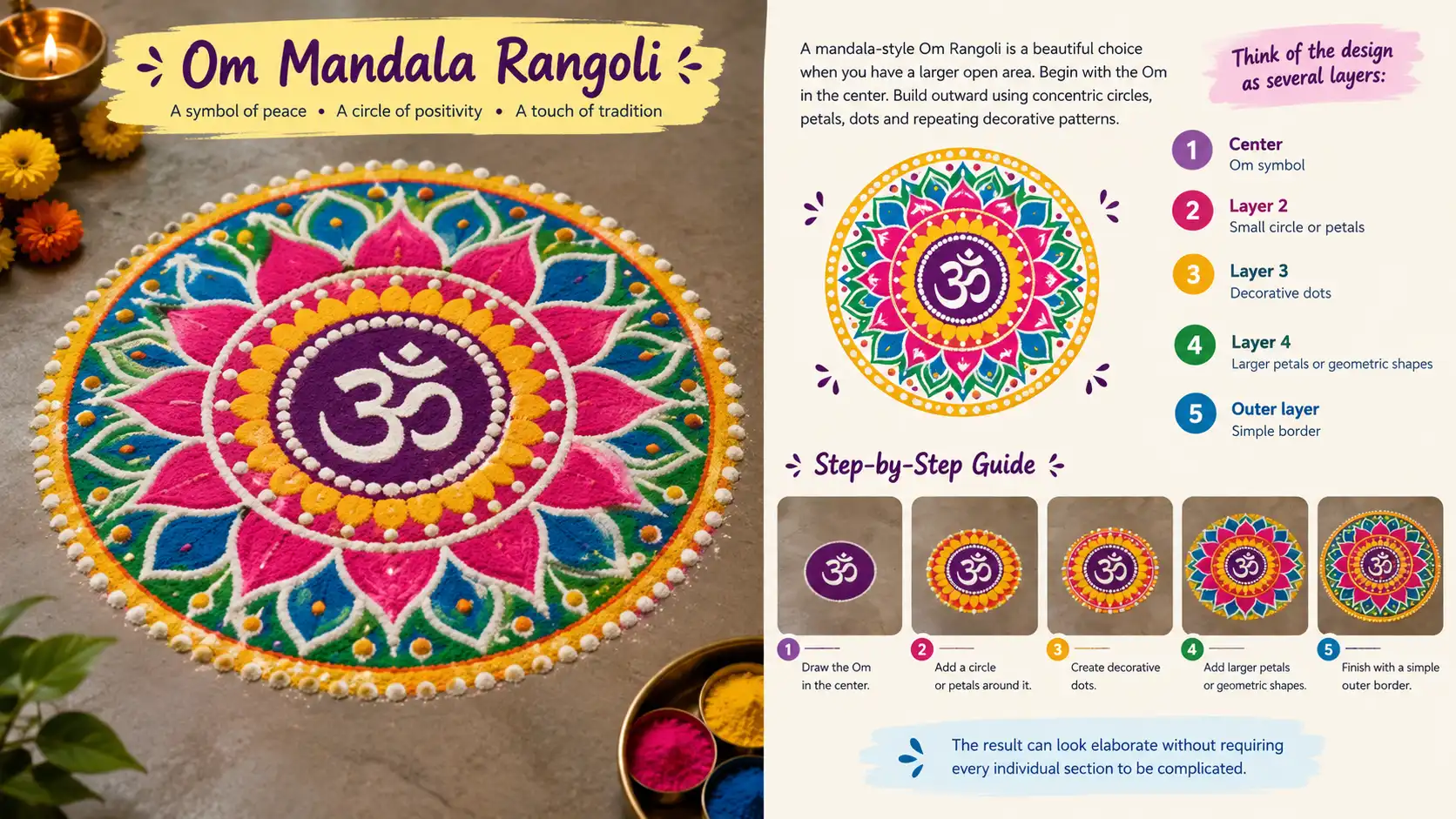
A mandala-style Om Rangoli is a beautiful choice when you have a larger open area.
Begin with the Om in the center. Build outward using concentric circles, petals, dots, and repeating decorative patterns.
Think of the design as several layers:
- Center: Om symbol
- Layer 2: Small circle or petals
- Layer 3: Decorative dots
- Layer 4: Larger petals or geometric shapes
- Outer layer: Simple border
The result can look elaborate without requiring every individual section to be complicated.
9. White Om Rangoli with Colored Accents
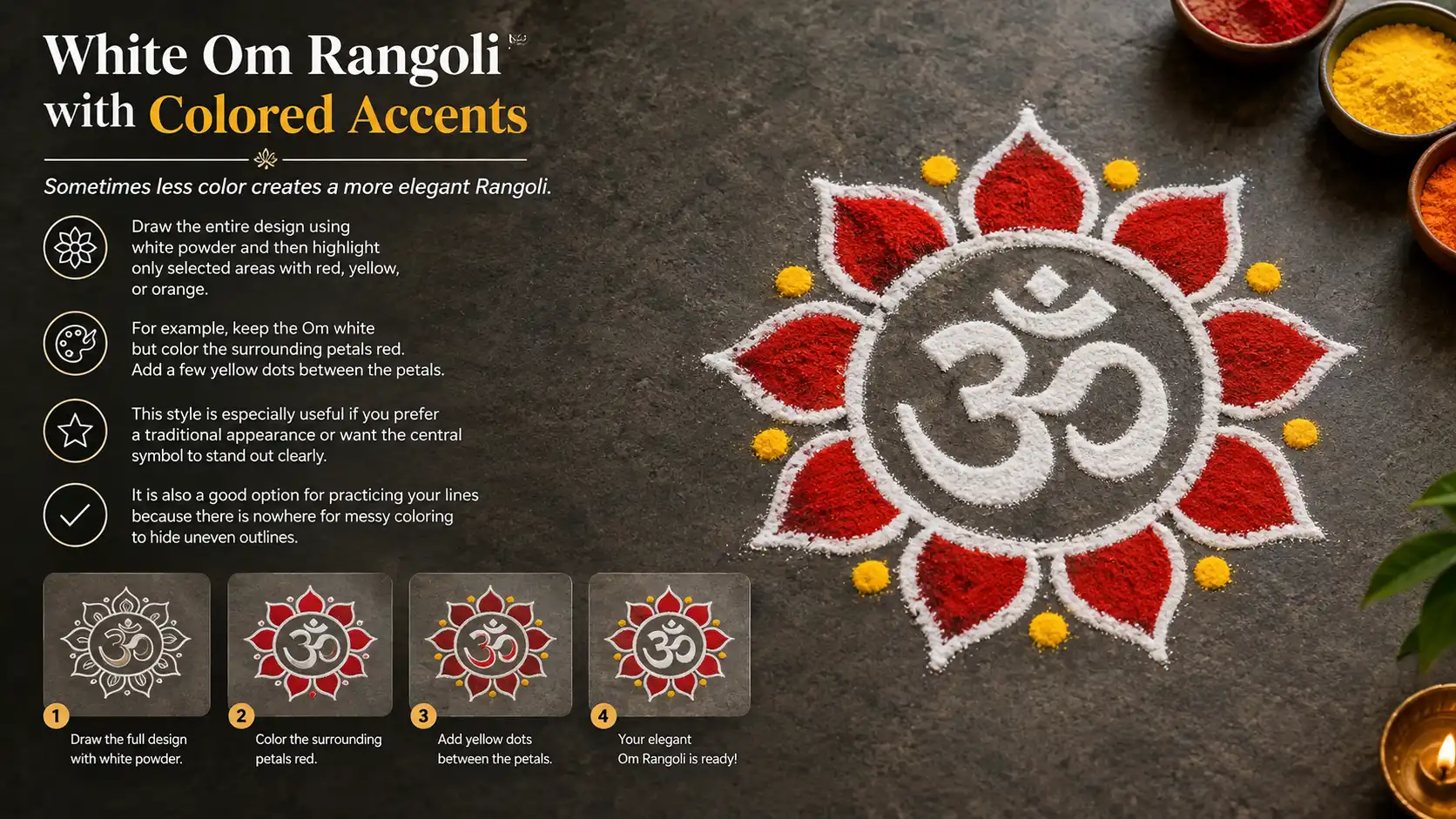
Sometimes less color creates a more elegant Rangoli.
Draw the entire design using white powder and then highlight only selected areas with red, yellow, or orange.
For example, keep the Om white but color the surrounding petals red. Add a few yellow dots between the petals.
This style is especially useful if you prefer a traditional appearance or want the central symbol to stand out clearly.
It is also a good option for practicing your lines because there is nowhere for messy coloring to hide uneven outlines.
10. Om Rangoli with Peacock Details
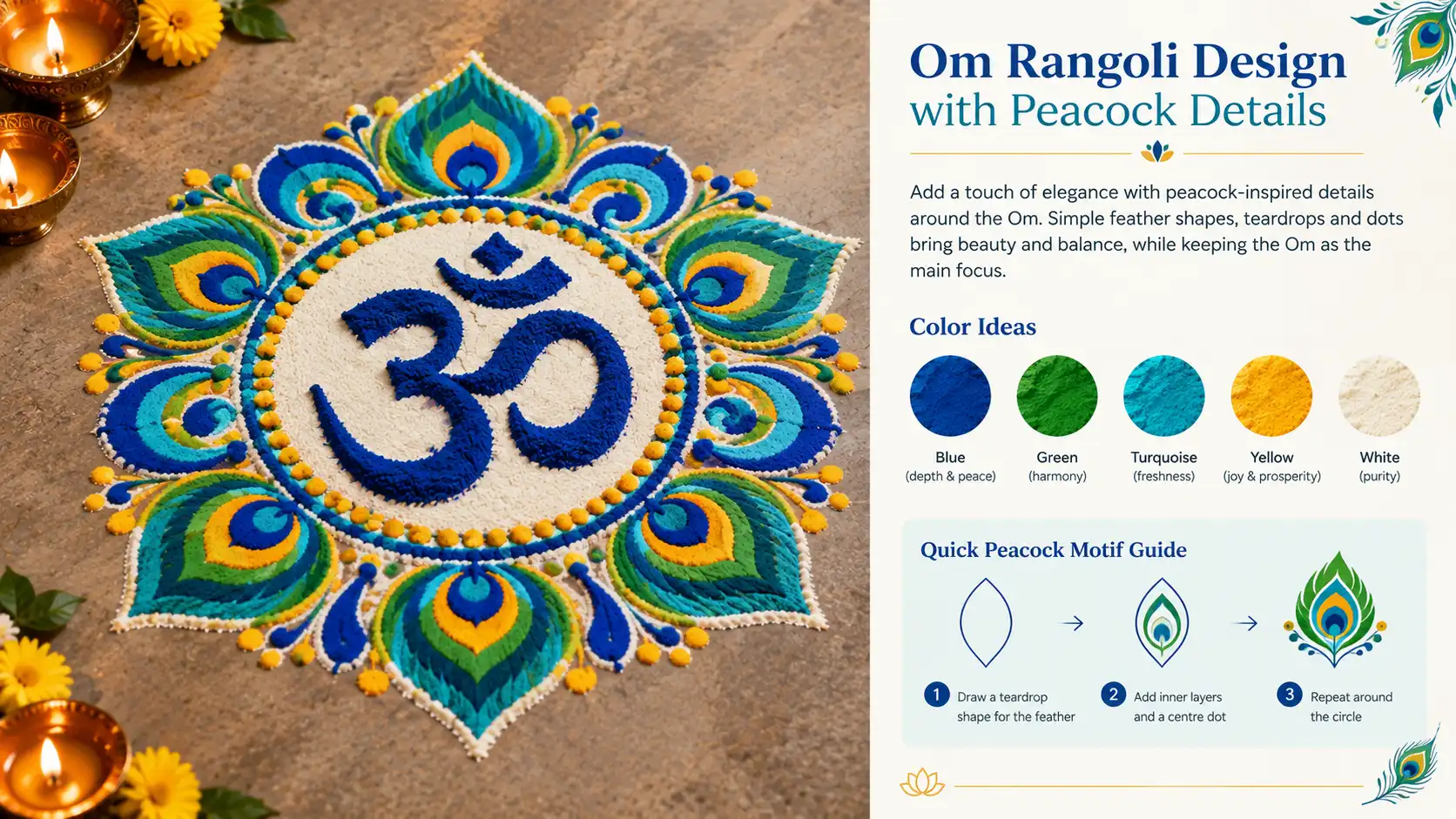
If you want a more decorative design, add small peacock-inspired details around the Om.
You do not need to draw a complete peacock. A few curved feather shapes, teardrops, and small dots can be enough.
Place the Om at the center and use the feather motifs around the outer circle.
Blue, green, turquoise, and yellow work beautifully for this design.
The important thing is to keep the Om visually dominant rather than allowing the decorative elements to overpower it.
11. Om Rangoli with Marigold Flowers
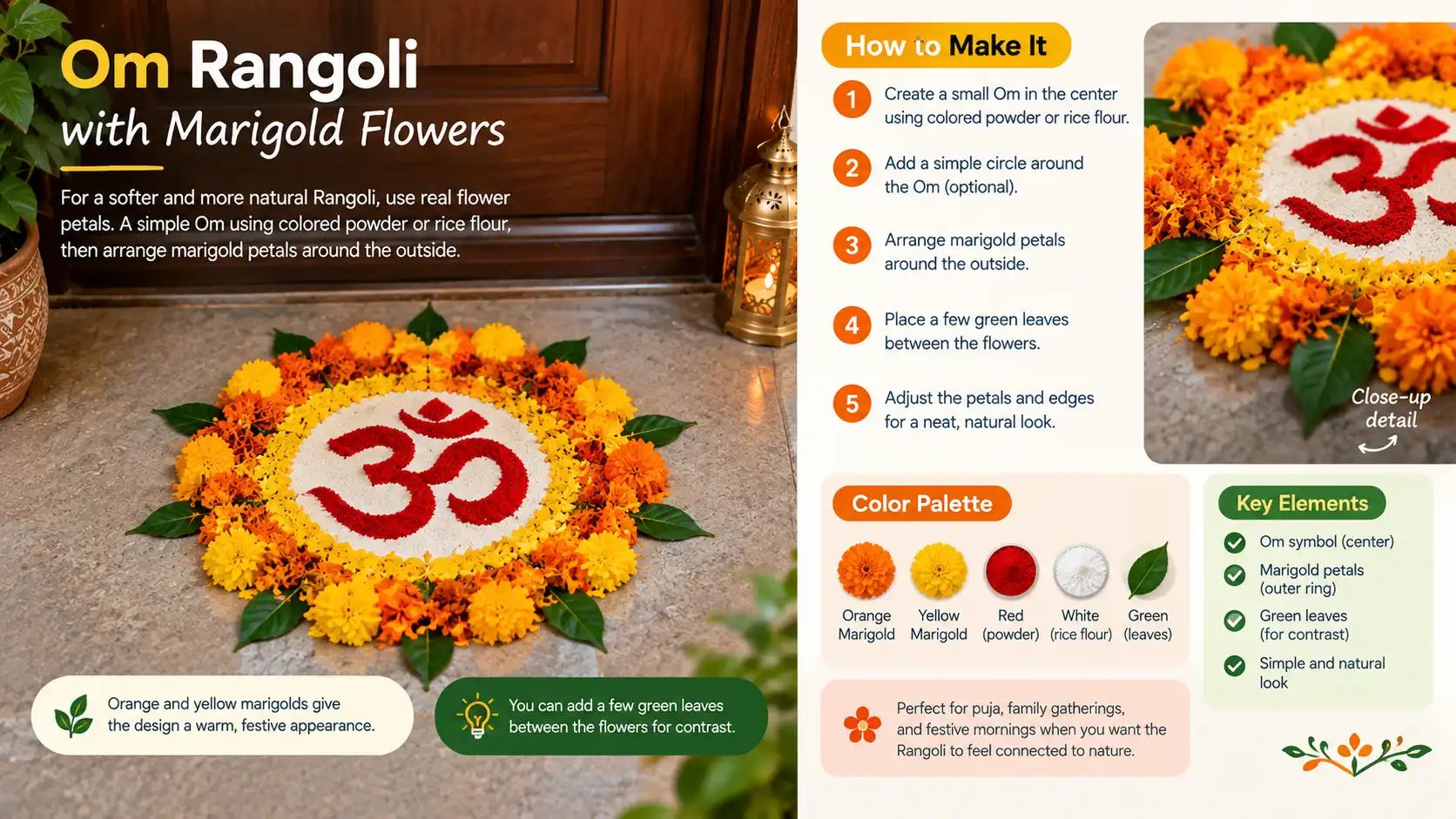
For a softer and more natural Rangoli, use real flower petals.
Create a simple Om using colored powder or rice flour, then arrange marigold petals around the outside.
Orange and yellow marigolds give the design a warm festive appearance. You can add a few green leaves between the flowers for contrast.
This approach is particularly nice for puja, family gatherings, and festive mornings when you want the Rangoli to feel connected to the natural surroundings of the home.
12. Red and White Om Rangoli
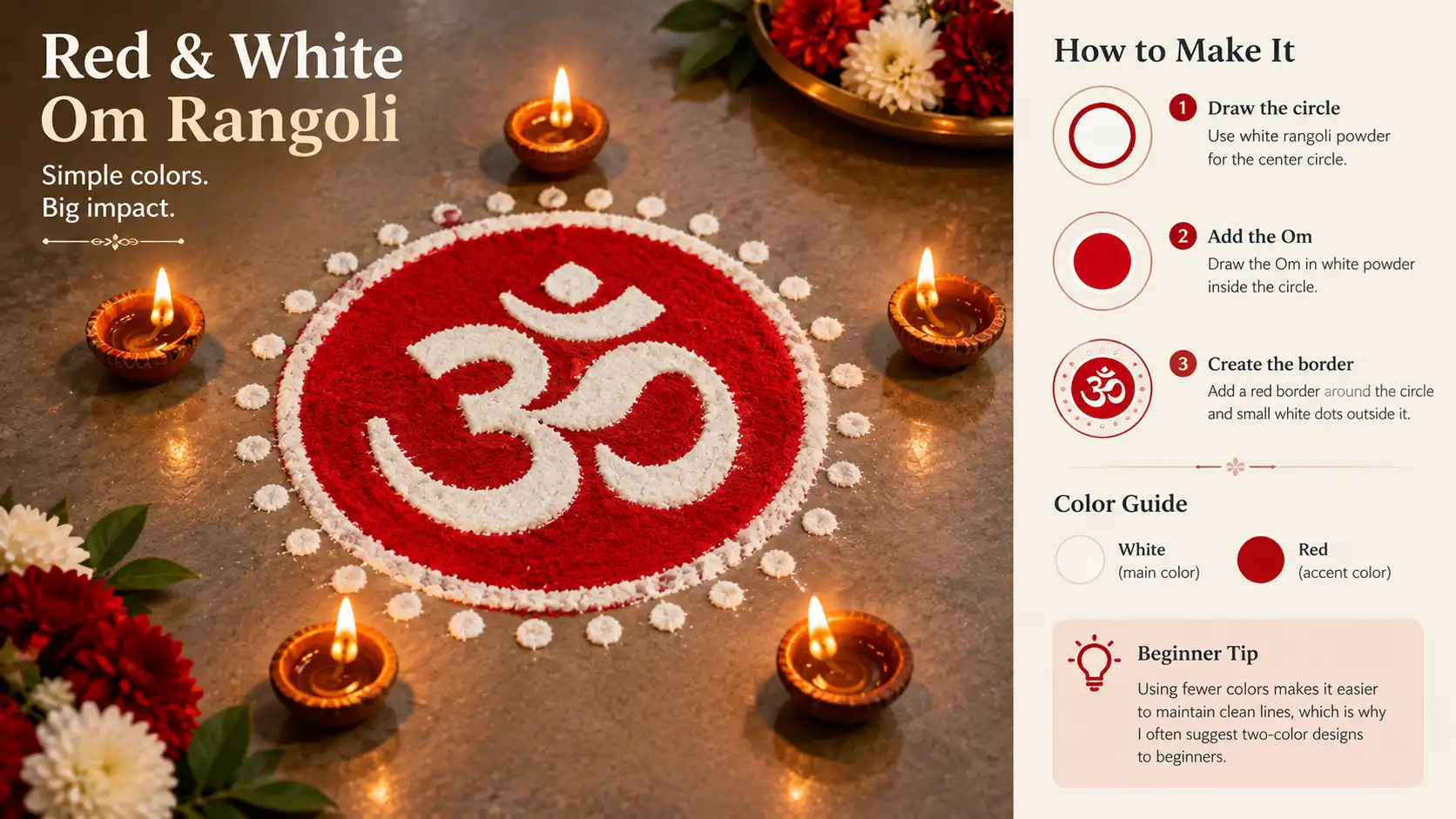
A two-color Rangoli can be just as striking as a multicolored one.
For this design, use white as the main base and red as the accent color.
Draw the Om in white, create a red circular border, and add small white dots outside it. You can also reverse the colors and experiment with the arrangement.
Using fewer colors makes it easier to maintain clean lines, which is why I often suggest two-color designs to beginners.
13. Om Rangoli for Puja Room
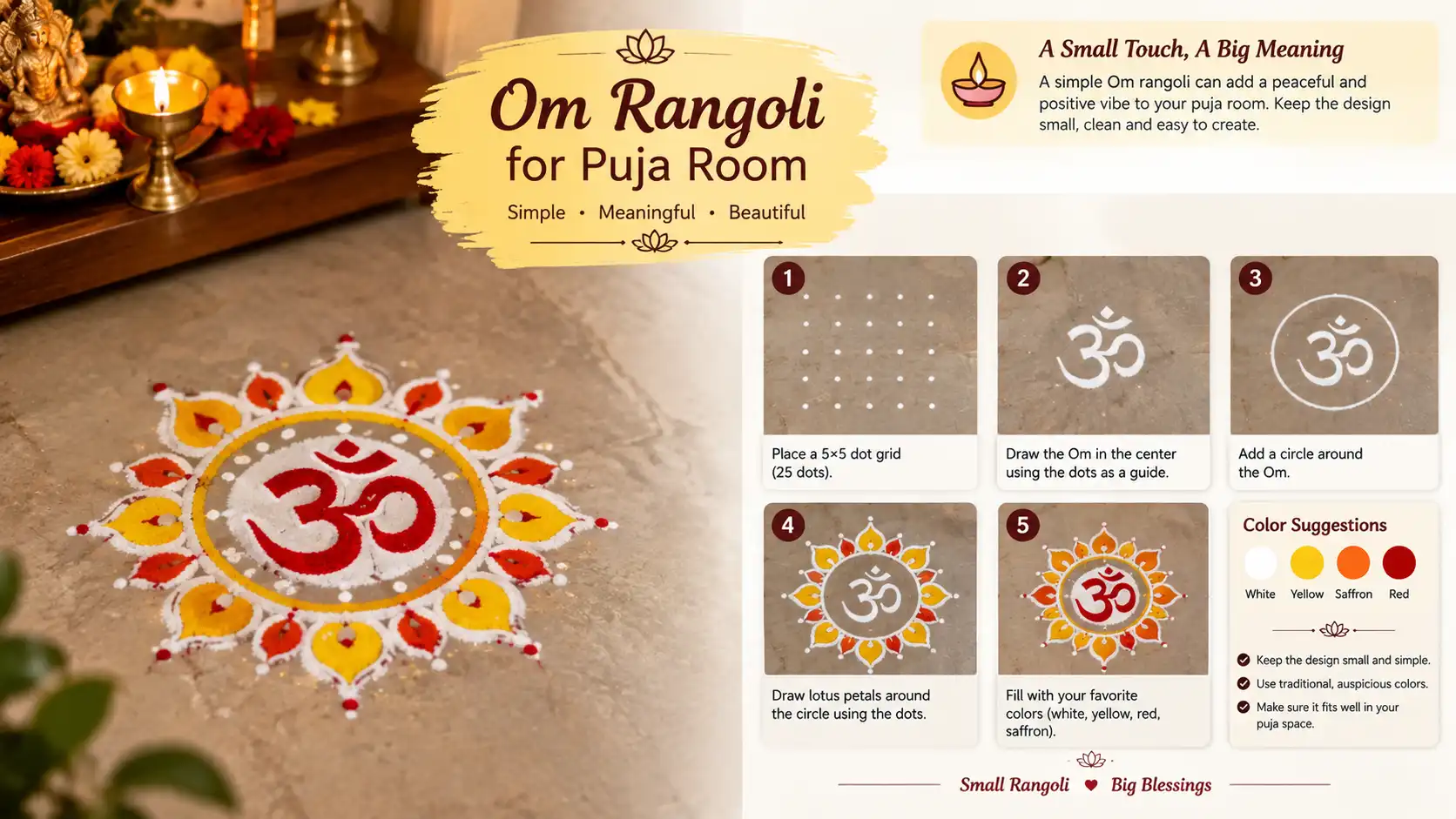
A small Om Rangoli can add a meaningful decorative touch to a puja area.
For a puja room, I would keep the design relatively simple. Draw a clean Om in the center and surround it with a few lotus petals or small dots.
Avoid making the pattern too large for the available space.
White, yellow, red, and saffron-inspired shades can create a traditional appearance without making the design visually crowded.
14. Om Rangoli for Diwali Entrance
For a larger Diwali entrance, you can turn the Om into the centerpiece of a complete festive Rangoli.
Start with the Om in the middle. Surround it with flowers, diyas, dots, and curved borders. Leave enough open space between each element so the design remains readable.
A good Diwali arrangement could look like this:
**Om → Lotus petals → Dots → Diyas → Outer floral border**
This layered approach gives you a clear visual hierarchy and makes the Rangoli look more finished.
If you’re preparing for the festival, you can also browse more Diwali Rangoli inspiration from our collection.
15. Modern Minimal Om Rangoli
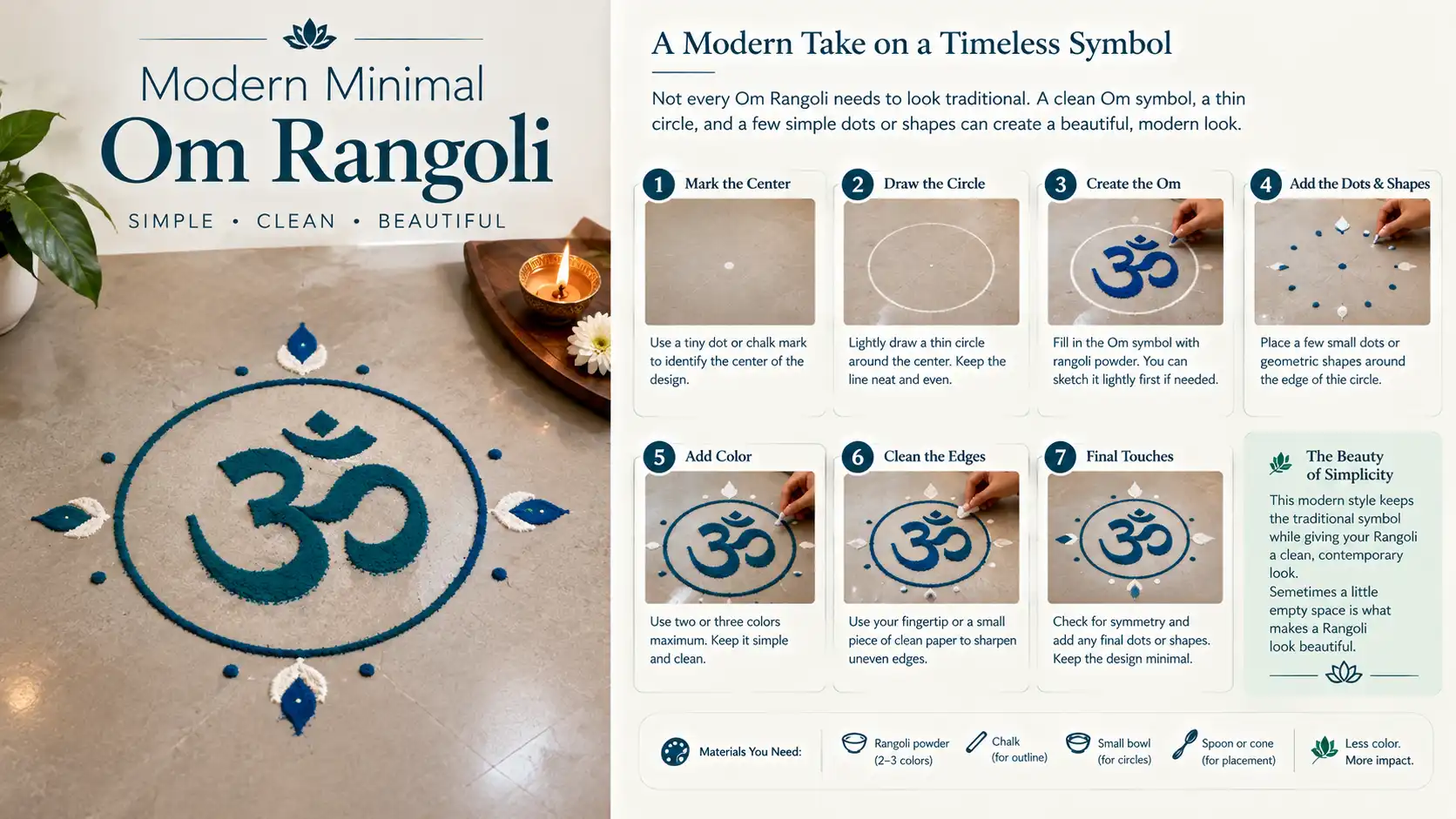
Not every Om Rangoli needs to look traditional.
For a modern version, draw a clean Om symbol in the center and surround it with a thin circular line. Add only a handful of small dots or geometric shapes around the edge.
Use two or three colors maximum.
I particularly like this style for modern homes because it keeps the traditional symbol while giving the overall design a clean, contemporary appearance.
Sometimes a little empty space is what makes a Rangoli look beautiful.
How to Make an Om Rangoli Design at Home
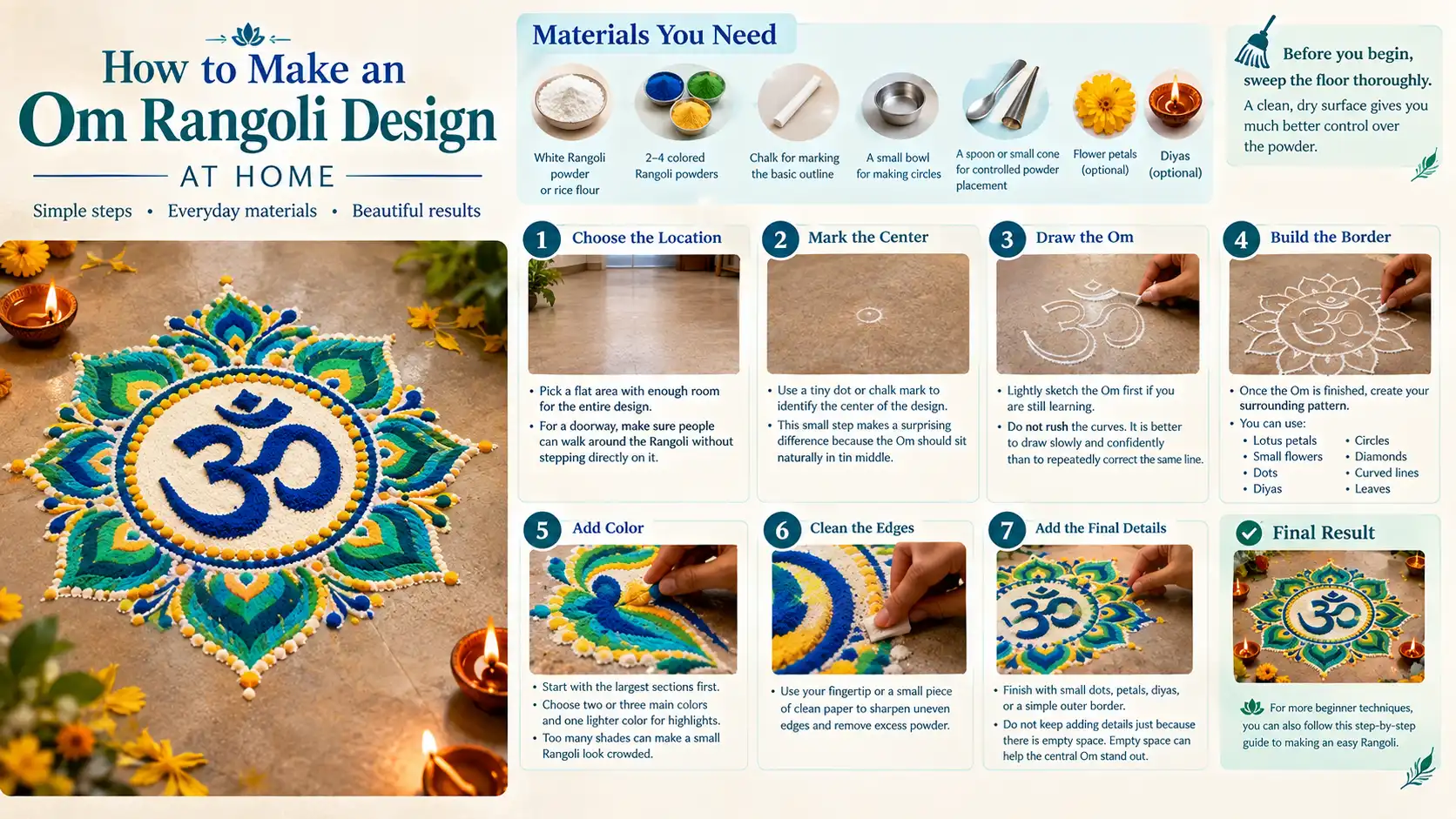
You do not need expensive materials or professional tools.
Materials You Need
- White Rangoli powder or rice flour
- 2–4 colored Rangoli powders
- Chalk for marking the basic outline
- A small bowl for making circles
- A spoon or small cone for controlled powder placement
- Flower petals, optional
- Diyas, optional
Before you begin, sweep the floor thoroughly. A clean, dry surface gives you much better control over the powder.
Step 1: Choose the Location
Pick a flat area with enough room for the entire design.
For a doorway, make sure people can walk around the Rangoli without stepping directly on it.
Step 2: Mark the Center
Use a tiny dot or chalk mark to identify the center of the design.
This small step makes a surprising difference because the Om should sit naturally in the middle of the surrounding decoration.
Step 3: Draw the Om
Lightly sketch the Om first if you are still learning.
Do not rush the curves. It is better to draw slowly and confidently than to repeatedly correct the same line.
Step 4: Build the Border
Once the Om is finished, create your surrounding pattern.
You can use:
- Lotus petals
- Small flowers
- Dots
- Diyas
- Leaves
- Circles
- Diamonds
- Curved lines
Step 5: Add Color
Start with the largest sections first.
I usually recommend choosing two or three main colors and one lighter color for highlights. Too many shades can make a small Rangoli look crowded.
Step 6: Clean the Edges
This is one of the easiest ways to improve the final result.
Use your fingertip or a small piece of clean paper to sharpen uneven edges and remove excess powder.
Step 7: Add the Final Details
Finish with small dots, petals, diyas, or a simple outer border.
Do not keep adding details just because there is empty space. Empty space can help the central Om stand out.
For more beginner techniques, you can also follow this step-by-step guide to making an easy Rangoli.
Best Colors for Om Rangoli
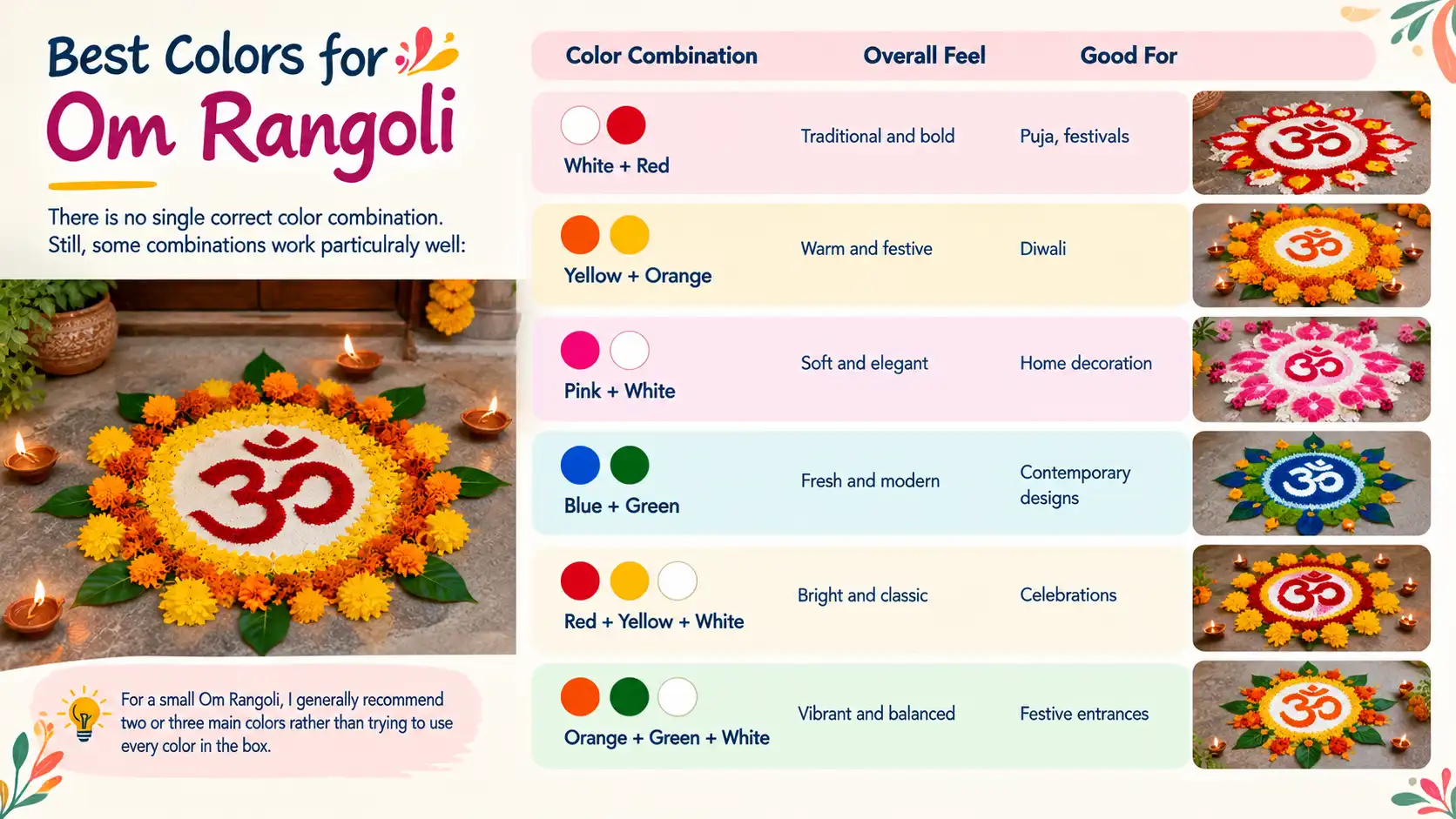
There is no single correct color combination.
Still, some combinations work particularly well:
| Color Combination | Overall Feel | Good For |
|---|---|---|
| White + Red | Traditional and bold | Puja, festivals |
| Yellow + Orange | Warm and festive | Diwali |
| Pink + White | Soft and elegant | Home decoration |
| Blue + Green | Fresh and modern | Contemporary designs |
| Red + Yellow + White | Bright and classic | Celebrations |
| Orange + Green + White | Vibrant and balanced | Festive entrances |
For a small Om Rangoli, I generally recommend **two or three main colors** rather than trying to use every color in the box.
Tips to Make Your Om Rangoli Look Neat
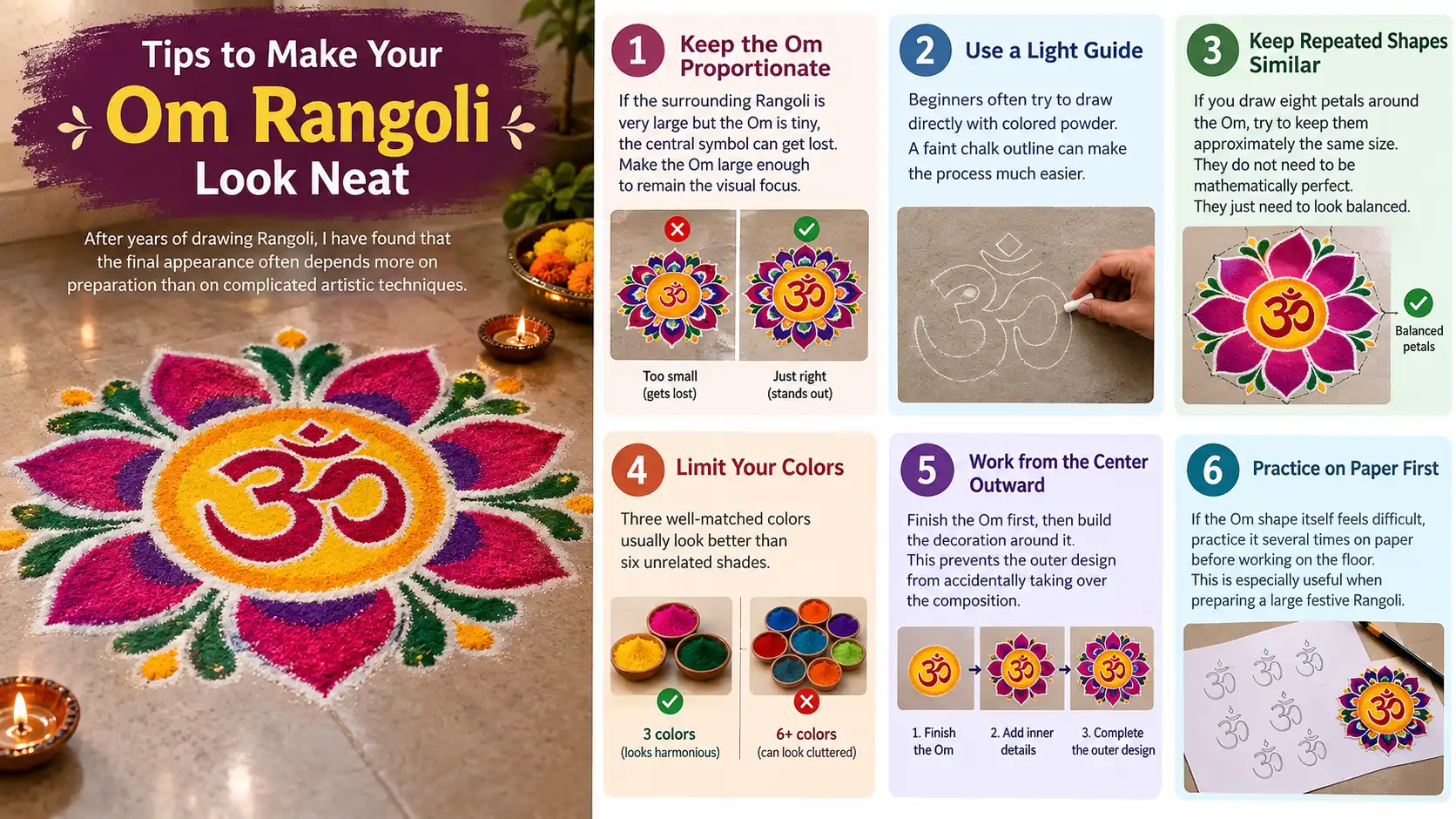
After years of drawing Rangoli, I have found that the final appearance often depends more on preparation than on complicated artistic techniques.
**Keep the Om Proportionate :** If the surrounding Rangoli is very large but the Om is tiny, the central symbol can get lost. Make the Om large enough to remain the visual focus.
**Use a Light Guide :** Beginners often try to draw directly with colored powder. A faint chalk outline can make the process much easier.
**Keep Repeated Shapes Similar :** If you draw eight petals around the Om, try to keep them approximately the same size. They do not need to be mathematically perfect. They just need to look balanced.
**Limit Your Colors :** Three well-matched colors usually look better than six unrelated shades.
**Work from the Center Outward :** Finish the Om first, then build the decoration around it. This prevents the outer design from accidentally taking over the composition.
**Practice on Paper First :** If the Om shape itself feels difficult, practice it several times on paper before working on the floor. This is especially useful when preparing a large festive Rangoli.
Where Can You Make an Om Rangoli?
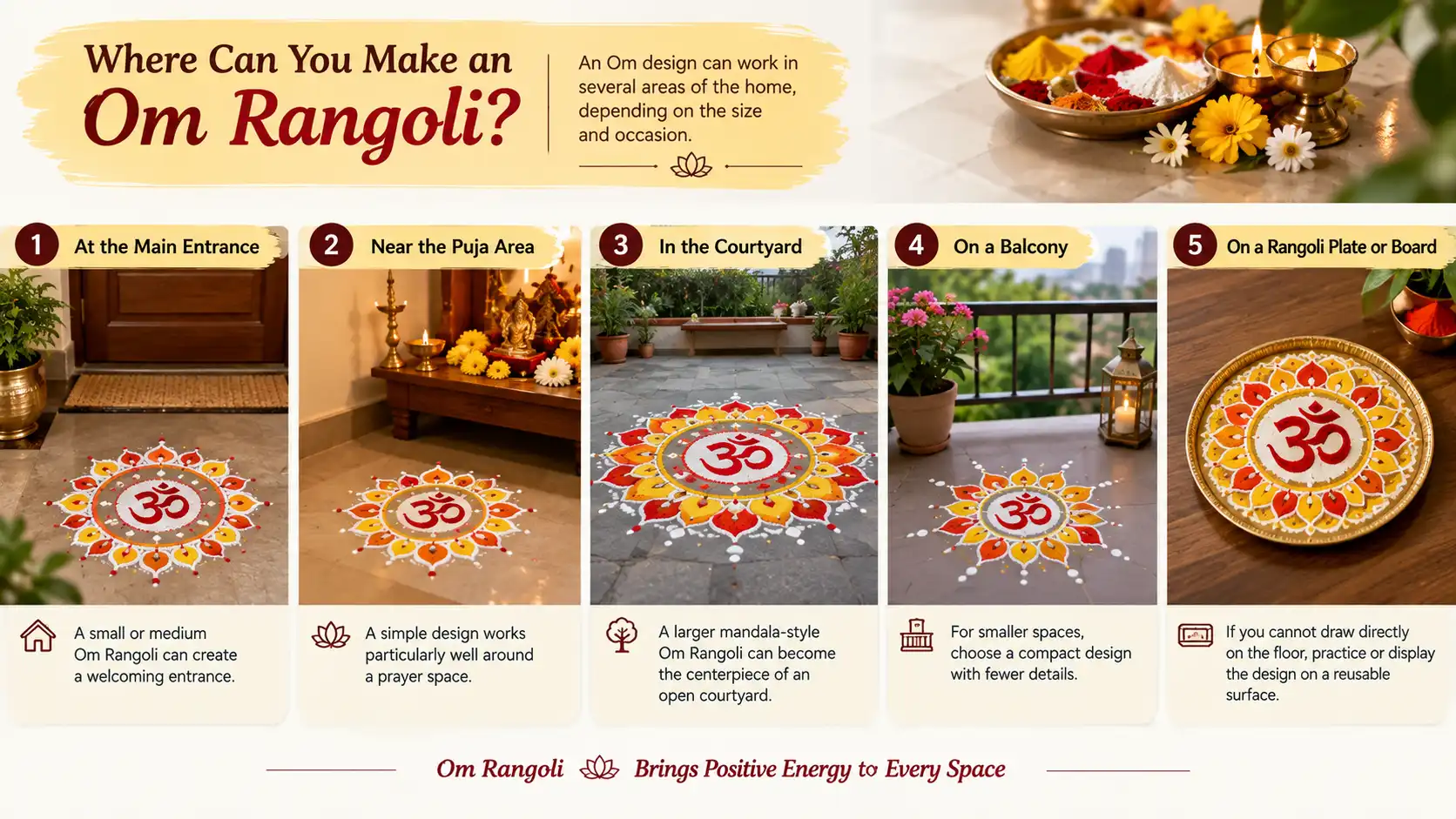
An Om design can work in several areas of the home, depending on the size and occasion.
**At the Main Entrance:** A small or medium Om Rangoli can create a welcoming entrance.
**Near the Puja Area:** A simple design works particularly well around a prayer space.
**In the Courtyard:** A larger mandala-style Om Rangoli can become the centerpiece of an open courtyard.
**On a Balcony:** For smaller spaces, choose a compact design with fewer details.
**On a Rangoli Plate or Board:** If you cannot draw directly on the floor, practice or display the design on a reusable surface.
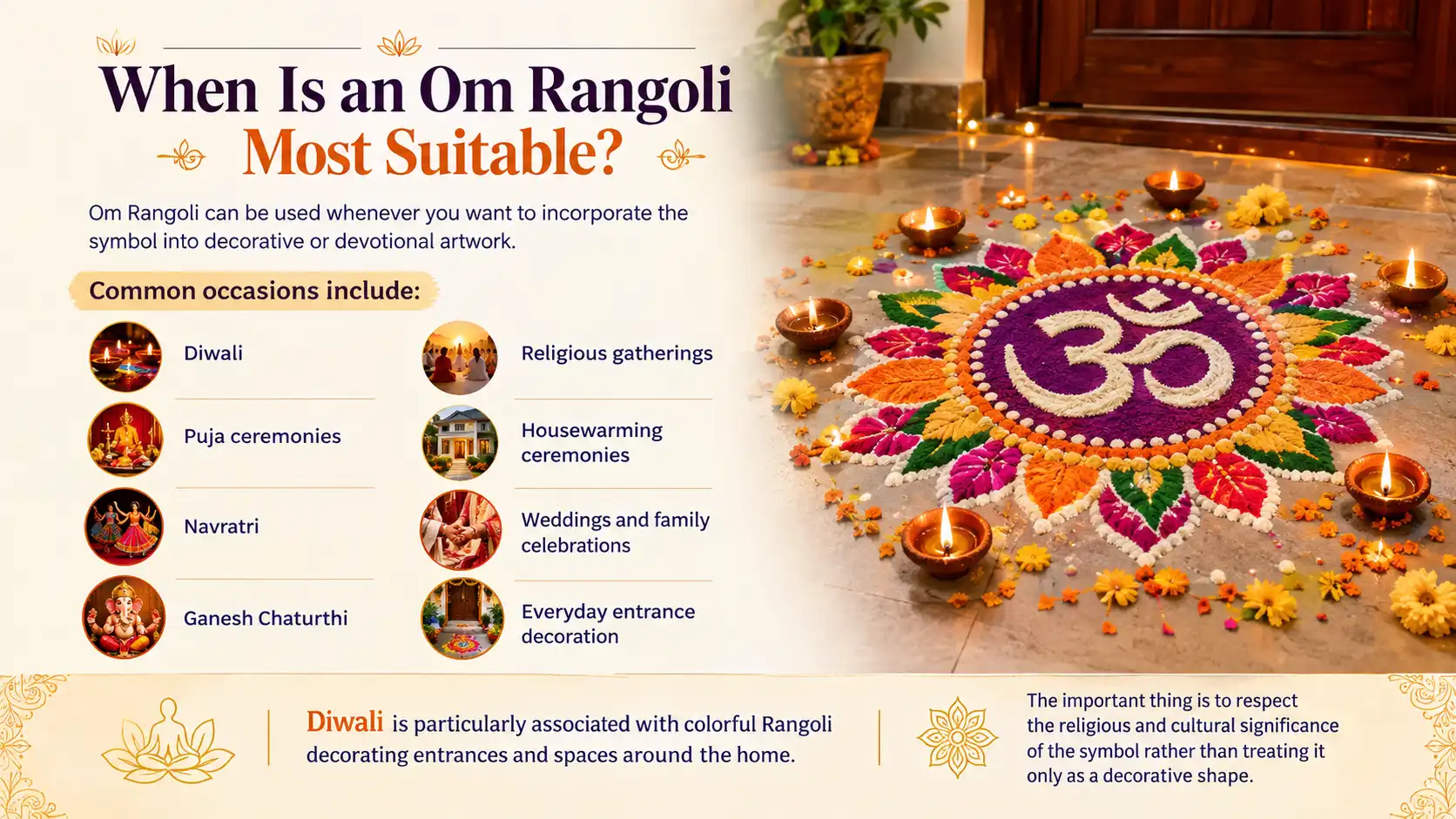
When Is an Om Rangoli Most Suitable?
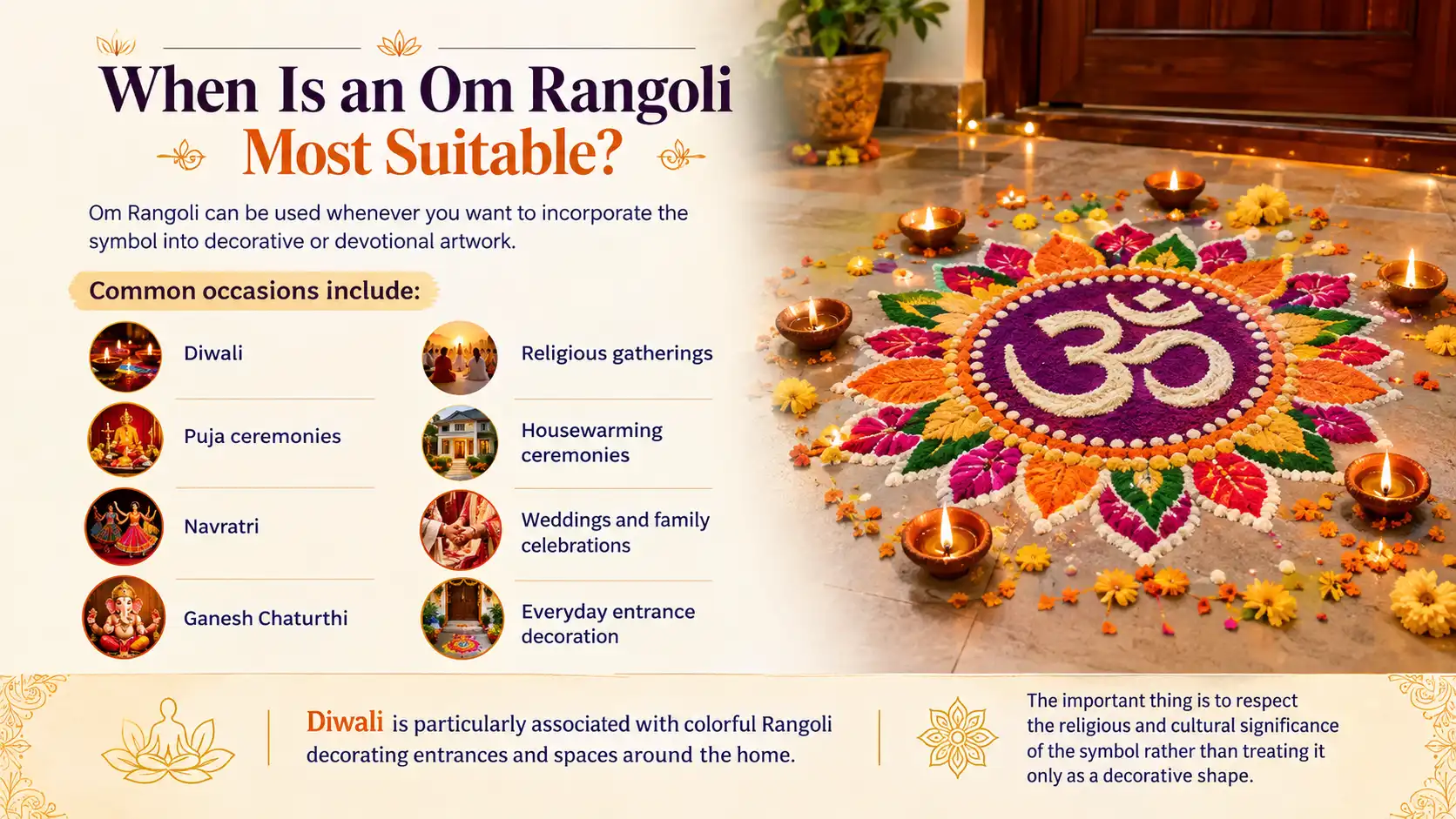
Om Rangoli can be used whenever you want to incorporate the symbol into decorative or devotional artwork.
Common occasions include:
- Diwali
- Puja ceremonies
- Navratri
- Ganesh Chaturthi
- Religious gatherings
- Housewarming ceremonies
- Weddings and family celebrations
- Everyday entrance decoration
Diwali is particularly associated with colorful Rangoli decorating entrances and spaces around the home.
The important thing is to respect the religious and cultural significance of the symbol rather than treating it only as a decorative shape.
Common Mistakes to Avoid
Even an easy Om Rangoli can lose its charm if the basic structure is overlooked.
**1.** **Making the Om Too Small:** The main symbol should remain visible from a short distance.
**2. Using Too Many Details:** A crowded design can make the central Om difficult to recognize.
**3. Uneven Circles:** Use a bowl or another simple round object as a guide if you struggle with freehand circles.
**4. Working on an Unclean Floor:** Dust and moisture can make Rangoli powder difficult to control.
**5. Filling Color Too Quickly:** Work slowly, especially around the edges of the Om.
**6. Ignoring the Outer Border:** A simple border can make the entire Rangoli look more complete.
A Tradition I Still Carry With Me
When I think about Om Rangoli today, I still remember those quiet mornings in Kolkata.
I can picture my mother and grandmother sitting near the doorway before sunrise, their hands moving naturally as the design slowly appeared on the floor. At the time, I did not think about symmetry, color combinations, or whether a design was technically perfect. I simply watched.
Eight years of drawing and documenting Rangoli have taught me something similar: the most beautiful designs are not always the most complicated ones.
An Om Rangoli can be a large festive centerpiece filled with flowers, colors, and diyas. It can also be a small white symbol drawn quietly near a doorway. Both can carry the same sense of care and tradition.
If you are trying one for the first time, start small. Draw the Om slowly, choose two or three colors you genuinely like, and give yourself permission to make imperfect lines. With practice, your hands will become more comfortable and your designs will naturally become more confident.
And that is one of the things I love most about Rangoli.
You start with a few simple lines on the floor, but somewhere between the dots, colors, curves, and memories, you create something that feels like home.
FAQs
What is an Om Rangoli design?
An Om Rangoli is a Rangoli pattern that uses the Om (ॐ) symbol as its central or primary motif. It can be decorated with flowers, dots, geometric patterns, diyas, or other traditional Rangoli elements.
Which Om Rangoli design is easiest for beginners?
A simple Om with a circular border is one of the easiest options. You can draw the symbol first, surround it with a few dots or petals, and use only two or three colors.
Which colors are best for an Om Rangoli?
White, red, yellow, orange, and pink are popular choices. For a clean design, start with white plus one or two accent colors. The best combination depends on your personal preference and the occasion.
Can I make an Om Rangoli for Diwali?
Yes. An Om Rangoli can be incorporated into a Diwali decoration, particularly with diyas, flowers, lotus motifs, and festive colors. Rangoli is widely used as part of Diwali home decoration.
How can I draw a perfect Om Rangoli?
Start by practicing the Om symbol separately on paper. When drawing on the floor, use a light chalk guide and work slowly. Keep the surrounding decorations symmetrical and avoid adding too many complicated elements. For structured patterns, a dot-grid technique can also help maintain spacing.