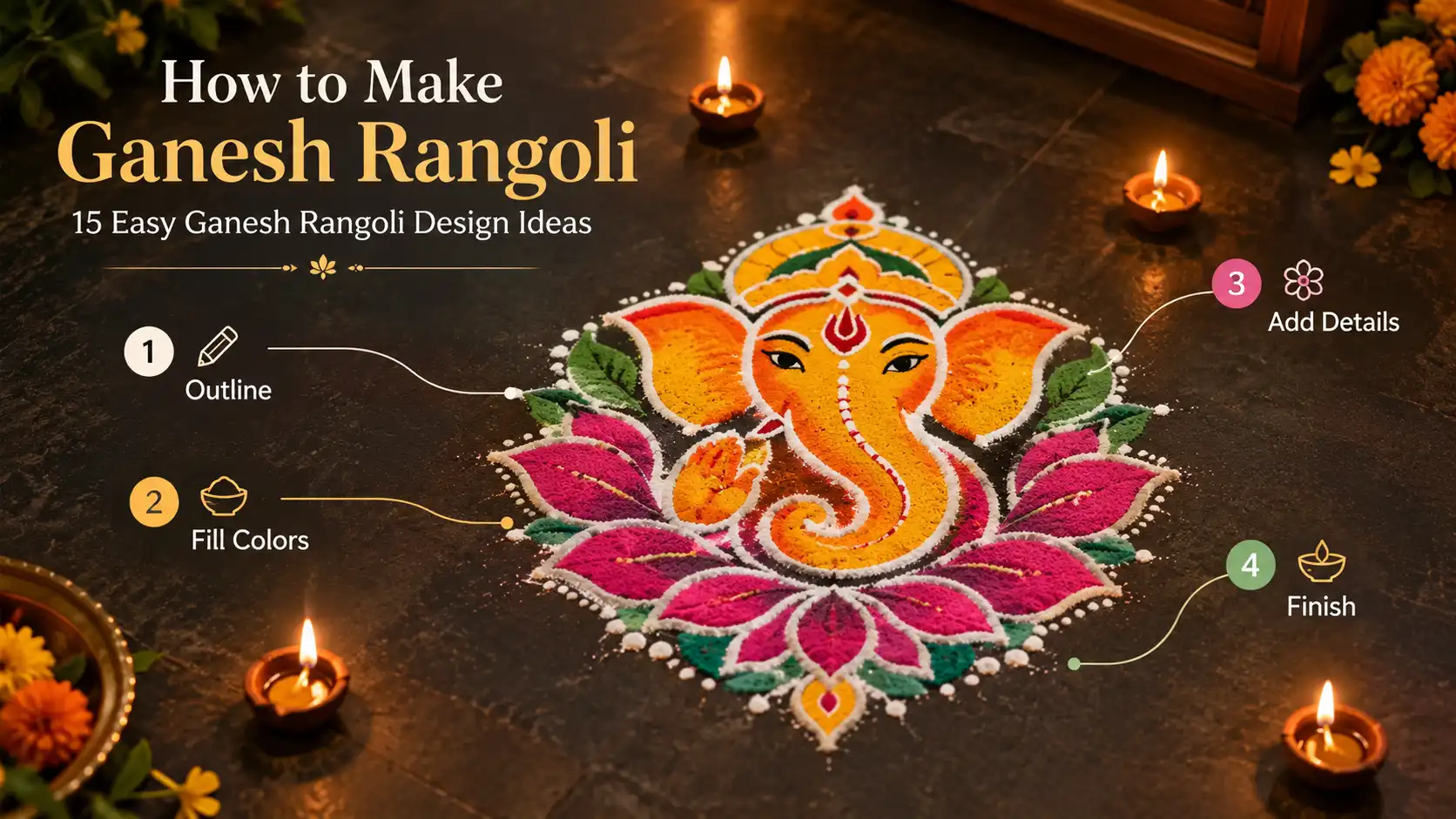
How to Make Ganesh Rangoli: 15 Easy Ganesh Rangoli Design Ideas
There is something special about drawing Lord Ganesha at the entrance of a home. The moment the first curve of the trunk takes shape and the ears, crown, and eyes begin to appear, a simple floor starts to feel completely different.
I am based in Kolkata, and I have been drawing and documenting rangoli for the past eight years. But my connection with this art started much earlier.
I grew up watching my mother and grandmother draw rangoli at our doorway every morning before sunrise. I would sit on the steps and watch them work quietly, one dot at a time, one curve at a time, one color at a time. They did not need complicated tools or elaborate plans. They simply knew how to turn a few lines and colors into something beautiful.
That daily ritual is where my love for rangoli began.
Over the years, I started collecting the designs I learned, trying different patterns, photographing them, and noticing which techniques made a design easier to draw. Ganesh rangoli has always been particularly interesting to me because even a very simple outline can make a strong centerpiece.
In this guide, I want to share how to make Ganesh rangoli in a way that feels approachable, especially if you are making one for the first time. You will find 15 easy Ganesh rangoli ideas, along with simple drawing steps, color suggestions, and practical tips that I have found useful over the years.
How to Make Ganesh Rangoli at Home
Easy Ganesh rangoli design for home
Before choosing a design, remember one thing: your Ganesh rangoli does not have to be complicated to look beautiful.
A clean outline, balanced spacing, two or three well-chosen colors, and a few finishing details can be enough. Many traditional rangoli methods also begin with a simple framework before colors and decorative details are added.
Materials You Will Need
For a basic Ganesh rangoli, keep these materials nearby:
- White rangoli powder or rice flour
- Colored rangoli powder
- A piece of chalk for a light sketch
- Small bowls for separating colors
- A cotton cloth for correcting mistakes
- Flower petals, if you want a floral design
- Small diyas for decoration
- A simple reference image, especially if you are a beginner
You can also use a small plate or bowl to make clean circles.
If you are new to rangoli, practicing the basic shapes on paper first can make the floor drawing much easier.
Simple Steps to Make a Ganesh Rangoli
Easy Ganesh rangoli design for home
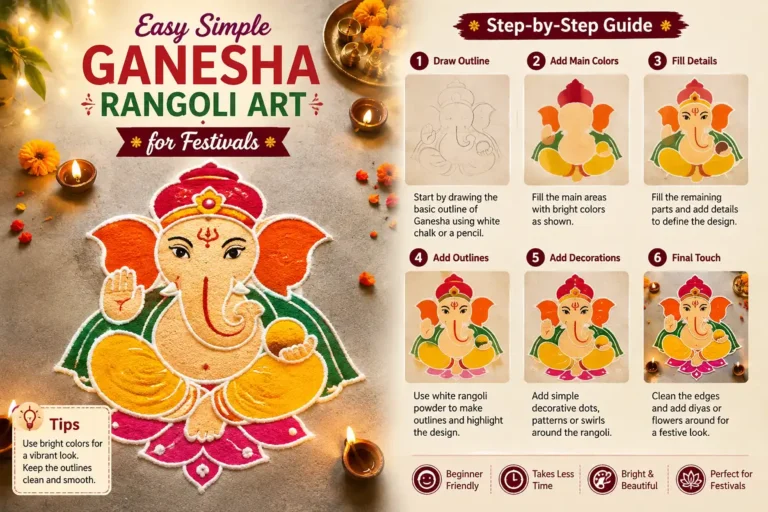
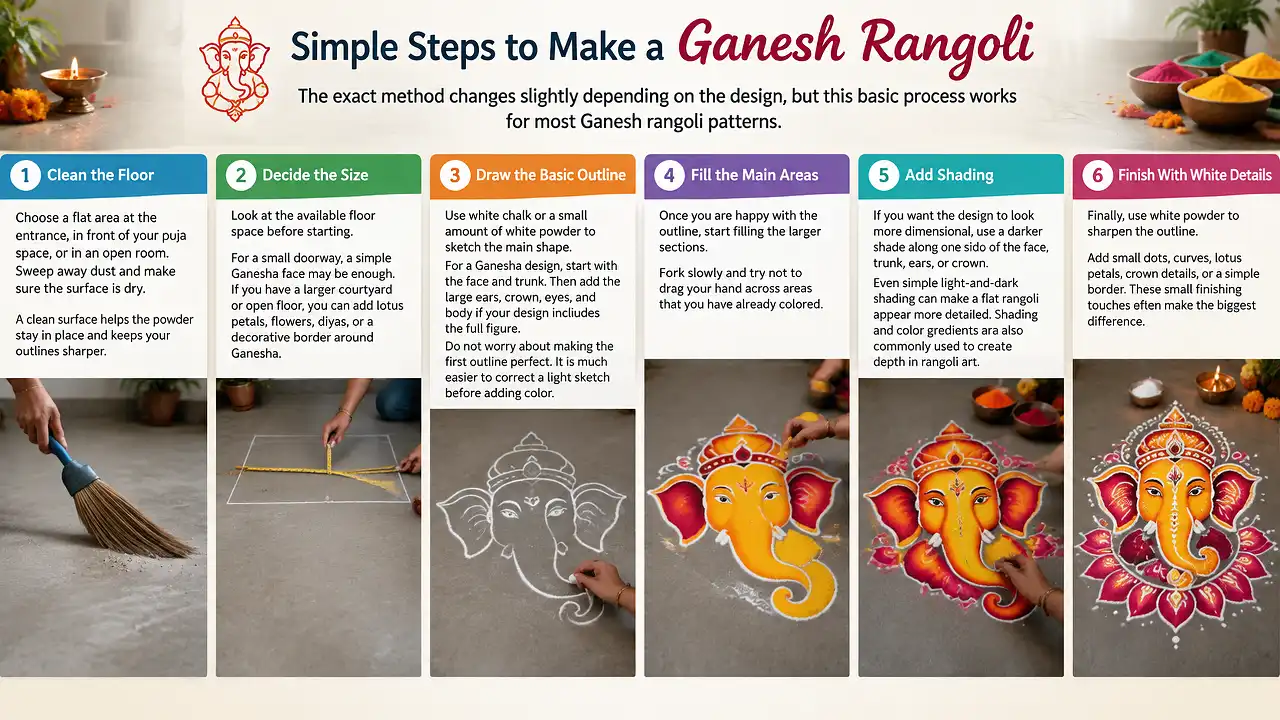
The exact method changes slightly depending on the design, but this basic process works for most Ganesh rangoli patterns.
1. Clean the Floor
Choose a flat area at the entrance, in front of your puja space, or in an open room. Sweep away dust and make sure the surface is dry.
A clean surface helps the powder stay in place and keeps your outlines sharper.
2. Decide the Size
Look at the available floor space before starting.
For a small doorway, a simple Ganesha face may be enough. If you have a larger courtyard or open floor, you can add lotus petals, flowers, diyas, or a decorative border around Ganesha.
3. Draw the Basic Outline
Use white chalk or a small amount of white powder to sketch the main shape.
For a Ganesha design, start with the face and trunk. Then add the large ears, crown, eyes, and body if your design includes the full figure.
Do not worry about making the first outline perfect. It is much easier to correct a light sketch before adding color.
4. Fill the Main Areas
Once you are happy with the outline, start filling the larger sections.
Work slowly and try not to drag your hand across areas you have already colored.
5. Add Shading
If you want the design to look more dimensional, use a darker shade along one side of the face, trunk, ears, or crown.
Even simple light-and-dark shading can make a flat rangoli appear more detailed. Shading and color gradients are also commonly used to create depth in rangoli art.
6. Finish With White Details
Finally, use white powder to sharpen the outline.
Add small dots, curves, lotus petals, crown details, or a simple border. These small finishing touches often make the biggest difference.
15 Easy Ganesh Rangoli Design Ideas
Here are 15 designs you can try, starting with very simple patterns and gradually moving toward more decorative ones.
1. Simple Ganesh Face Rangoli
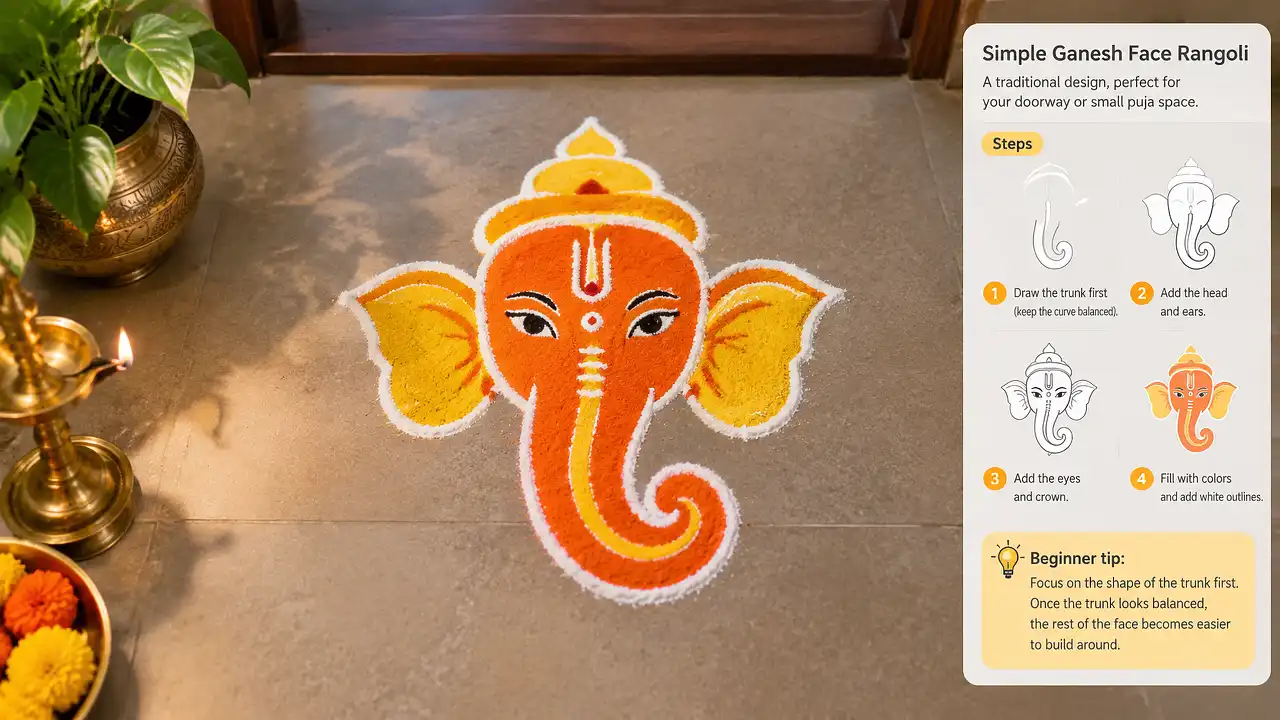
Simple Ganesh Face Rangoli
If this is your first attempt, start with just the face of Lord Ganesha.
Draw a rounded forehead, two large ears, and a curved trunk. Add simple eyes and a small crown above the head.
For colors, try orange and yellow for the face with white outlining.
This design does not require a large floor area and is particularly suitable for a doorway or small puja space.
Beginner tip: Focus on the shape of the trunk first. Once the trunk looks balanced, the rest of the face becomes much easier to build around it.
2. Easy Ganesh Rangoli With Dots
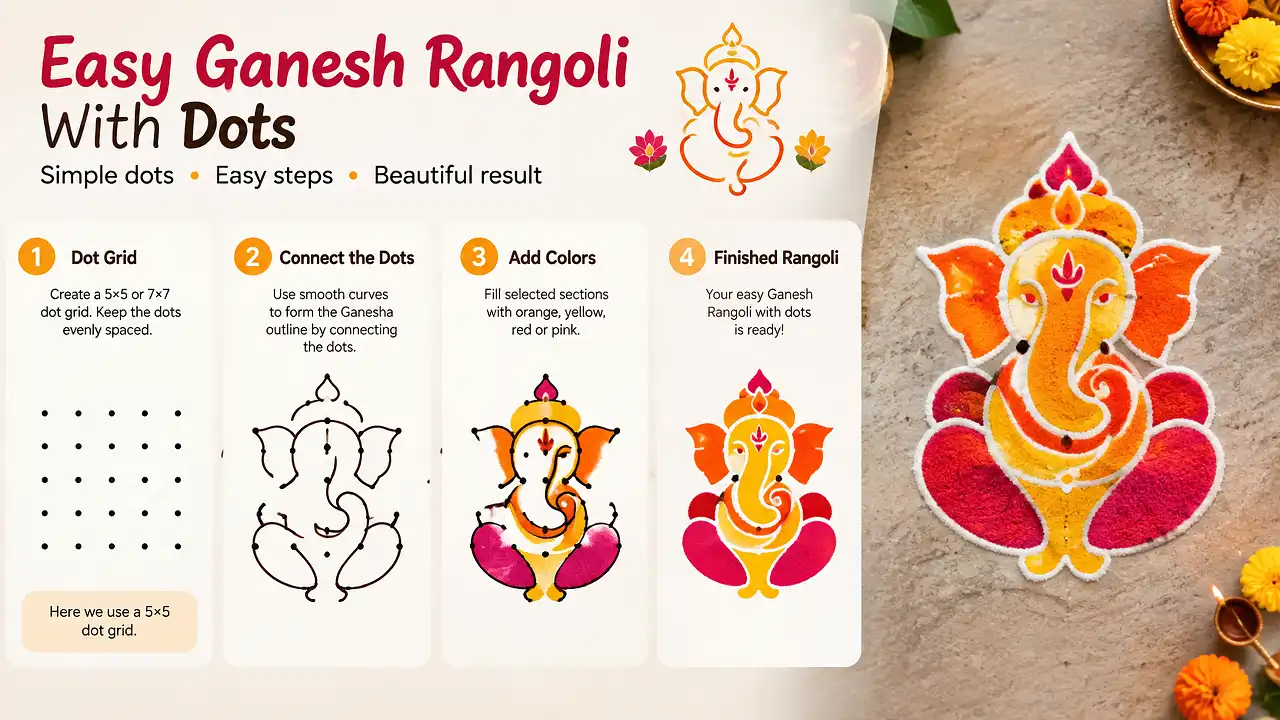
Simple Ganesh rangoli made with dots
A dot-based design is a useful choice when you want help with symmetry.
Start with an evenly spaced dot grid. You can use a small 5×5 or 7×7 arrangement for a compact design. Connect the dots with curves to form a simplified Ganesha shape.
Dot rangoli works well for beginners because the dots provide a visual framework for spacing and proportion.
After completing the outline, fill selected sections with orange, yellow, red, or pink.
3. Ganesh Rangoli With Lotus
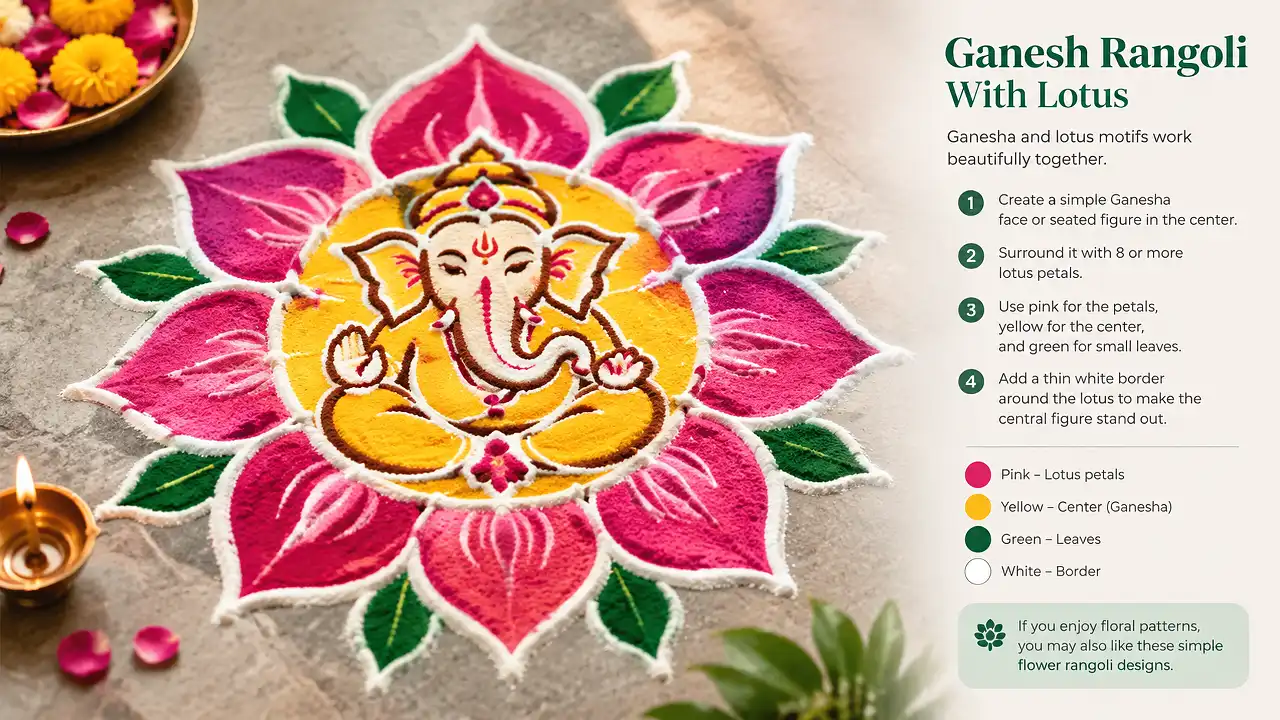
Beautiful Ganesh rangoli with lotus design
Ganesha and lotus motifs work beautifully together.
Start with a simple Ganesha face or seated figure in the center. Surround it with eight or more lotus petals.
You can use pink for the petals, yellow for the center, and green for small leaves.
A thin white border around the lotus will help separate the colors and make the central figure stand out.
If you enjoy floral patterns, you may also like these simple flower rangoli designs.
4. Small Ganesh Rangoli for Doorway
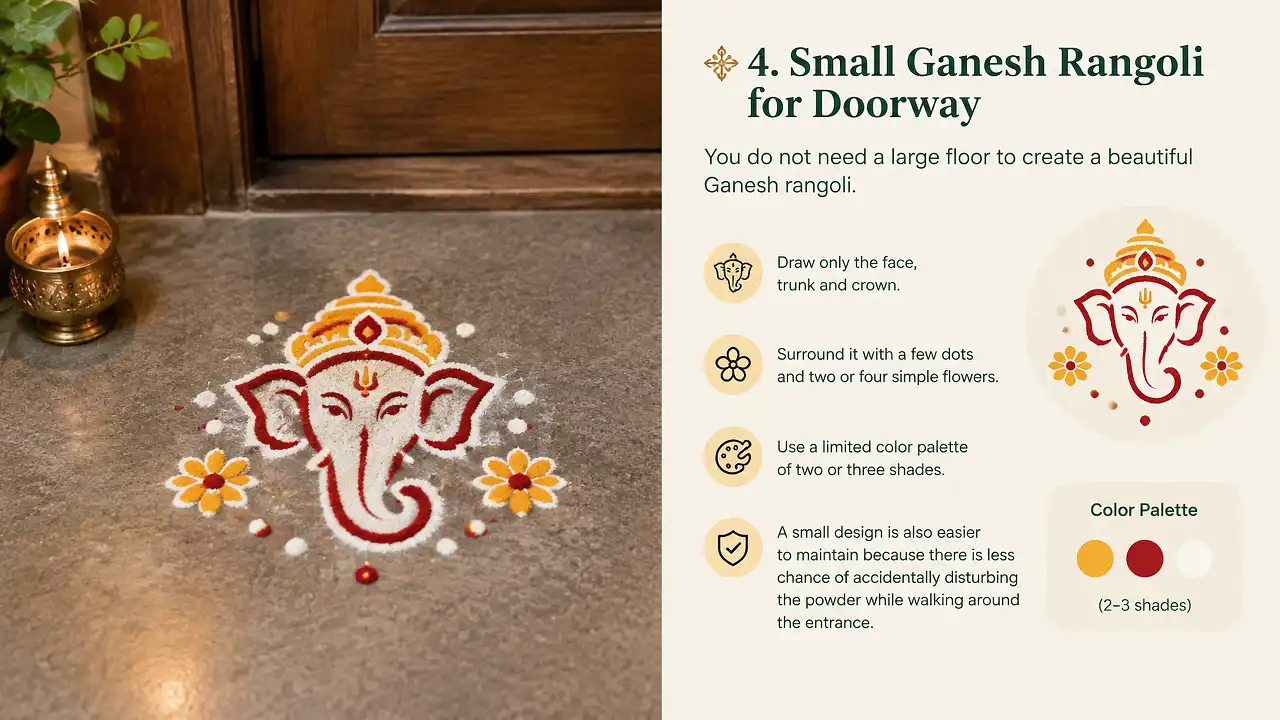
Small Ganesh rangoli at the doorway
You do not need a large floor to create a beautiful Ganesh rangoli.
For a small entrance, draw only the face, trunk, and crown. Surround it with a few dots and two or four simple flowers.
Keep the color palette limited to two or three shades.
A small design is also easier to maintain because there is less chance of accidentally disturbing the powder while walking around the entrance.
5. Ganesh Rangoli With Diyas
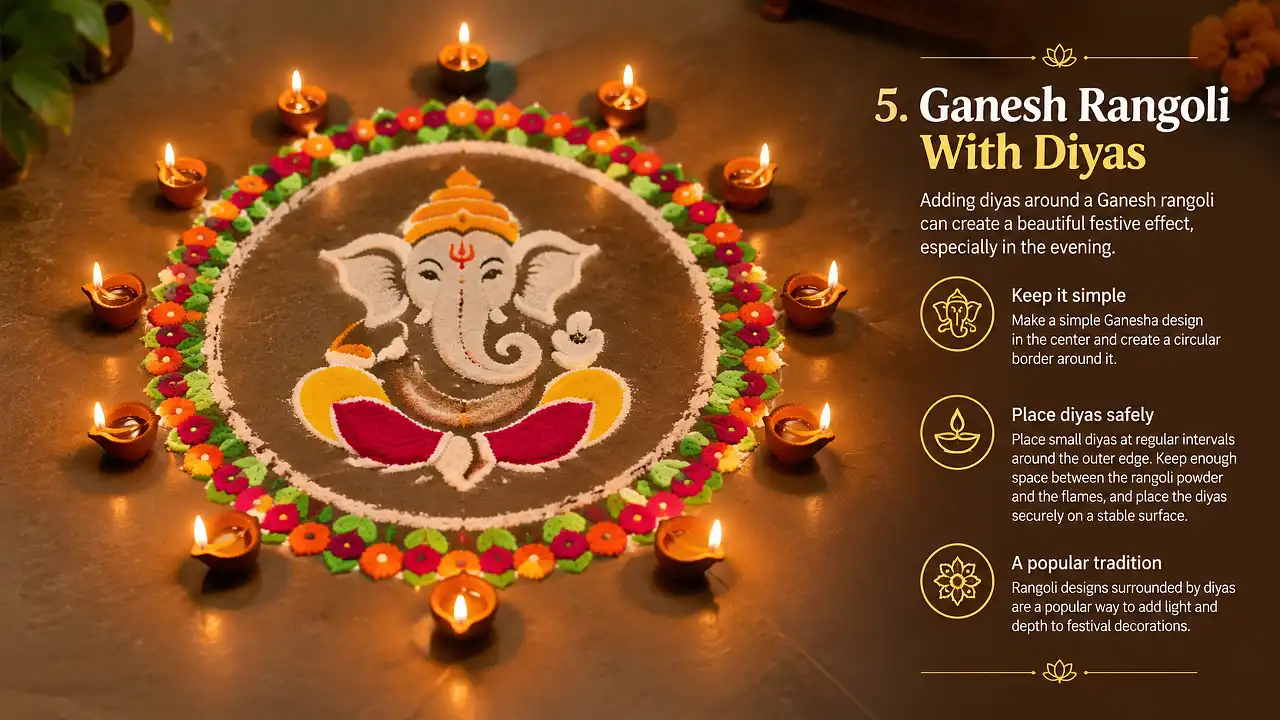
Beautiful Ganesh rangoli decorated with diyas
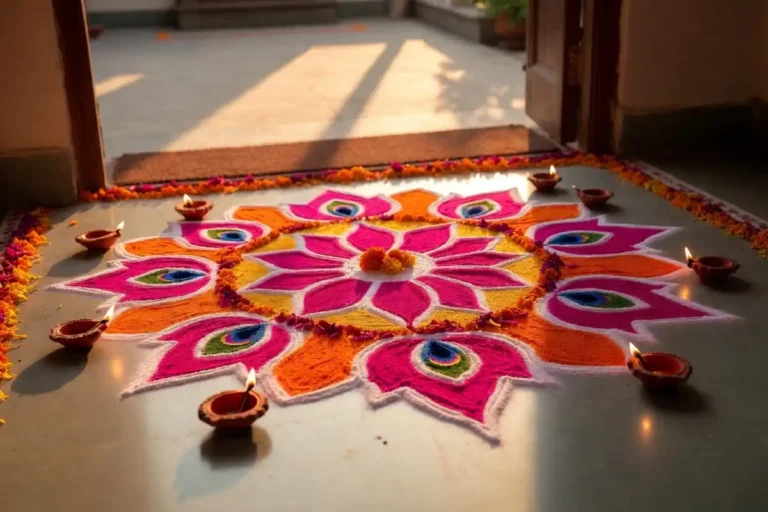
Adding diyas around a Ganesh rangoli can create a beautiful festive effect, especially in the evening.
Make a simple Ganesha design in the center and create a circular border around it. Place small diyas at regular intervals around the outer edge.
Keep enough space between the rangoli powder and the flames, and place the diyas securely on a stable surface.
Rangoli designs surrounded by diyas are a popular way to add light and depth to festival decorations.
6. Flower Petal Ganesh Rangoli
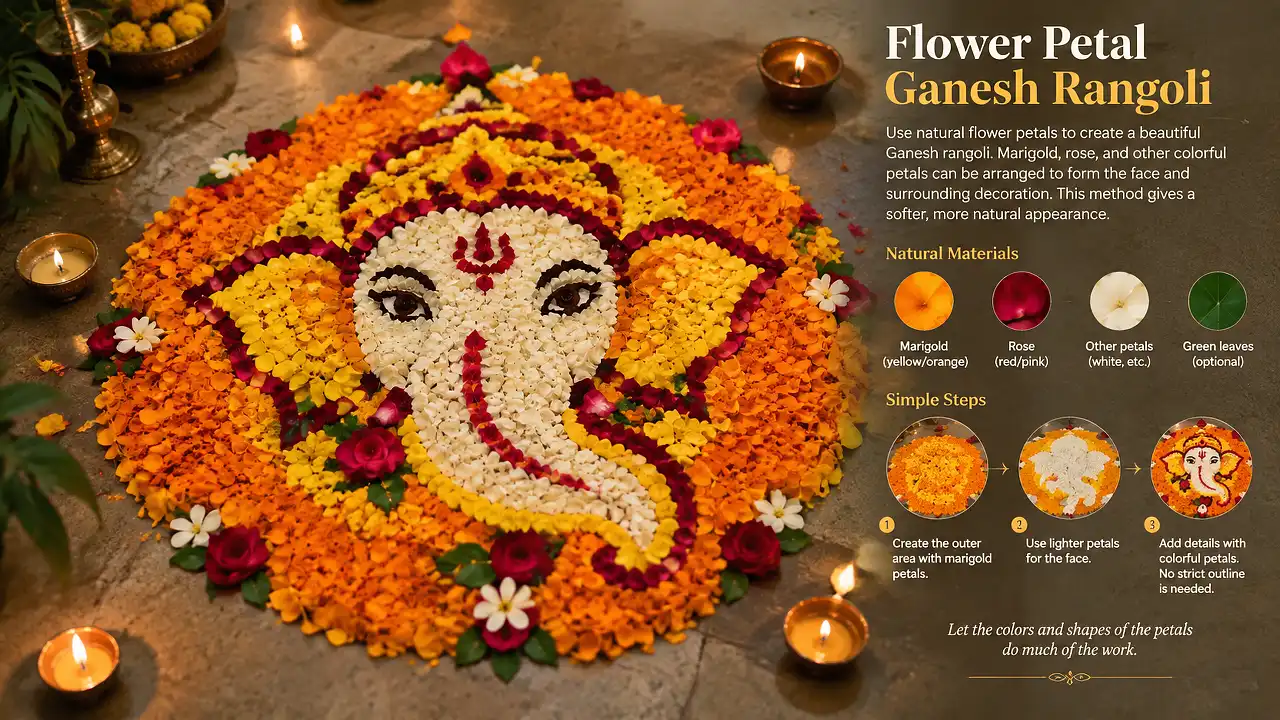
Beautiful Ganesh rangoli made with flower petals
If you prefer natural materials, try making Ganesha with flower petals.
Marigold, rose, and other colorful petals can be arranged to create the face and surrounding decoration. Flower-petal rangoli is especially useful when you want a softer, more natural appearance.
One simple approach is to use orange or yellow marigold petals for the outer area and lighter petals for the face.
You do not necessarily need a detailed outline. The colors and shapes of the petals can do much of the work.
7. Ganesh Rangoli With Peacock Motif
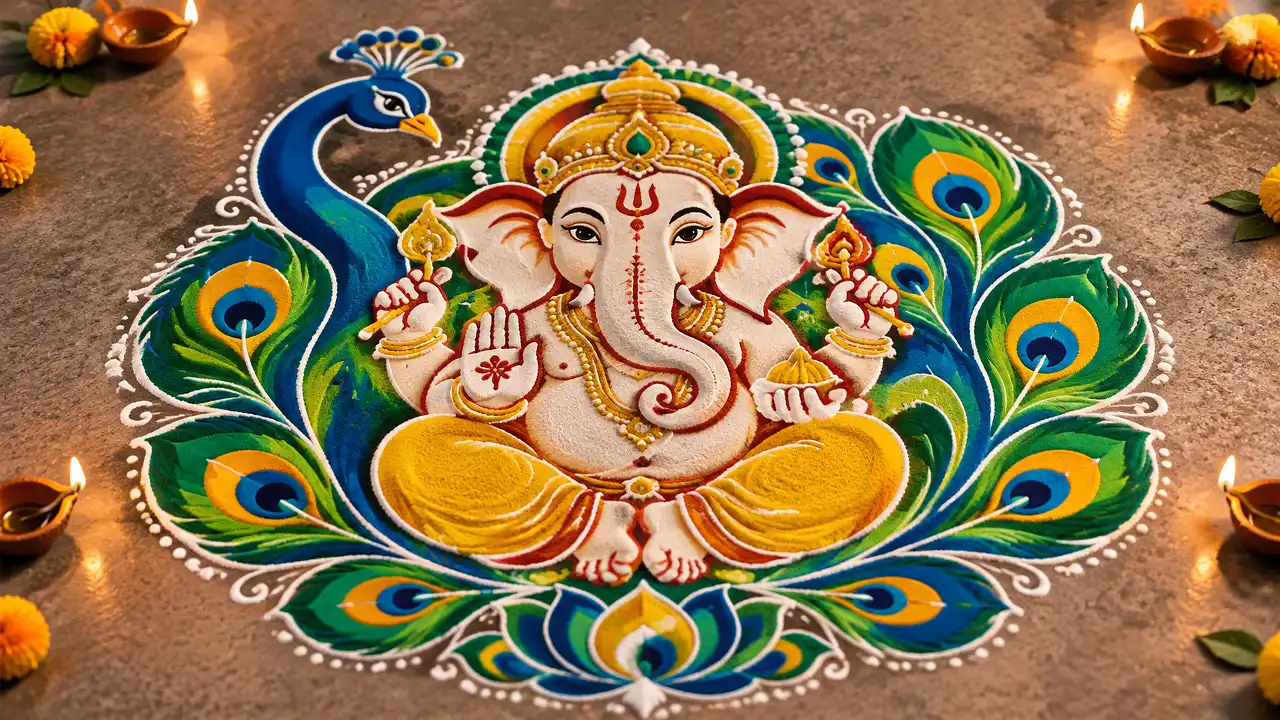
Beautiful Ganesh rangoli with a colorful peacock motif.
For a larger design, combine Ganesha with a peacock motif.
Place Ganesha in the center and use curved feather shapes around one or both sides. Blue, green, yellow, and white work particularly well for the feather details.
The important thing is to keep the peacock decoration secondary so that the central Ganesha figure remains the focus.
8. Minimalist Ganesh Rangoli
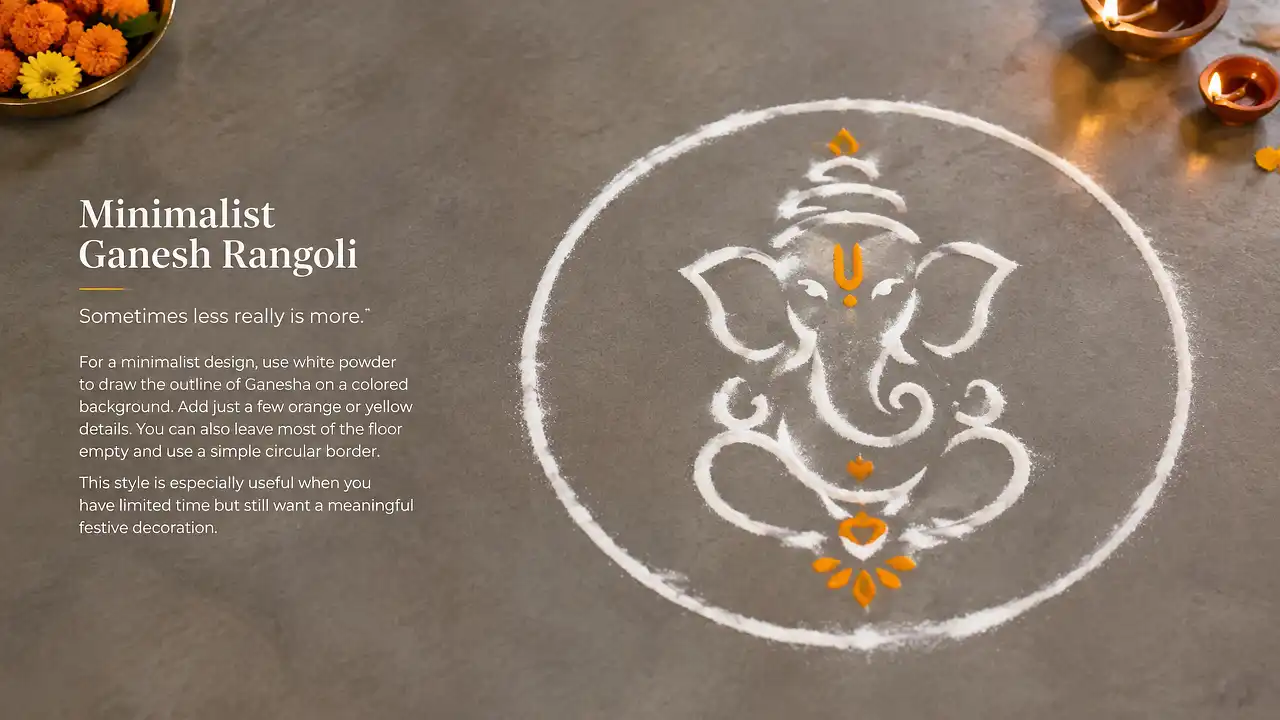
Simple Ganesh rangoli with clean patterns
Sometimes less really is more.
For a minimalist design, use white powder to draw the outline of Ganesha on a colored background. Add just a few orange or yellow details.
You can also leave most of the floor empty and use a simple circular border.
This style is especially useful when you have limited time but still want a meaningful festive decoration.
9. Colorful Ganpati Rangoli
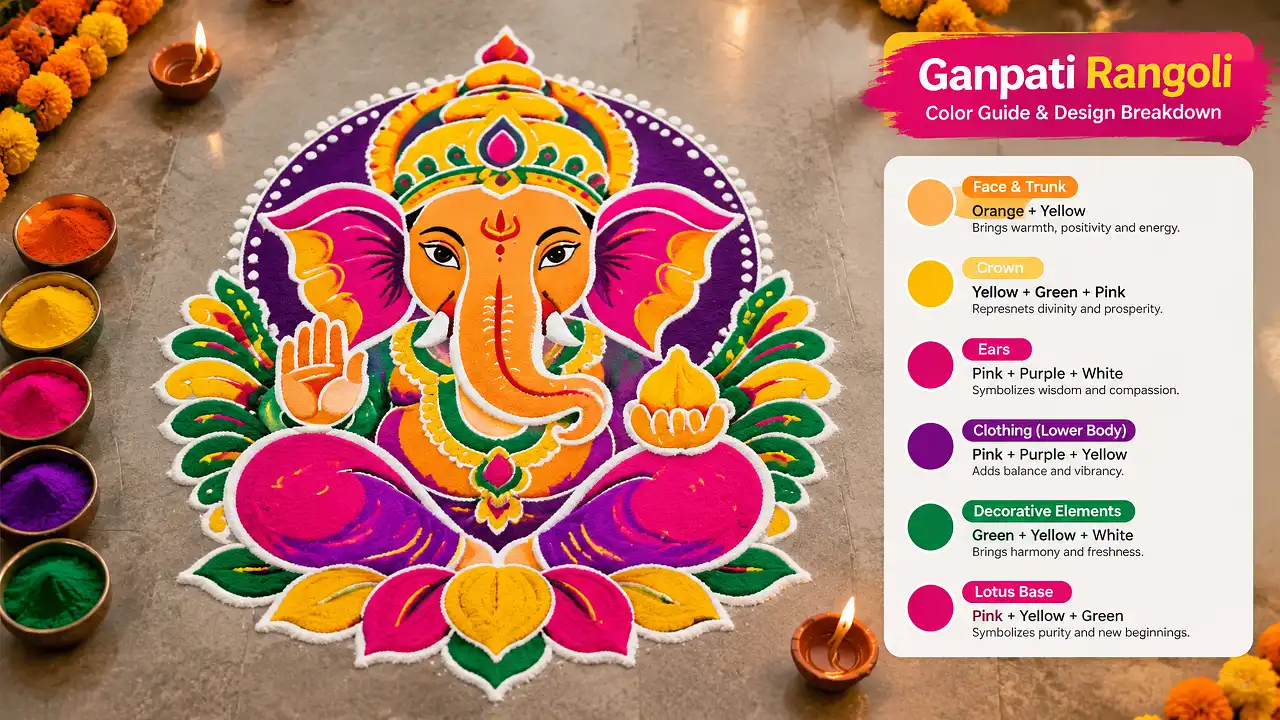
Bright Ganpati rangoli with colorful patterns
If you enjoy working with colors, create a brighter Ganpati design using several shades.
Start with the basic outline, then divide the face, crown, ears, and decorative elements into separate sections.
Try combinations such as:
- Orange + yellow + white
- Pink + purple + white
- Red + yellow + green
- Blue + pink + yellow
Avoid using too many colors in very small areas. A little contrast usually looks cleaner than a crowded palette.
10. Ganesh Rangoli With Floral Border
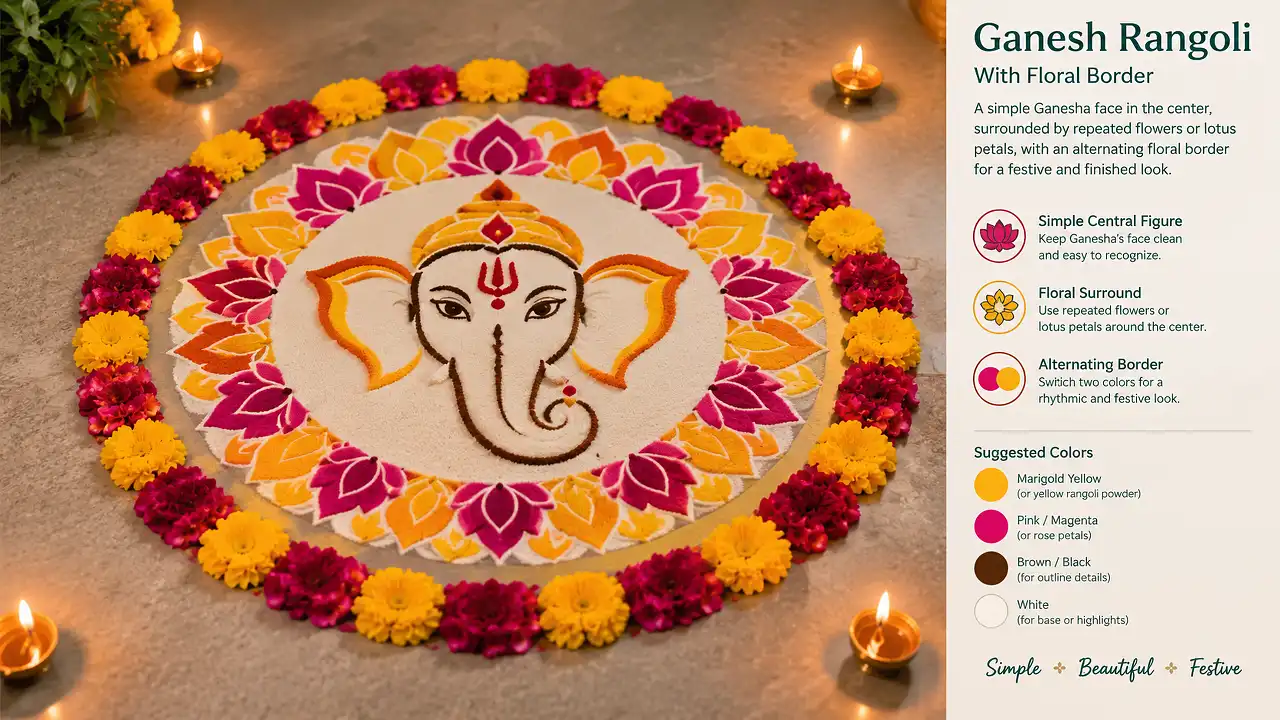
Beautiful Ganesh rangoli with a floral border
Instead of filling the entire floor with decoration, keep Ganesha simple and use the outer area for flowers.
Draw a central Ganesha face and surround it with repeated flowers or lotus petals.
You can alternate two colors around the border to create rhythm.
This is a good design when you want the central figure to remain easy while still giving the rangoli a finished, festive appearance.
11. Ganesh Rangoli With Om Detail
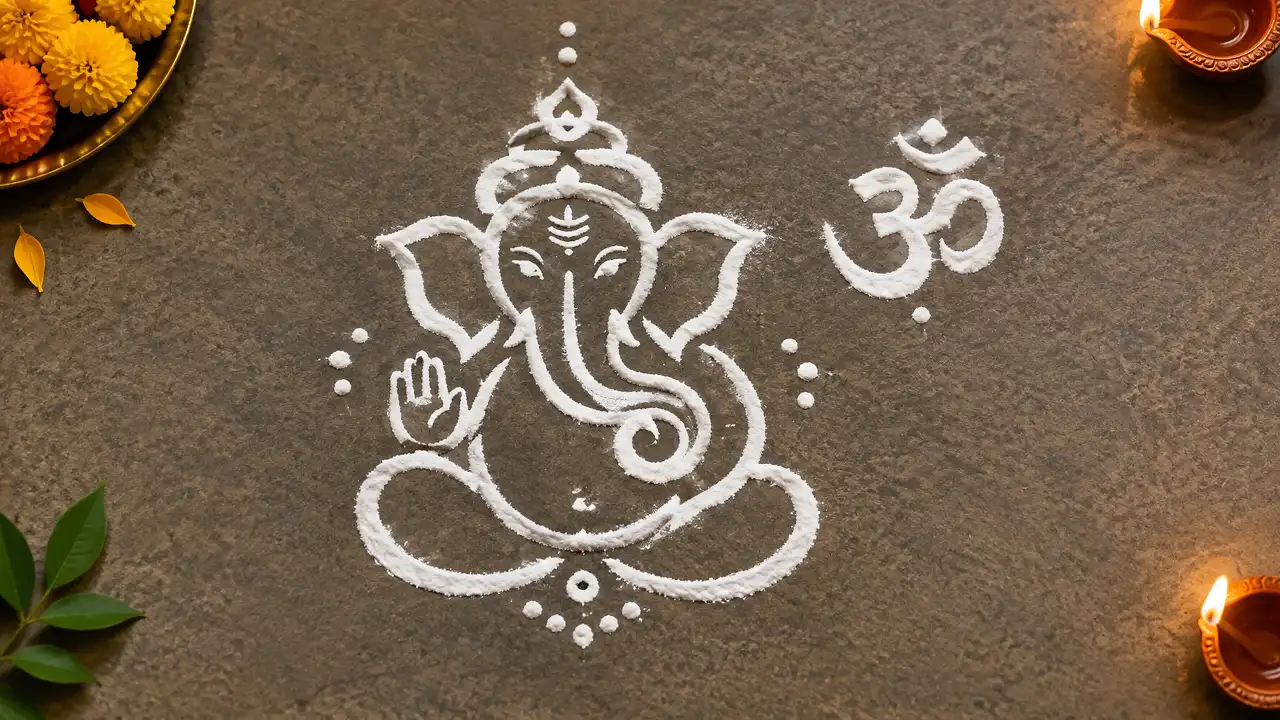
Beautiful Ganesh rangoli with Om detail
A small Om motif can be added above or beside a simple Ganesha design.
Start with the main Ganesha outline. Once the figure is complete, add the Om symbol carefully using white powder.
Keep the symbol separate enough from the main design so that the elements do not visually merge.
A few small dots around the edges can complete the composition.
12. Bal Ganesha Rangoli
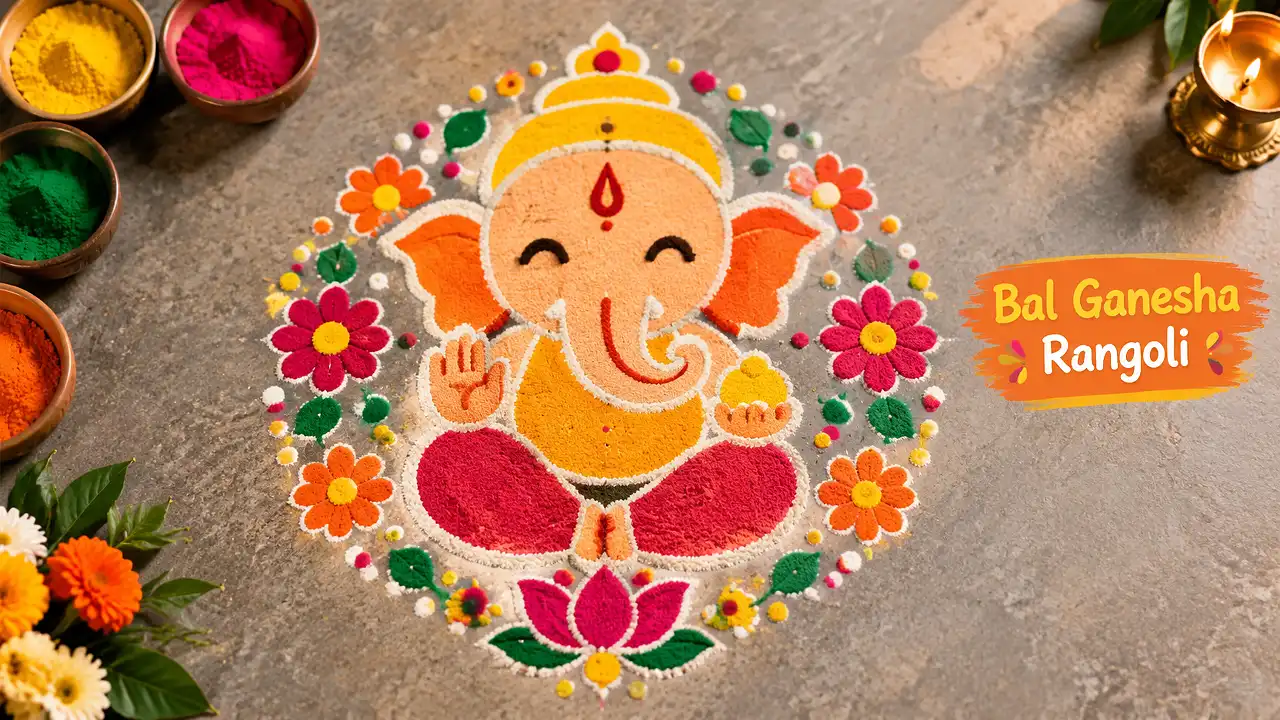
Beautiful Bal Ganesha Rangoli Design
A playful Bal Ganesha design can be a lovely choice for families and children.
Instead of trying to create a highly detailed figure, use a simple childlike Ganesha shape and surround it with flowers, dots, or colorful geometric patterns.
This is also a design where children can help with filling colors and adding dots after an adult has drawn the main outline.
The idea of simplifying Ganesha into a playful or child-friendly figure is also found in existing Ganesh rangoli collections.
13. Ganesha Face With Concentric Circles
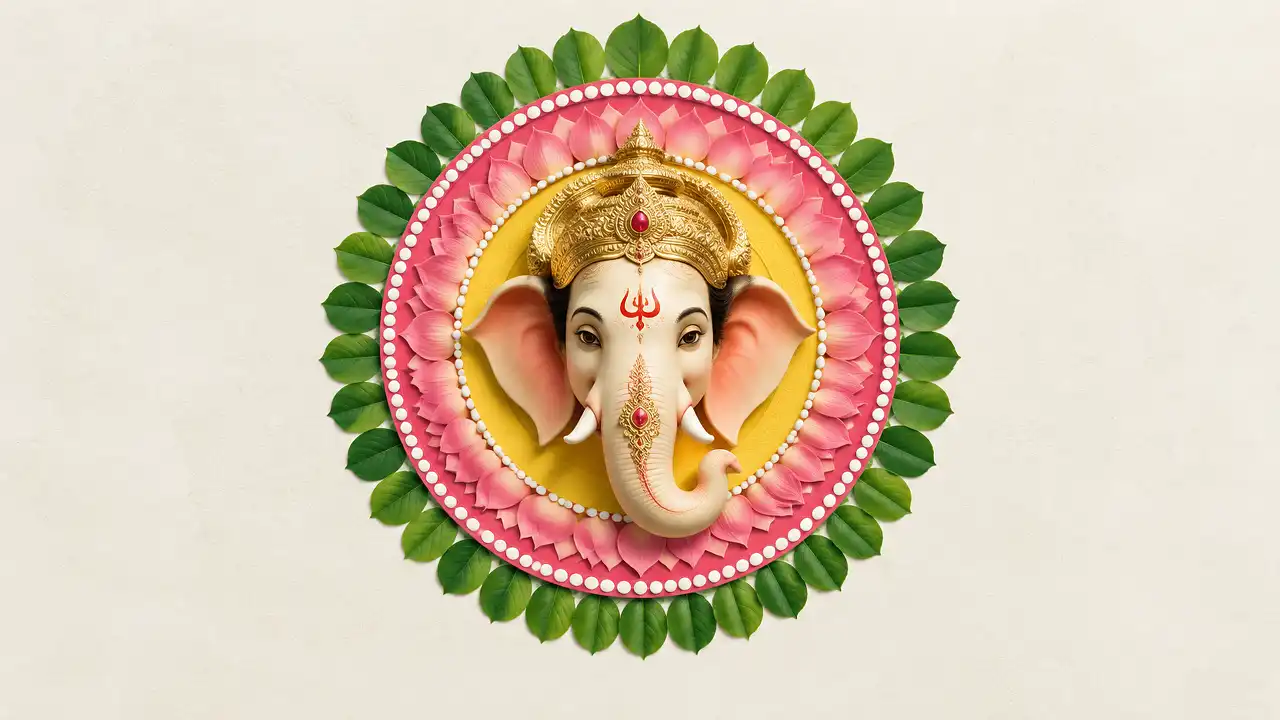
Ganesha face with concentric circles
For a modern-looking design, place Ganesha’s face in the center and surround it with several circular rings.
Each ring can have a different color or pattern.
For example:
Center: Ganesha face
Ring 1: Yellow
Ring 2: Pink petals
Ring 3: White dots
Outer ring: Green leaves
The circular structure makes the design feel balanced and is relatively easy to plan.
14. Traditional White Ganesh Rangoli
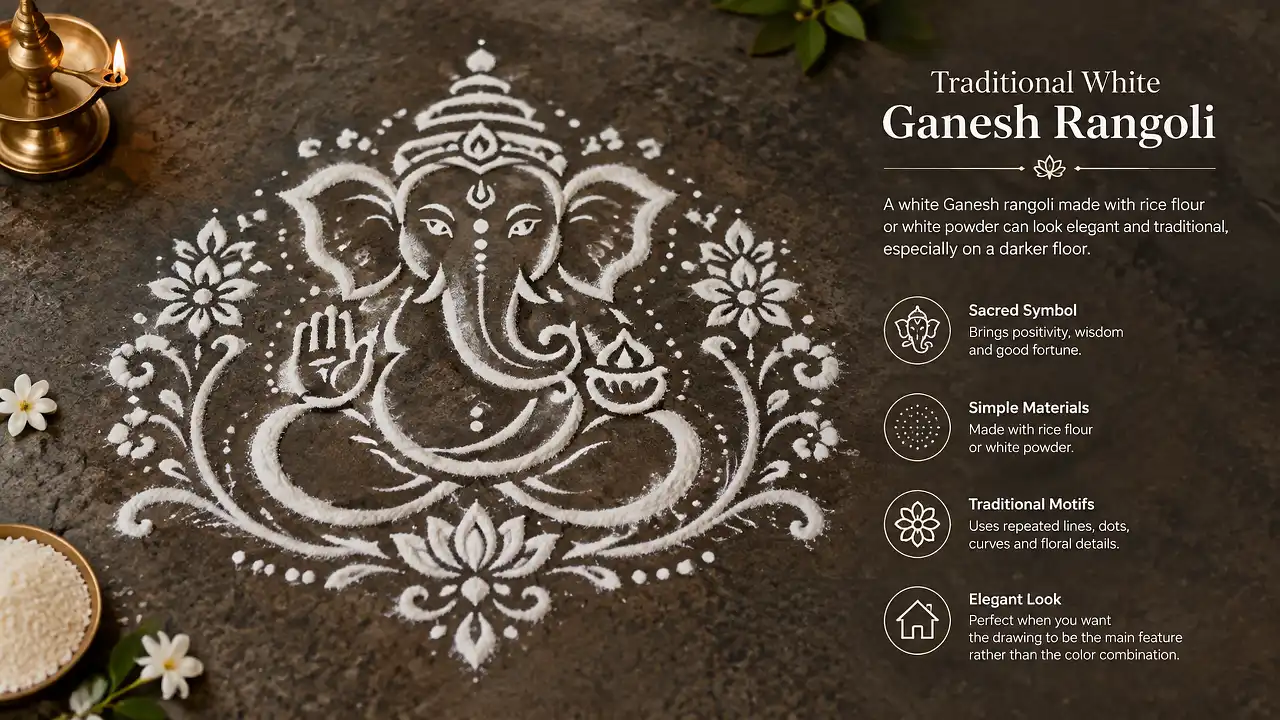
Traditional white Ganesh rangoli design for festive decor.
You do not always need bright colors.
A white Ganesh rangoli made with rice flour or white powder can look elegant and traditional, especially on a darker floor.
Begin with the face or full figure and use repeated lines, dots, curves, and small floral details around it.
This is a good option when you want the drawing itself to be the main feature rather than the color combination.
15. Large Ganesh Rangoli With Decorative Mandala
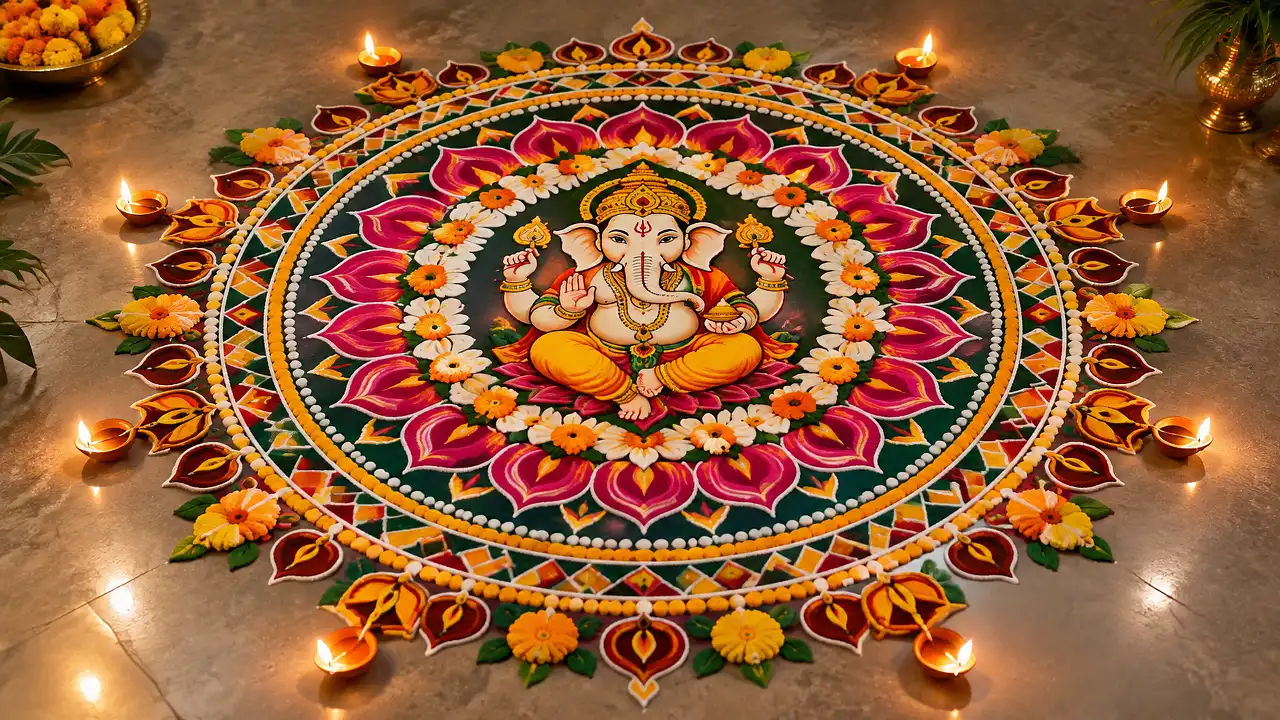
Large Ganesh Rangoli with a decorative mandala design.
If you have plenty of space and more time, build the entire rangoli around Ganesha.
Place Ganesha in the center and create several layers around him:
- Inner floral ring
- Petal ring
- Decorative dots
- Geometric border
- Outer flower or diya border
Work from the center outward and complete one layer before beginning the next.
This approach helps prevent the design from becoming crowded and makes it easier to maintain symmetry.
How to Choose Colors for Ganesh Rangoli
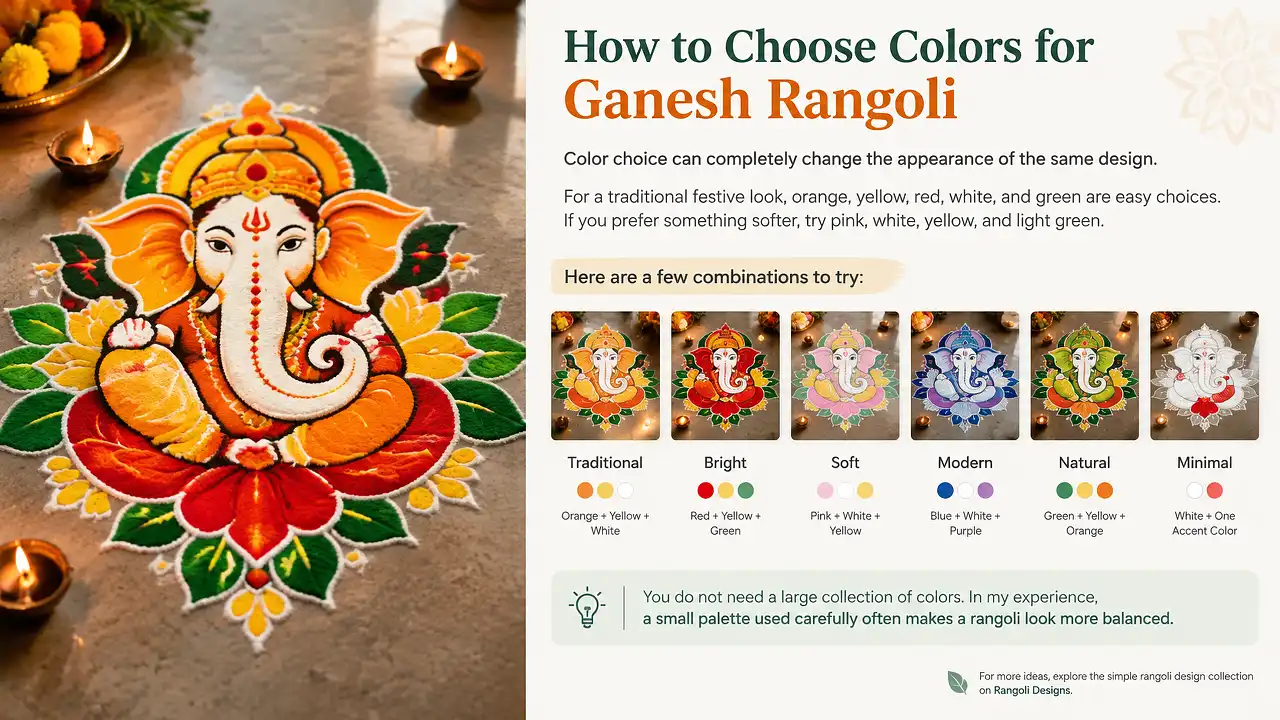
Color ideas for a beautiful Ganesh rangoli.
Color choice can completely change the appearance of the same design.
For a traditional festive look, orange, yellow, red, white, and green are easy choices. If you prefer something softer, try pink, white, yellow, and light green.
Here are a few combinations to try:
| StyleColor Combination | |
|---|---|
| Traditional | Orange + Yellow + White |
| Bright | Red + Yellow + Green |
| Soft | Pink + White + Yellow |
| Modern | Blue + White + Purple |
| Natural | Green + Yellow + Orange |
| Minimal | White + One Accent Color |
You do not need a large collection of colors. In my experience, a small palette used carefully often makes a rangoli look more balanced.
For more ideas, explore the simple rangoli design collection on Rangoli Designs.
Tips for Making Ganesh Rangoli Easier
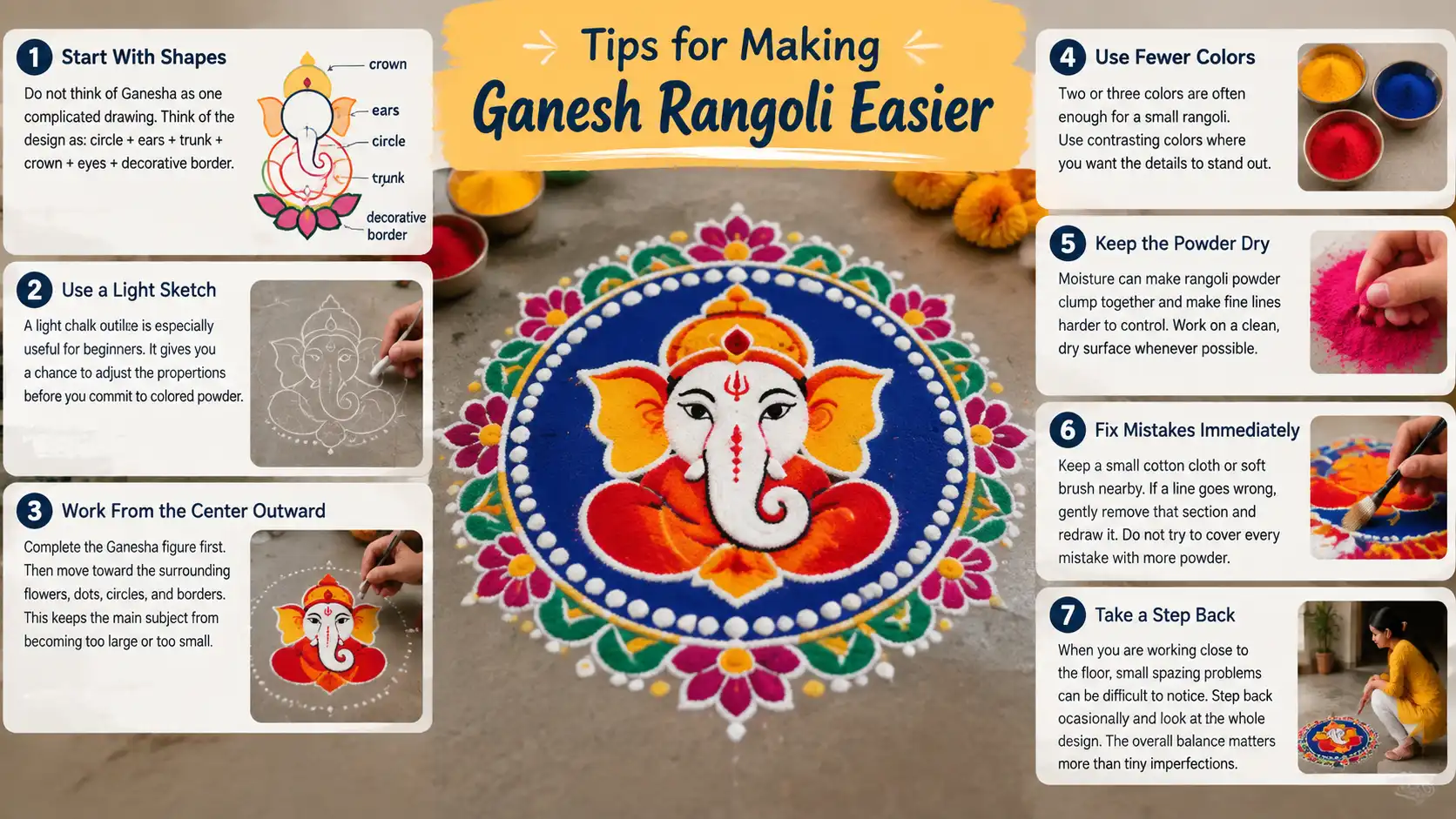
Simple tips for making Ganesh rangoli
After drawing rangoli for years, I have learned that the easiest way to make a difficult design manageable is to break it into smaller shapes.
Start With Shapes
Do not think of Ganesha as one complicated drawing.
Think of the design as:
circle + ears + trunk + crown + eyes + decorative border
Once you see it this way, the drawing becomes much less intimidating.
Use a Light Sketch
A light chalk outline is especially useful for beginners. It gives you a chance to adjust the proportions before you commit to colored powder.
Work From the Center Outward
Complete the Ganesha figure first. Then move toward the surrounding flowers, dots, circles, and borders.
This keeps the main subject from becoming too large or too small.
Use Fewer Colors
Two or three colors are often enough for a small rangoli.
Use contrasting colors where you want the details to stand out.
Keep the Powder Dry
Moisture can make rangoli powder clump together and make fine lines harder to control.
Work on a clean, dry surface whenever possible.
Fix Mistakes Immediately
Keep a small cotton cloth or soft brush nearby.
If a line goes wrong, gently remove that section and redraw it. Do not try to cover every mistake with more powder.
Take a Step Back
This is one of the simplest tips I learned from watching my family draw.
When you are working close to the floor, small spacing problems can be difficult to notice. Step back occasionally and look at the whole design.
The overall balance matters more than tiny imperfections.
Ganesh Rangoli Inspiration on Pinterest
If you want to see how different artists interpret the same Ganesha theme, Pinterest can be useful for visual inspiration. You can browse Ganesh rangoli ideas on Pinterest and then adapt the basic shapes to your own space and skill level.
When using an inspiration image, I recommend treating it as a starting point rather than trying to copy every tiny detail. A design usually becomes easier and more personal when you adjust its size, colors, and border to suit your own floor.
Common Mistakes to Avoid
Even experienced rangoli artists make mistakes. The important thing is knowing how to recover from them.
Making the central figure too large: Leave enough room for the outer decoration.
Using too many colors: Too many shades can make a small design look busy.
Skipping the outline: A clear white outline can help separate neighboring colors.
Starting with details: Always establish the main shape before adding tiny decorations.
Ignoring the floor: Dust, moisture, and uneven surfaces can affect the final result.
Trying an advanced design first: If you are a beginner, start with a simple Ganesha face or dot-based design.
If you want to practice basic techniques first, this easy rangoli guide for beginners is a useful place to start.
A Rangoli That Carries a Tradition
When I think about how to make Ganesh rangoli, I do not think only about the colors or the finished picture.
I think about those early mornings in Kolkata when I would sit quietly on the steps and watch my mother and grandmother draw at the doorway. There was never a rush. They started with a simple idea, worked patiently, corrected little mistakes, and slowly turned an empty patch of floor into something beautiful.
That is still the way I approach rangoli today.
After eight years of drawing, collecting, and photographing these designs, I have learned that a rangoli does not need to be perfect to feel special. Sometimes a simple Ganesha face with a few flowers says more than a complicated design filled with dozens of details.
So if you are making your first Ganesh rangoli, start small. Draw the outline. Take your time with the trunk and ears. Choose two or three colors you love. Add a few flowers or diyas if you have space.
And most importantly, enjoy the process.
The design may disappear after the celebration, but the quiet moment of creating it—and the tradition behind it—can stay with you much longer.
If you want to explore more patterns after finishing your Ganesh rangoli, visit the Rangoli Designs home collection for more flower, dot, simple, and festival rangoli ideas.
FAQs
How to make Ganesh rangoli for beginners?
Start with a simple Ganesha face rather than a full figure. Draw a light outline with chalk, add the ears and curved trunk, and then fill the main sections with two or three colors. Finish with a white outline and a few dots or flowers.
Which colors are best for Ganesh rangoli?
Orange, yellow, red, white, and green are popular choices for a traditional festive appearance. However, there is no single required color combination. Choose shades that contrast clearly and suit your floor.
Can I make Ganesh rangoli without dots?
Yes. You can make a freehand Ganesha rangoli using chalk or white powder as a guide. Freehand rangoli is flexible because you are not limited by a dot grid, although it usually takes more practice to keep the proportions balanced.
What can I use instead of rangoli powder?
You can use rice flour for white designs and fresh flower petals for floral rangoli. Colored sand or other suitable dry decorative materials can also be used depending on the design. Flower-petal rangoli is particularly effective when you want a natural festive look.
How long does it take to make a Ganesh rangoli?
A small Ganesha face may take only a few minutes once you are comfortable with the basic shapes. A larger design with flowers, shading, borders, and multiple colors can take considerably longer. Your available space and level of detail will make the biggest difference.