Border Rangoli Design: 25 Stunning Ideas to Beautify Every Corner of Your Home
A single line of color can transform an ordinary floor into a festive masterpiece. Border rangoli design is one of the most versatile and underrated forms of rangoli art — framing doorways, lining staircases, and turning long corridors into vibrant works of art.
In this guide, you’ll discover 25 beautiful border rangoli designs that range from beginner-friendly patterns to intricate traditional styles. Whether you’re decorating for Diwali, a wedding, or simply want to add a festive touch to your home, there’s a border design here for you.
What Is a Border Rangoli Design?
A border rangoli design is a linear or strip-style rangoli pattern created along the edges of floors, doorways, staircases, pathways, or as a decorative frame around a central rangoli motif. Unlike circular or full-floor designs, border rangoli runs in a continuous or repeating pattern along a defined length.
Border designs are particularly popular because:
- They work in narrow spaces where full circular designs don’t fit
- They’re faster to create than large centerpiece rangoli
- They can stand alone or enhance a larger rangoli composition
- They suit both indoor and outdoor settings
According to Pinterest overview of Rangoli, linear floor art has been a part of South Asian domestic ritual decoration for thousands of years — and border patterns are among the oldest recorded forms.
Types of Border Rangoli Designs
Floral Border Rangoli
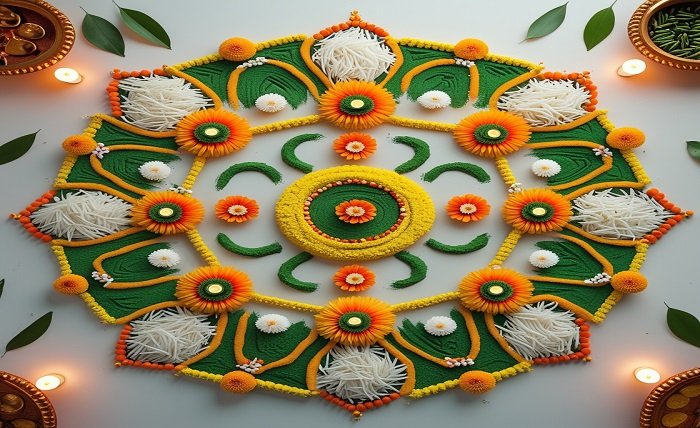
Floral border designs are the most popular choice for festive occasions. Repeating flower motifs — lotus, marigold, rose — create a lush, welcoming visual line.
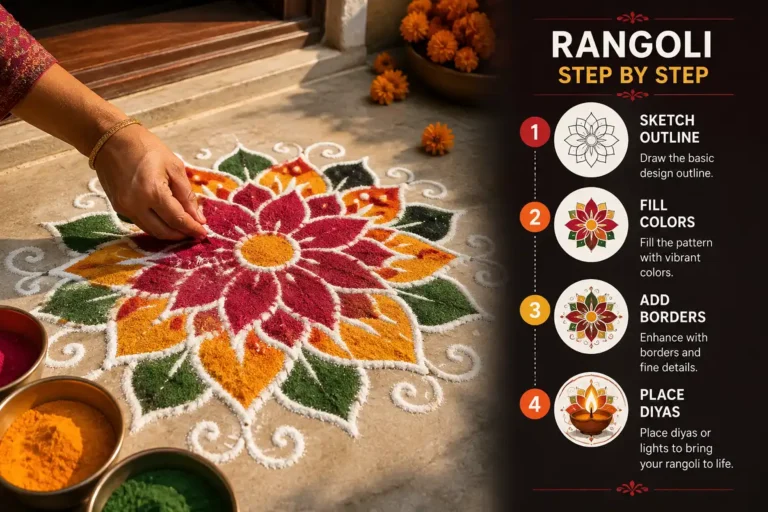
How to create it- Draw a central horizontal line as your guide
- Sketch alternating flower heads every 3–4 inches
- Fill with contrasting colors (pink flowers, green leaves, yellow centers)
- Connect with vine or curved stem lines between each bloom
Floral borders pair beautifully with larger circular designs. For more floral inspiration, explore these beautiful flower rangoli design ideas to complement your border work.
Geometric Border Rangoli
Geometric patterns — diamonds, triangles, zigzags, and chevrons — offer crisp, modern aesthetics. These are ideal for contemporary homes and apartment entrances.
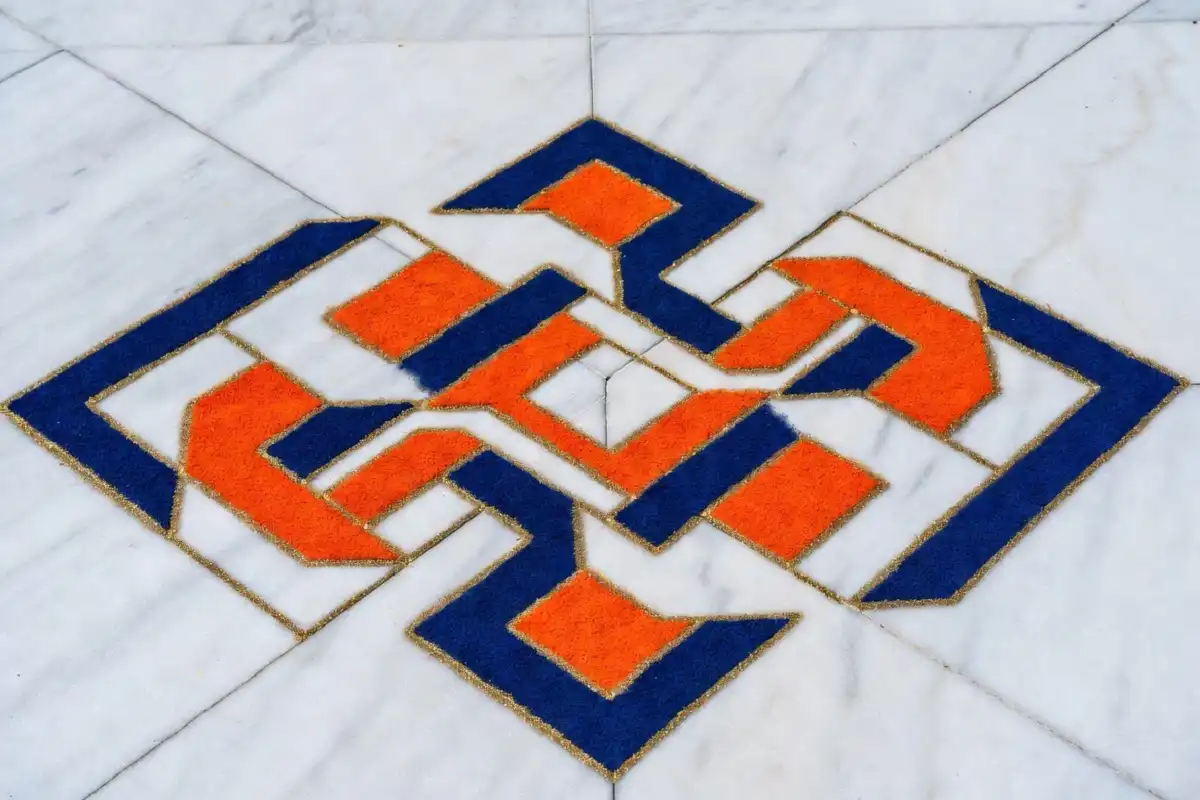
- Diamond chain — Repeating diamond shapes connected at their points
- Zigzag stripe — Two or three colored zigzag bands running in parallel
- Interlocking triangles — Alternating up and down triangles forming a continuous band
- Hexagonal border — Small honeycomb cells arranged in a linear strip
Dot-Based Border Rangoli (Kolam-Style)
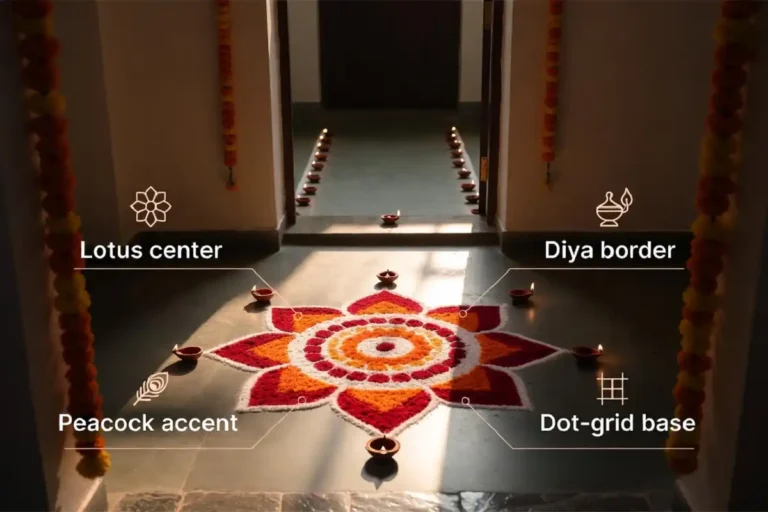
Rooted in South Indian kolam tradition, dot-based borders use a grid of equidistant dots as anchors. Lines are drawn connecting dots in specific sequences to create interlocking, looping patterns.
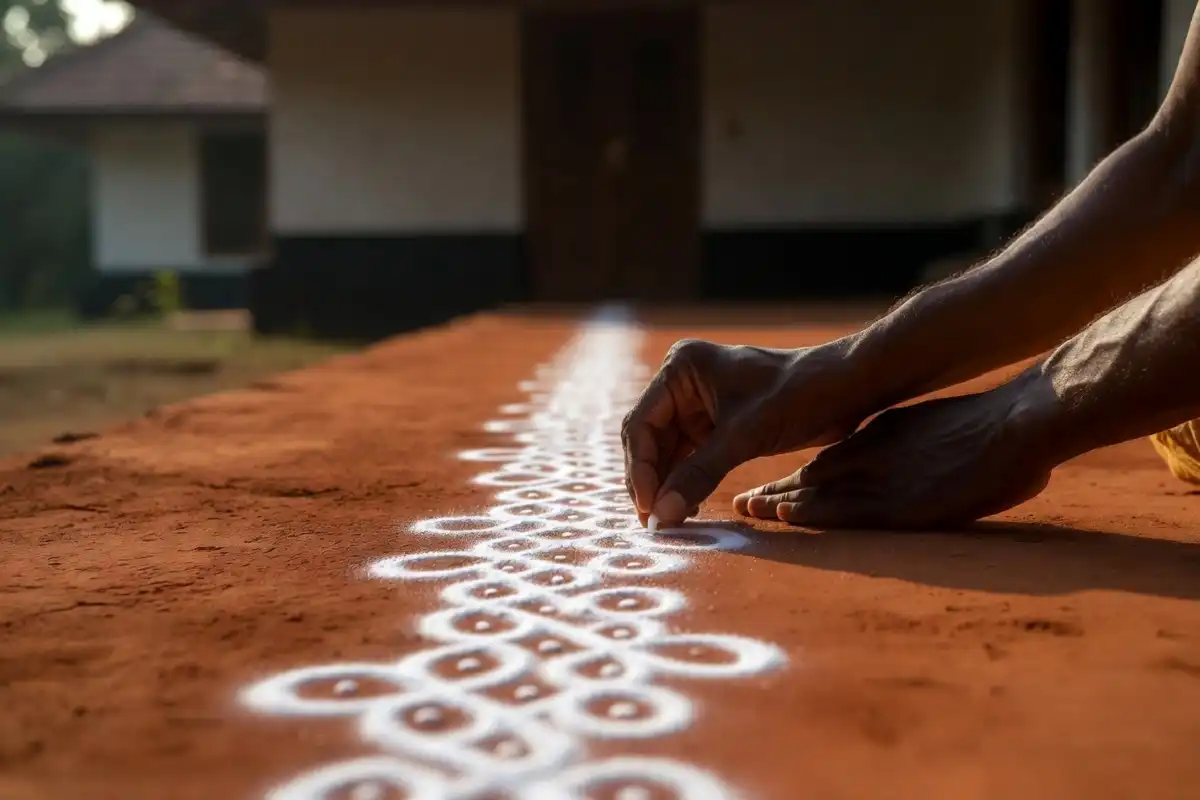
This style of border rangoli design is especially satisfying to create — once you master the dot-to-dot rules, the patterns practically draw themselves.
Peacock Border Rangoli
A row of stylized peacocks marching in profile makes for one of the most eye-catching border designs. Each peacock body curves gracefully with a spread tail fan above or below the walking line.
Use blues, greens, and golds for the most authentic peacock palette.
Diya and Lamp Border Rangoli
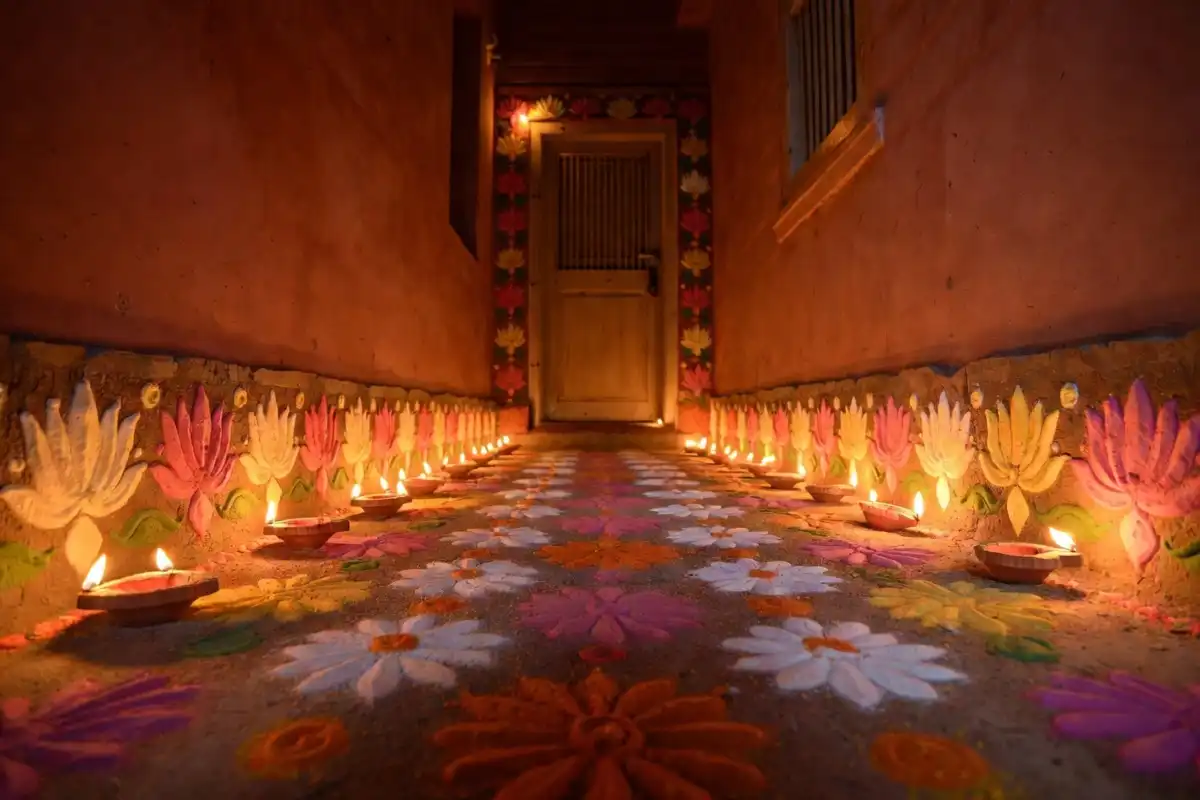
A repeating diya (clay lamp) motif is perfect for Diwali entrances. Each illustrated lamp can be filled with warm oranges and yellows, with flame tips in red and white. Place actual diyas between the drawn motifs for a stunning mixed-media effect.
Easy Border Rangoli Designs for Beginners
New to rangoli? These simple border rangoli design styles are completely beginner-friendly:
🌱 Beginner FriendlySimple Wave Border
Draw a continuous S-curve or wavy line. Fill the upper curves with one color and the lower curves with another. It takes less than 10 minutes and looks elegantly professional.
Straight Stripe Border
Three parallel stripes in contrasting colors — such as orange, white, and green — form a clean and cheerful border. This is the simplest possible border rangoli and works beautifully on staircases.
Petal Chain Border
Alternate outward-facing petals above and below a central line, like a chain of leaves. Fill odd petals with pink and even petals with yellow for a lively, rhythmic pattern.
Dot Row Border
A single row of evenly spaced large colored dots with a thin line running through their centers — minimal, modern, and achievable in minutes.
For more beginner-appropriate patterns, check out these simple rangoli design ideas with 25 easy patterns that adapt easily to border formats.
Advanced Border Rangoli Designs for Experienced Artists
If you’re ready to push your skills, these detailed border rangoli design styles will challenge and reward you:
🔥 Advanced LevelIntricate Paisley Border
The paisley (or boteh) motif — a curved, teardrop shape with elaborate internal detail — forms a stunning repeating border when lined in sequence. Fill each paisley with miniature geometric patterns inside for a truly heirloom-quality result.
Multi-Layer Checkered Border
Stack three or four distinct border strips in parallel: a thin geometric line, a floral middle band, another geometric line, and an outer dot row. Multi-layer borders are popular around central mandala rangoli for Diwali and wedding ceremonies.
Traditional Madhubani Border
Inspired by Bihar’s Madhubani painting tradition, these borders feature fish, sun, and bird motifs outlined in thick black and filled with flat, bold colors — red, yellow, blue, and white. They carry deep cultural symbolism and make extraordinary statement pieces.
Warli-Style Tribal Border
Using white powder on a dark (black or deep red) surface, Warli-inspired borders depict human figures, animals, and trees in simple geometric forms. The contrast is dramatic and visually striking.
For traditional design inspiration, browse this curated collection of traditional rangoli designs with 20 beautiful patterns — many of which include border elements worth adapting.
Where to Use Border Rangoli Design in Your Home
One of the greatest advantages of border rangoli is its flexibility. Here are the best spots to use it:
Border Rangoli Design for Diwali: Special Ideas
Diwali calls for the most festive and elaborate border rangoli design treatments. Here are Diwali-specific ideas:
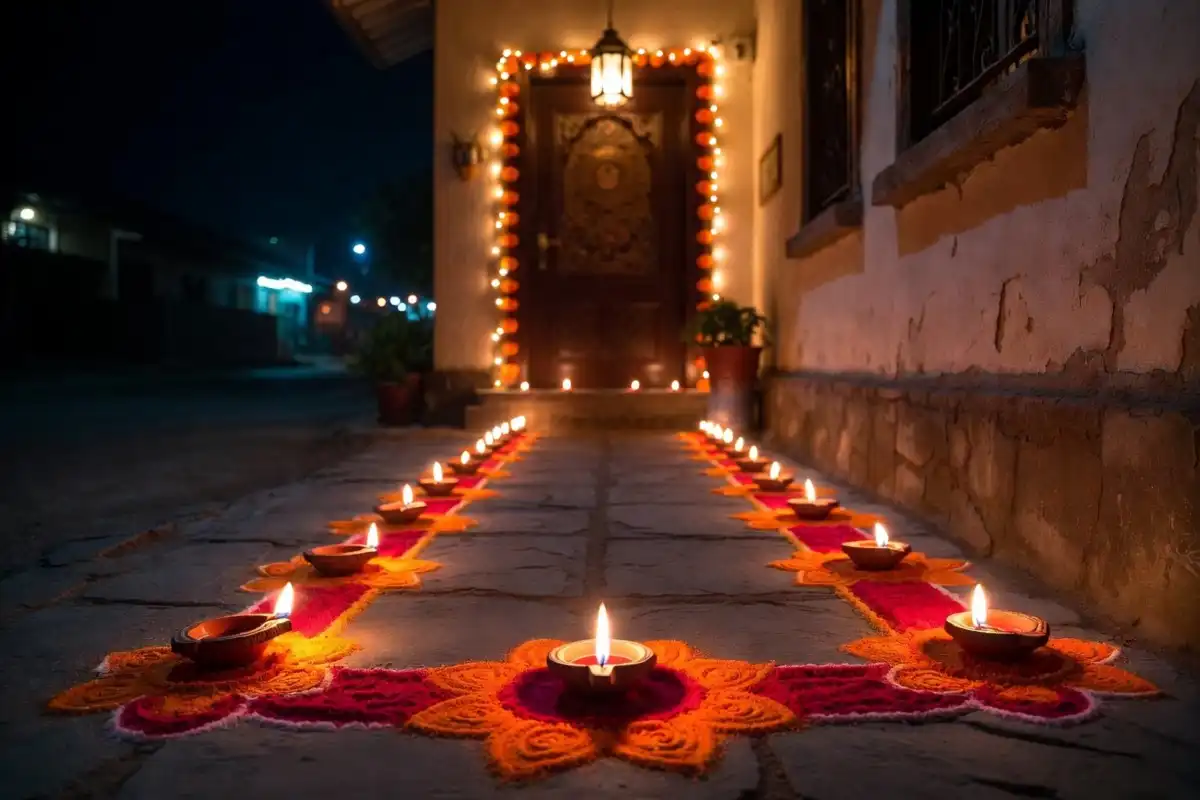
- Diya chain border — Alternate drawn diyas with real lit clay lamps along a pathway
- Om and swastika repeat border — Auspicious symbols linked in sequence along doorway edges
- Lotus chain border — Sacred lotus flowers in pink and white as a continuous garland motif
- Lakshmi footprint border — Small footprint motifs leading from the main entrance inward, symbolically inviting the goddess inside
For the best Diwali-specific patterns, explore this full collection of easy and beautiful rangoli designs for Diwali and Diwali rangoli design ideas with 25 stunning patterns.
Materials for Creating the Perfect Border Rangoli
🎨 Essential Supplies
- Colored rangoli powder (at least 4–6 colors)
- White chalk or rice flour for sketching
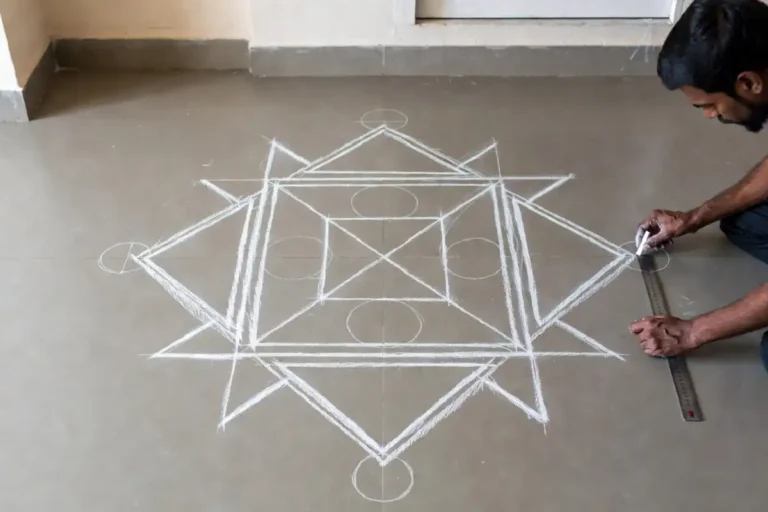
- A ruler or straight edge for alignment
- Squeeze bottles or small cones for precision
- A flat brush for blending and correcting edges
✨ Optional Enhancements
- Flower petals for organic, fragrant borders
- Colored sand for a gritty, textured look
- Mirror tiles or glass beads as accent points
- Tea-light candles or diyas placed along the border at intervals
Tips for a Flawless Border Rangoli Design
- Plan your length first — Measure the space and calculate how many pattern repeats fit
- Work symmetrically — Start from the center and work outward in both directions to keep the pattern balanced
- Use odd number repeats — Three, five, or seven pattern repeats look more visually harmonious than even numbers
- Keep consistent spacing — Uneven gaps between repeating motifs are the most common beginner mistake
- Seal outdoor borders — A light mist of hairspray prevents wind from disturbing powder designs
According to Architectural Digest India’s guide to festival home décor, well-placed border rangoli at home entrances significantly elevates the overall festive ambiance and is one of the highest-impact low-effort décor choices.
For even more pattern variety, this photo gallery of 40 stunning rangoli designs includes many border arrangements you can draw from directly.
Eco-Friendly Border Rangoli: Natural Alternatives
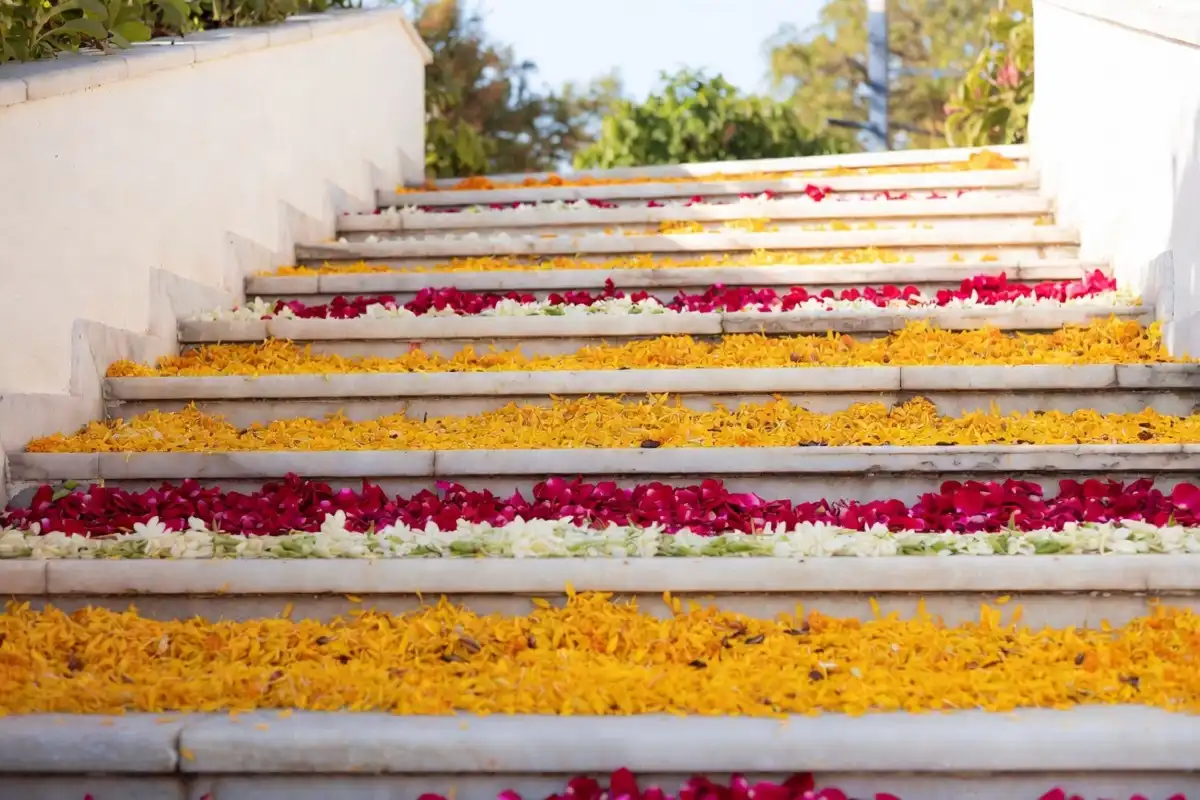
With growing awareness around sustainable festivals, many artists now create border rangoli designs using natural, biodegradable materials:
- Flower petals — Rose, marigold, and chrysanthemum petals in natural shades
- Turmeric — Deep golden yellow without any chemical dyes
- Rice flour — Classic white base material, feeds birds after the festival
- Dried lentils and seeds — Textured, rustic border patterns with zero waste
- Leaves — Fresh or dried leaves arranged in chevron or wave patterns
Natural rangoli materials are especially popular for borders because the repeating linear format suits the uniform texture of organic elements beautifully.
FAQ: Border Rangoli Design
Q. What is the best border rangoli design for beginners?
The simplest border rangoli design for beginners is the wave or S-curve pattern, the petal chain, or the straight three-stripe design. These require no artistic background and can be completed in under 15 minutes.
Q. How wide should a border rangoli be?
Most doorway and corridor border rangoli designs are 4–8 inches wide. Borders that frame a central design can be 2–4 inches wide. For staircase risers, match the border width to the riser height, typically 6–7 inches.
Q. Can border rangoli be made with flowers instead of powder?
Absolutely. Flower petal border rangoli designs are popular for weddings and Diwali. Marigold petals work especially well for long corridor borders due to their vibrant color and uniform size.
Q. How do I keep a border rangoli design straight?
Use a length of string or masking tape as a straight-edge guide before laying your powder. A ruler helps mark equal spacing for repeating motifs. Always sketch lightly in chalk first before applying color.
Q. How long does it take to make a border rangoli?
A simple 3-foot border rangoli design takes 15–30 minutes. A detailed multi-layer or intricate border along a full corridor may take 1–2 hours depending on complexity and length.
Q. What colors are best for a border rangoli design?
High-contrast color combinations work best — white on dark surfaces, or bright complementary pairings like orange and blue, red and white, or pink and green. For Diwali, warm tones (orange, gold, red) are considered most auspicious.
Conclusion
A border rangoli design is proof that you don’t need the entire floor to make a stunning statement. Whether you’re framing a doorway with a simple petal chain, lining a corridor with geometric stripes, or creating an intricate peacock procession for Diwali, border rangoli brings color, culture, and artistry to every edge of your home.
Start with a beginner-friendly wave pattern, experiment with dot-based kolam borders, and gradually work up to layered traditional designs. The journey is as rewarding as the result.
🎨 Ready to start creating?
Explore 20 Easy Rangoli Designs to Try