How to Make Flower Rangoli: 15 Easy Ideas and Tips
I’m based in Kolkata, and I’ve been drawing and documenting rangoli for 8 years. I grew up watching my mother and grandmother draw rangoli at our doorway every morning before sunrise. I used to sit on the steps and watch the patterns take shape, dot by dot, color by color. What seemed like a simple morning ritual slowly became something I looked forward to.
Over the years, I started learning the designs they taught me, experimenting with new patterns, and photographing the ones I enjoyed most. Some were tiny enough to finish before breakfast, while others grew into larger floral designs that took much more patience.
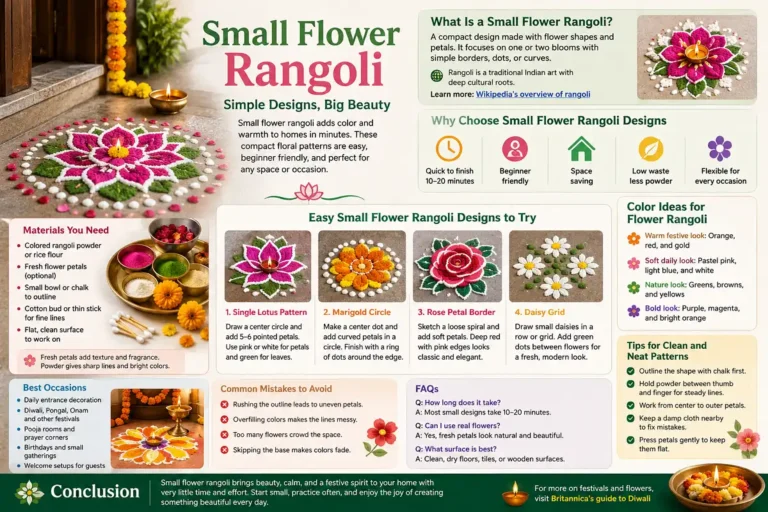
Flower rangoli has always had a special place in that journey. There is something very natural about building a design from petals, leaves, circles, and simple flower shapes. You do not need to be an expert artist, and you do not need a huge collection of materials. A few fresh flowers and a little planning can be enough to create something beautiful.
If you have been wondering how to make flower rangoli, I want to show you the simple approach I use. In this guide, you will find 15 easy flower rangoli ideas, a step-by-step method for beginners, useful flower and color combinations, and small tips that can make the finished design look much neater.
What Is a Flower Rangoli?
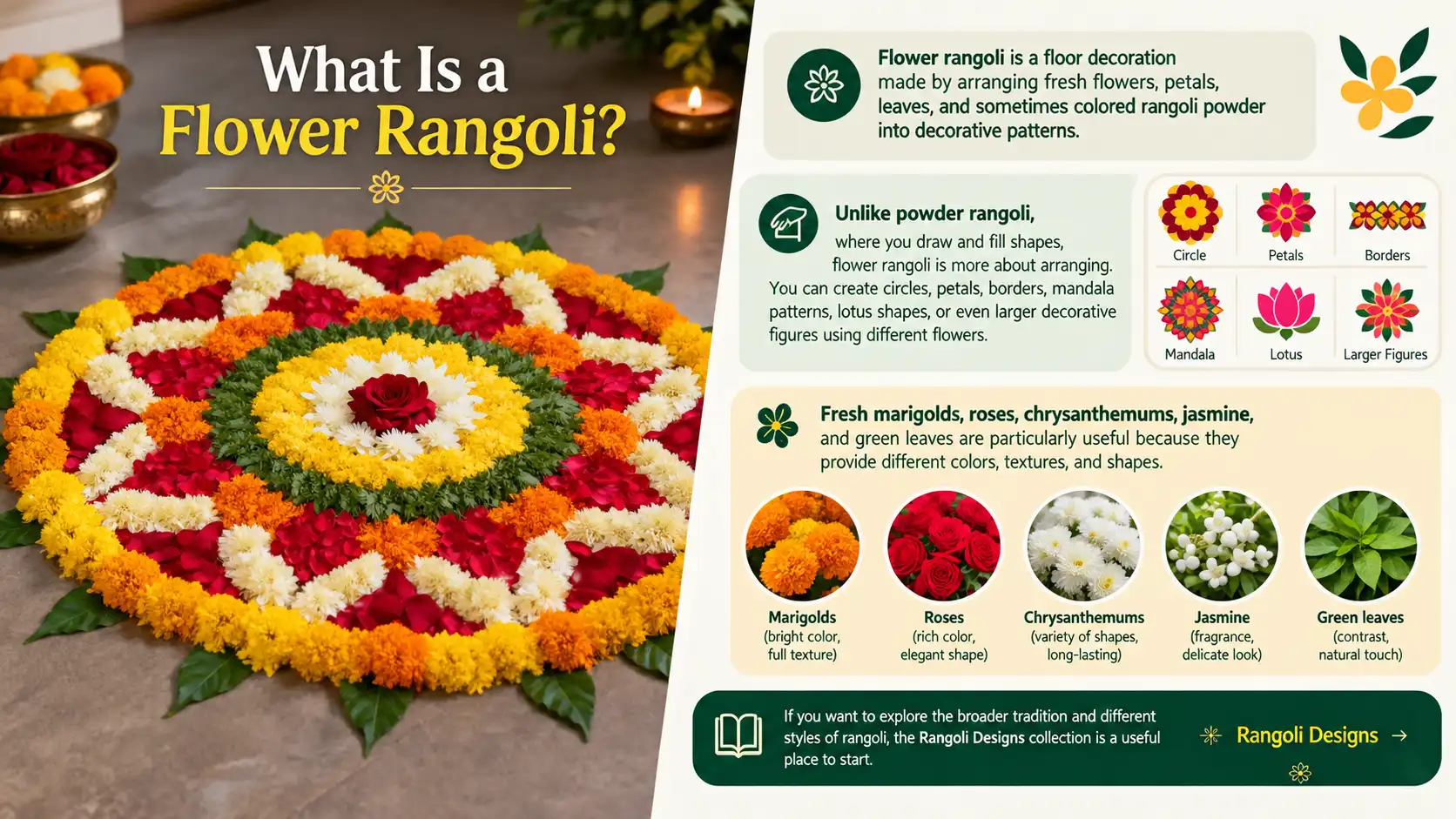
Flower rangoli is a floor decoration made by arranging fresh flowers, petals, leaves, and sometimes colored rangoli powder into decorative patterns.
Unlike powder rangoli, where you draw and fill shapes, flower rangoli is more about arranging. You can create circles, petals, borders, mandala patterns, lotus shapes, or even larger decorative figures using different flowers.
Fresh marigolds, roses, chrysanthemums, jasmine, and green leaves are particularly useful because they provide different colors, textures, and shapes.
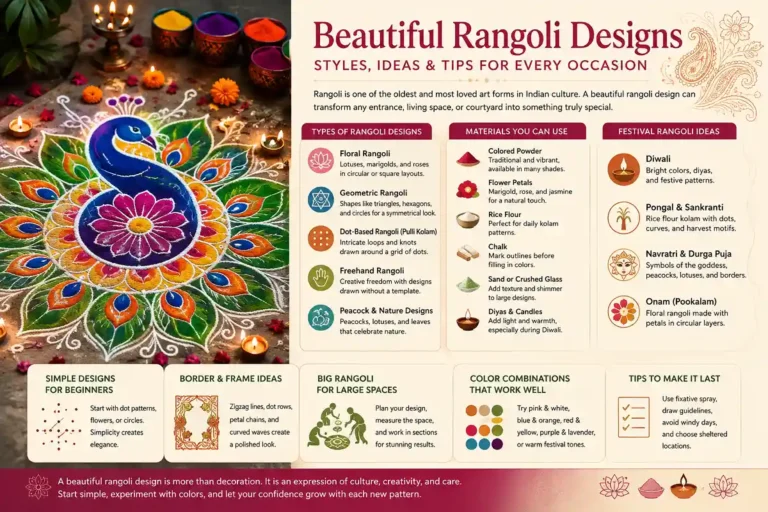
If you want to explore the broader tradition and different styles of rangoli, visit the Rangoli Designs collection.
Why Flower Rangoli Is So Easy for Beginners
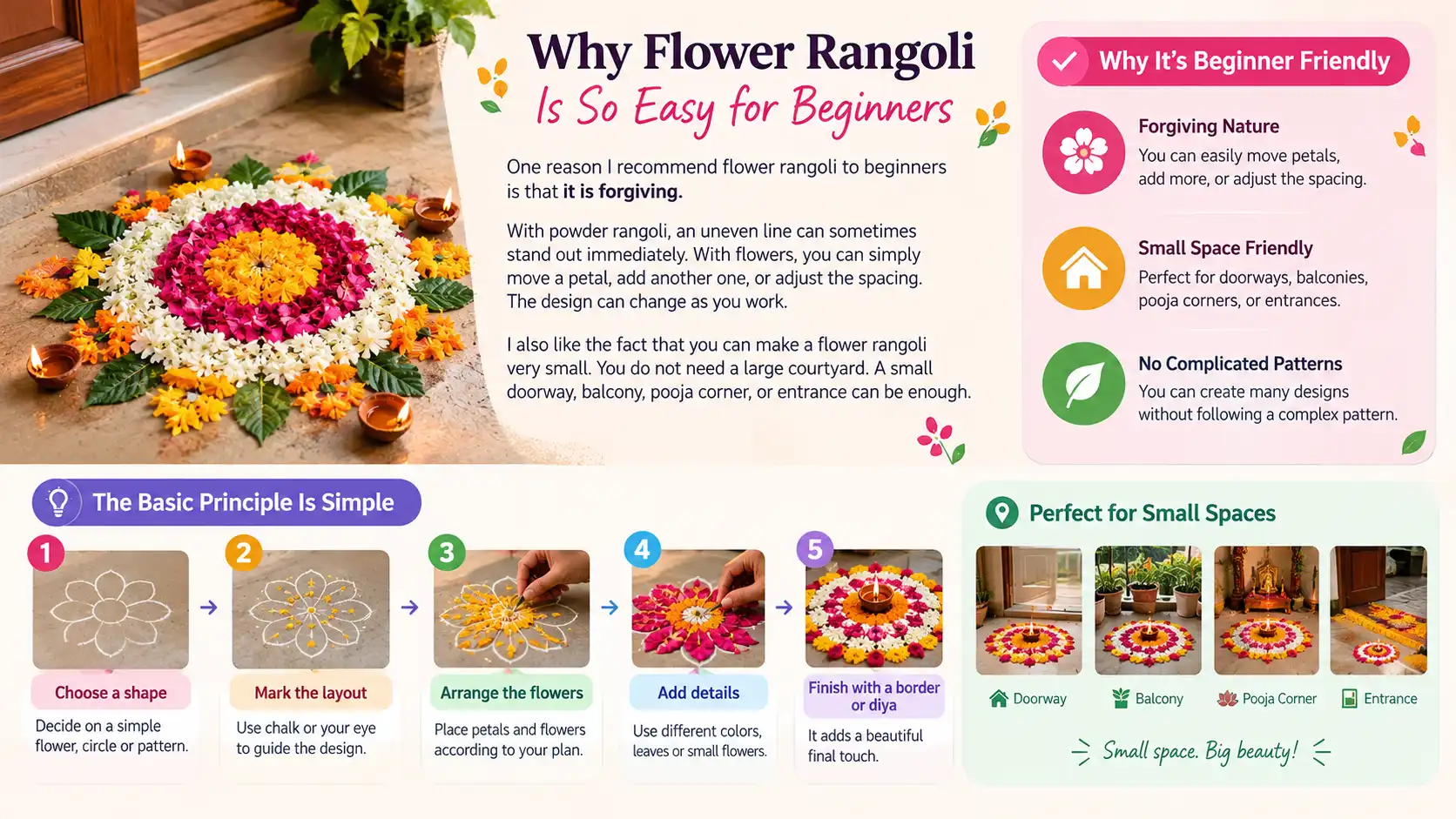
One reason I recommend flower rangoli to beginners is that it is forgiving.
With powder rangoli, an uneven line can sometimes stand out immediately. With flowers, you can simply move a petal, add another one, or adjust the spacing. The design can change as you work.
I also like the fact that you can make a flower rangoli very small. You do not need a large courtyard. A small doorway, balcony, pooja corner, or entrance can be enough.
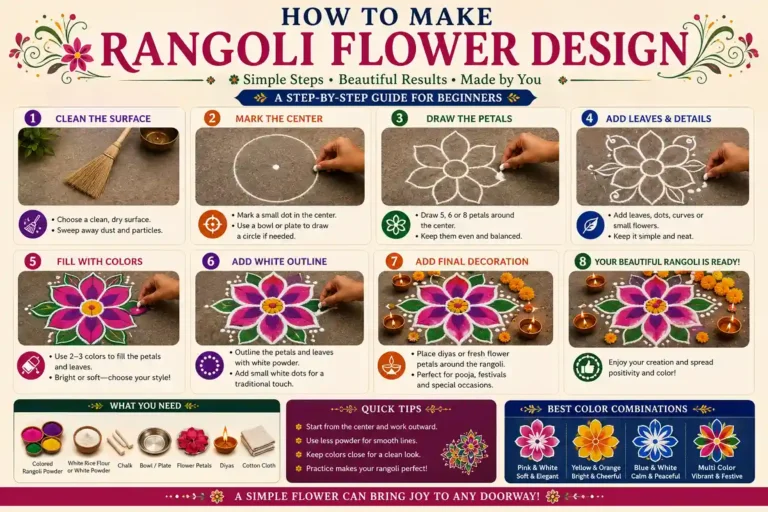
Choose a shape → mark the layout → arrange the flowers → add details → finish with a border or diya.
Once you understand that process, you can create many different designs without following a complicated pattern.
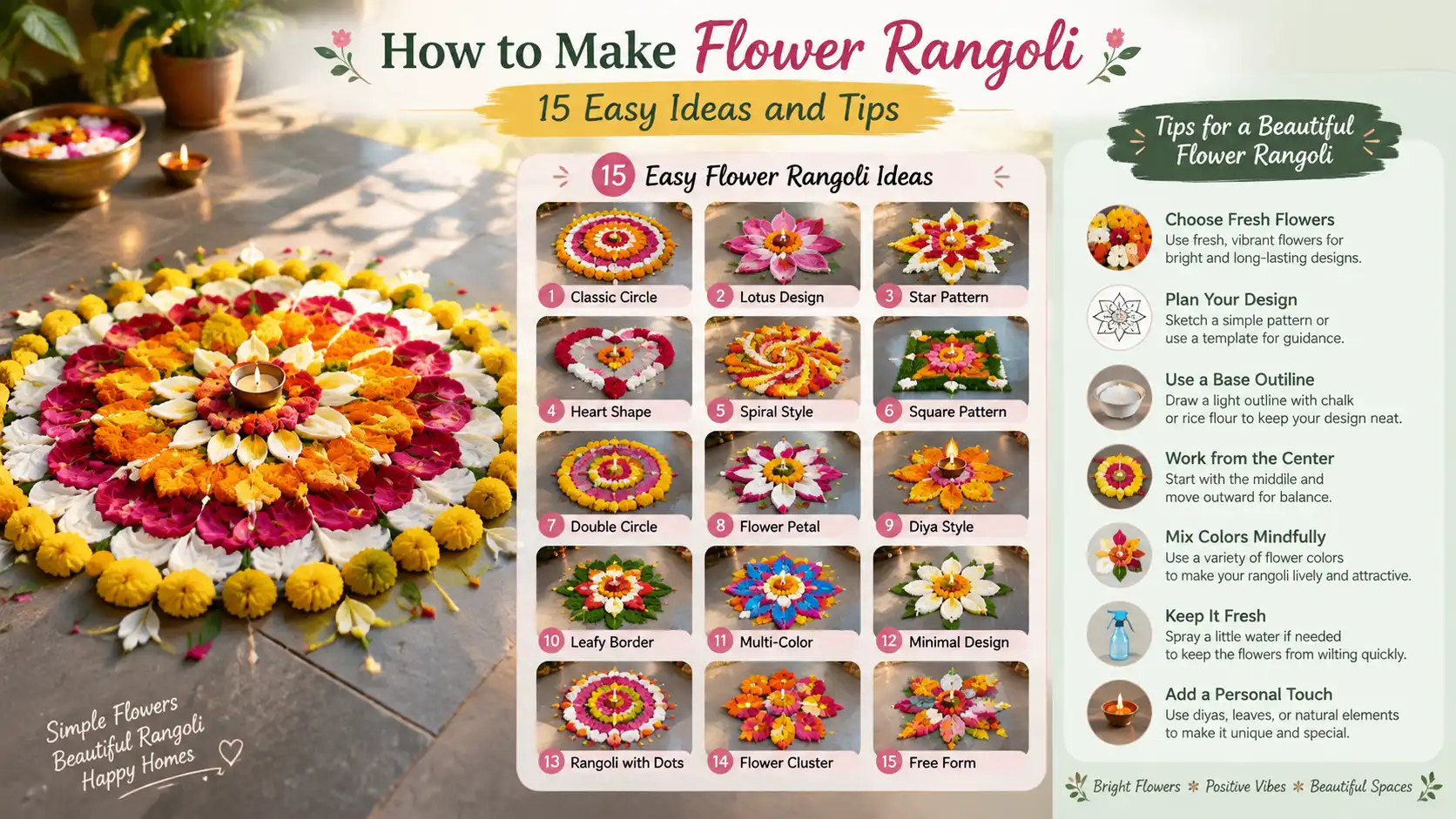
15 Easy Flower Rangoli Ideas
Once you know the basic method, you can change the layout without making the process complicated. Here are 15 ideas I would recommend trying.
1. Simple Five-Petal Flower Rangoli
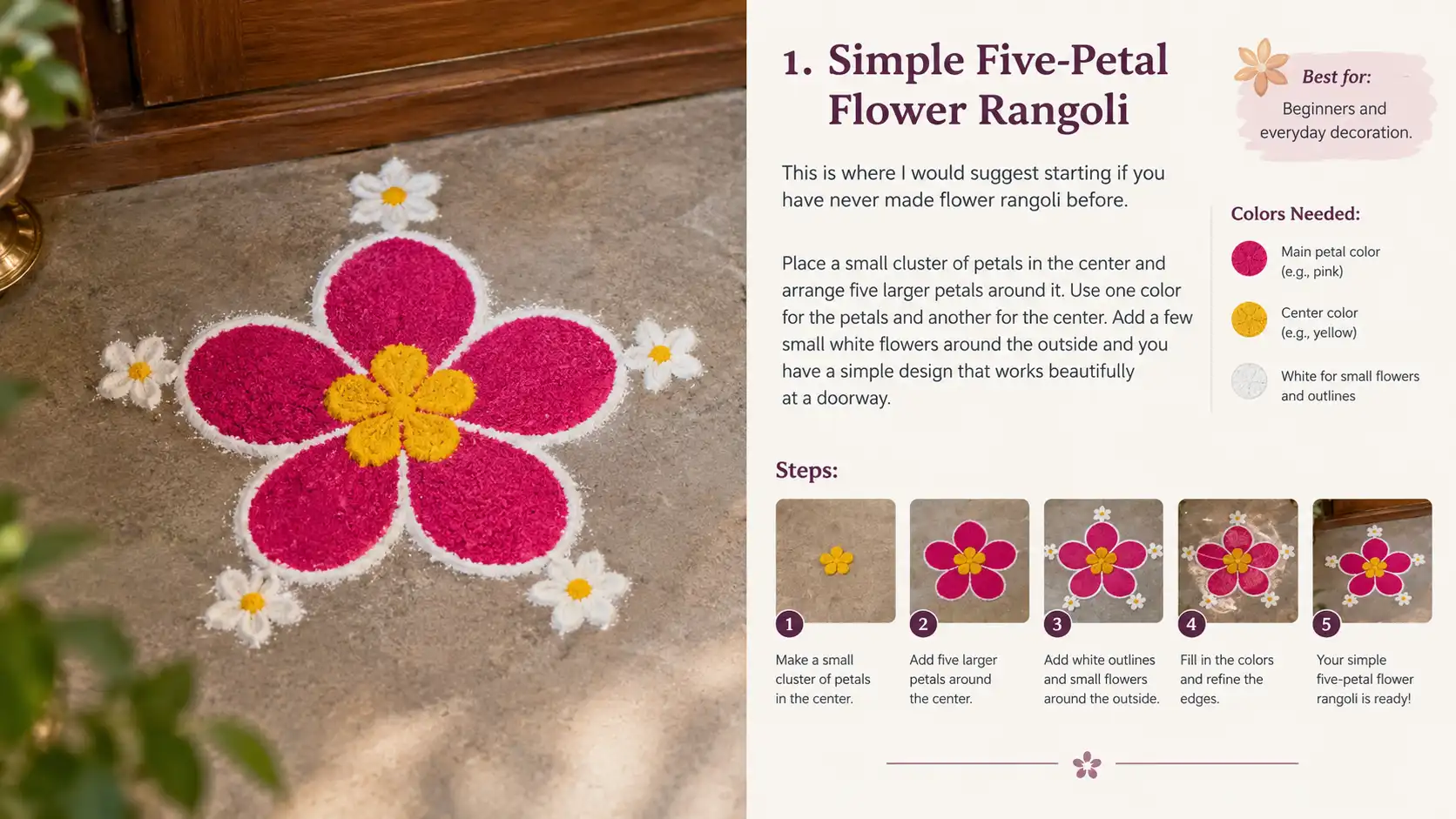
This is where I would suggest starting if you have never made flower rangoli before.
Place a small cluster of petals in the center and arrange five larger petals around it. Use one color for the petals and another for the center.
Add a few small white flowers around the outside and you have a simple design that works beautifully at a doorway.
Beginners and everyday decoration.
2. Six-Petal Floral Circle
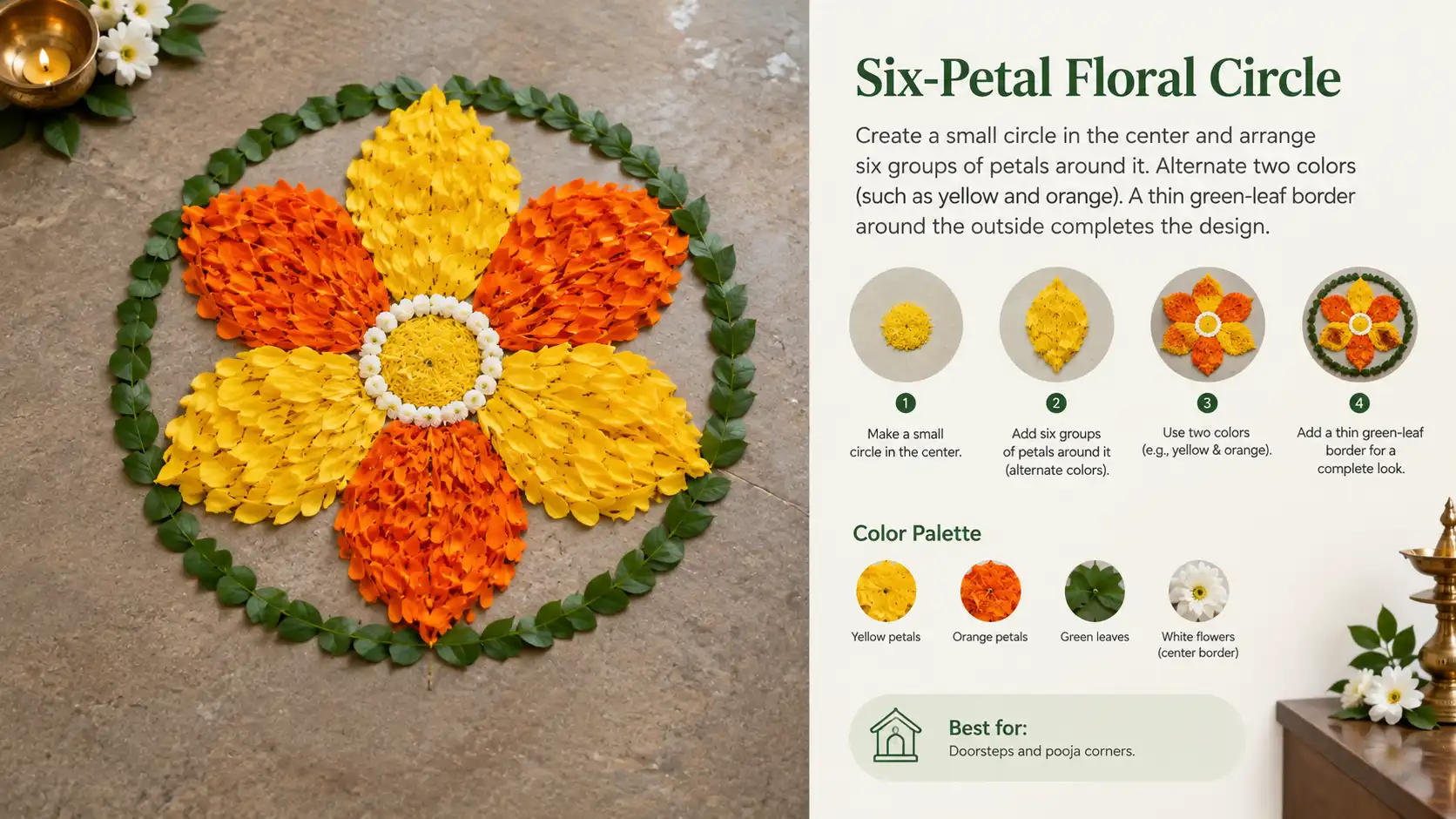
Create a small circle in the center and arrange six groups of petals around it.
Try alternating two colors, such as yellow and orange. The repeated pattern naturally creates a balanced appearance.
A thin green-leaf border around the outside can make the design look more complete.
Doorsteps and pooja corners.
3. Marigold and Leaf Rangoli
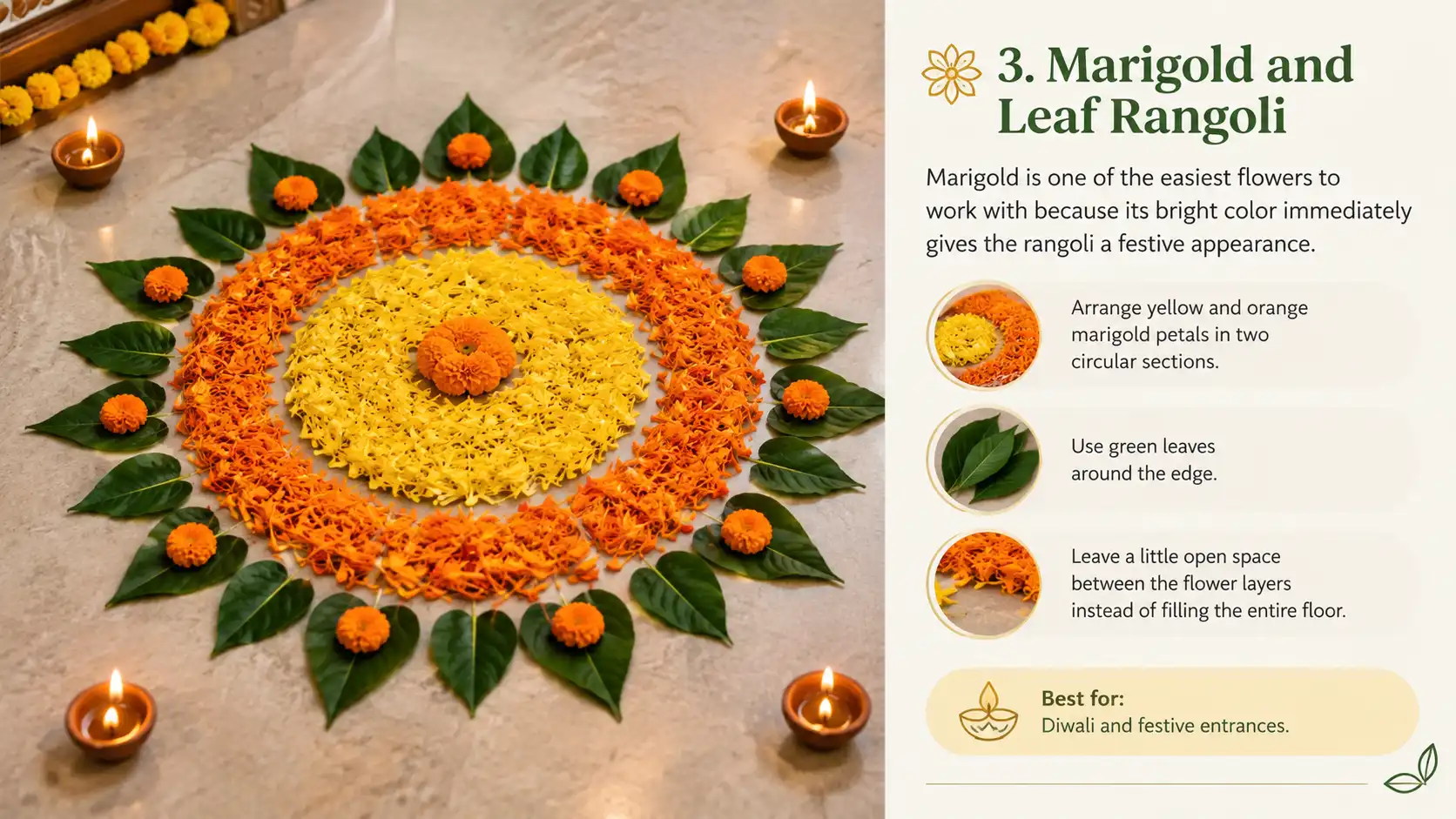
Marigold is one of the easiest flowers to work with because its bright color immediately gives the rangoli a festive appearance.
Arrange yellow and orange marigold petals in two circular sections and use green leaves around the edge.
You can also leave a little open space between the flower layers instead of filling the entire floor.
Diwali and festive entrances.
4. Rose Petal Flower Rangoli
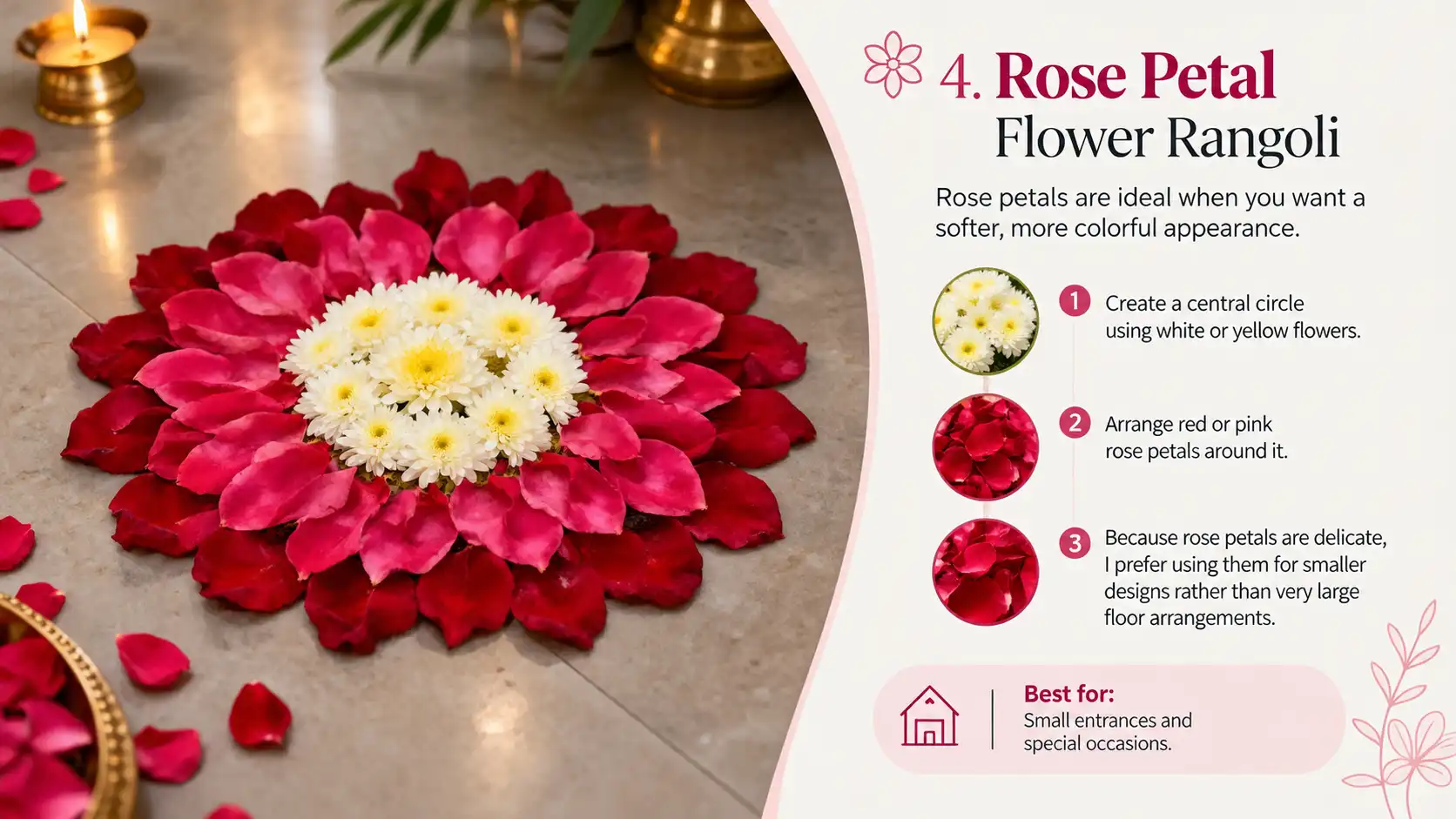
Rose petals are ideal when you want a softer, more colorful appearance.
Create a central circle using white or yellow flowers, then arrange red or pink rose petals around it.
Because rose petals are delicate, I prefer using them for smaller designs rather than very large floor arrangements.
Small entrances and special occasions.
5. Lotus Flower Rangoli
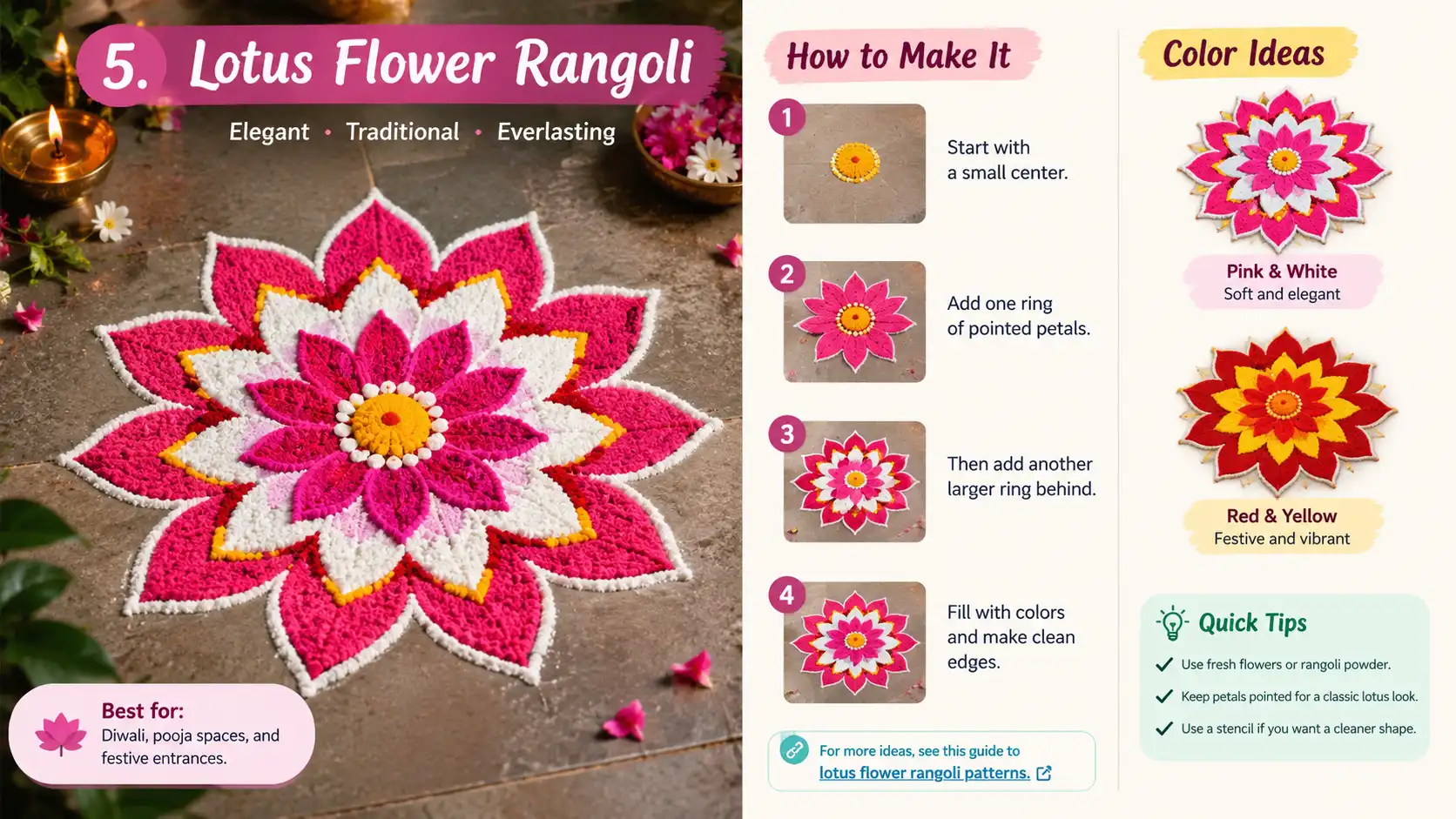
The lotus is one of my favorite floral shapes because the layered petals naturally create a beautiful rangoli.
Start with a small center. Add one ring of pointed petals and then another larger ring behind it.
You can use pink and white flowers for a soft appearance or red and yellow for a more festive design.
For more ideas, see this guide to lotus flower rangoli patterns.
Diwali, pooja spaces, and festive entrances.
6. Flower Rangoli With a Central Diya
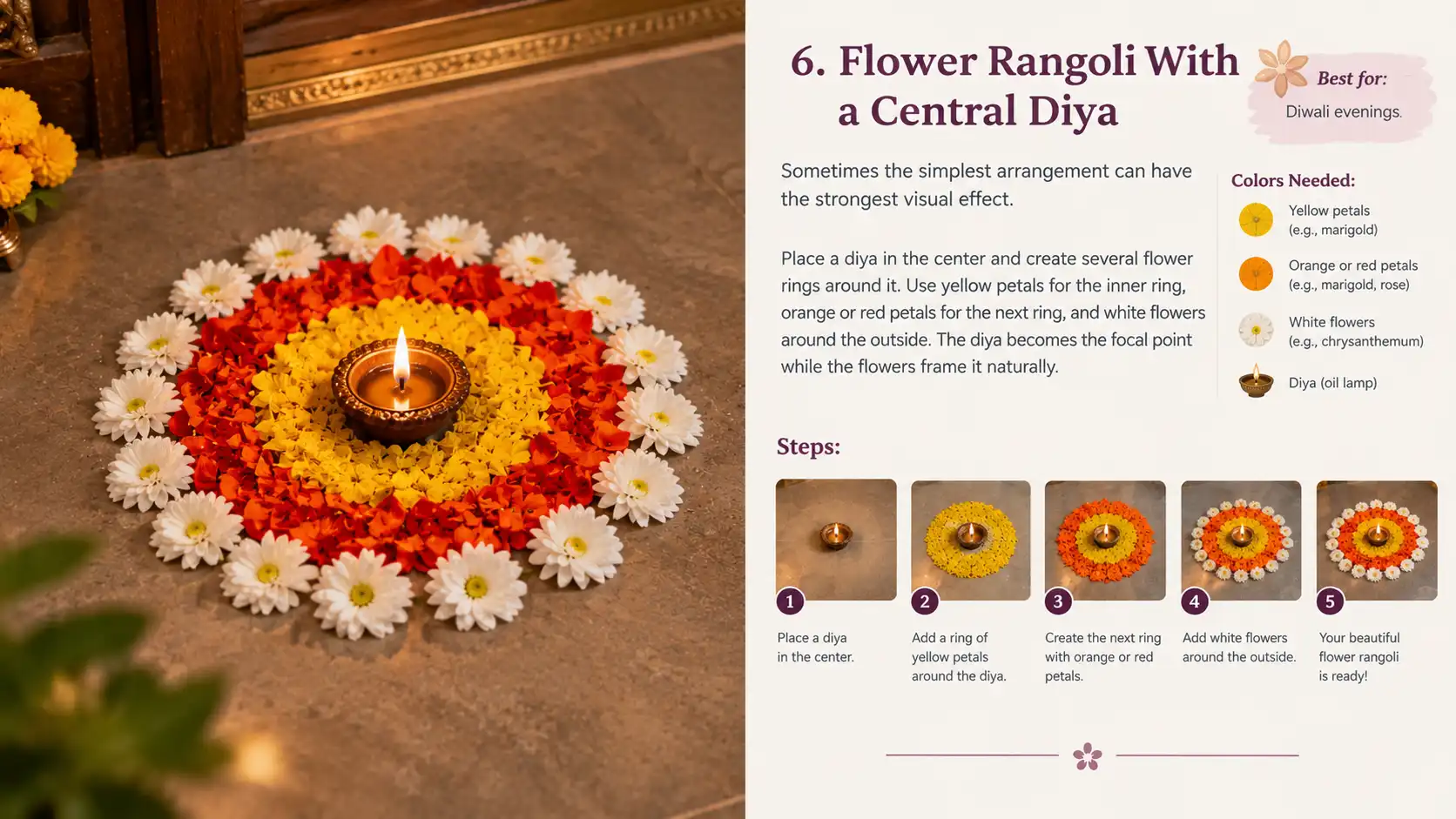
Sometimes the simplest arrangement can have the strongest visual effect.
Place a diya in the center and create several flower rings around it. Use yellow petals for the inner ring, orange or red petals for the next ring, and white flowers around the outside.
The diya becomes the focal point while the flowers frame it naturally.
Diwali evenings.
7. Floral Mandala Rangoli
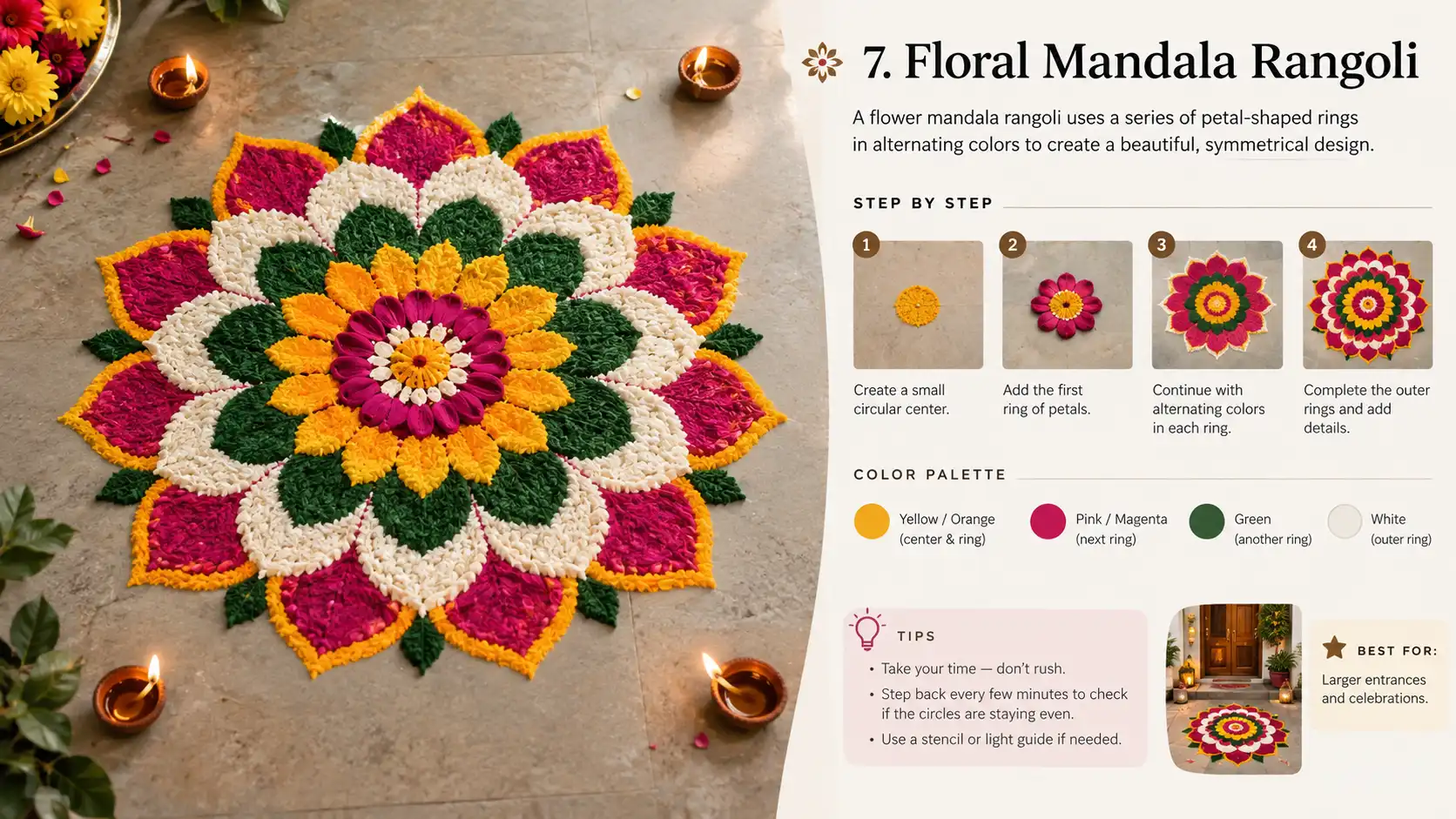
If you want something slightly more detailed, try a flower mandala.
Begin with a small circular center and gradually add symmetrical rings of petals. Alternate colors between the rings to make each layer easy to see.
The key here is not to rush. Step back every few minutes and check whether the circles are staying reasonably even.
Larger entrances and celebrations.
8. Teardrop Flower Rangoli
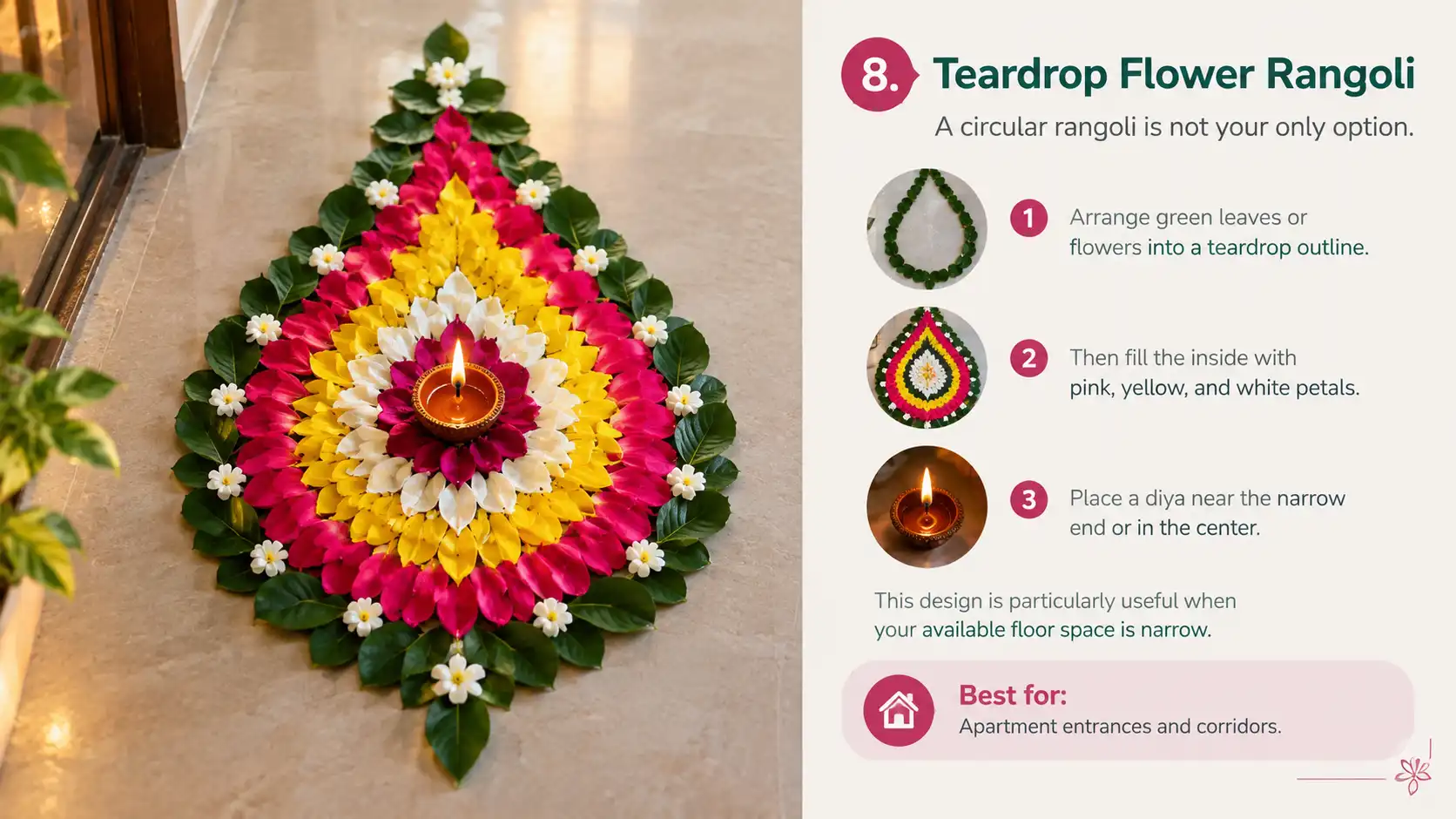
A circular rangoli is not your only option.
Arrange green leaves or flowers into a teardrop outline, then fill the inside with pink, yellow, and white petals.
Place a diya near the narrow end or in the center.
Apartment entrances and corridors.
9. Flower Border Rangoli
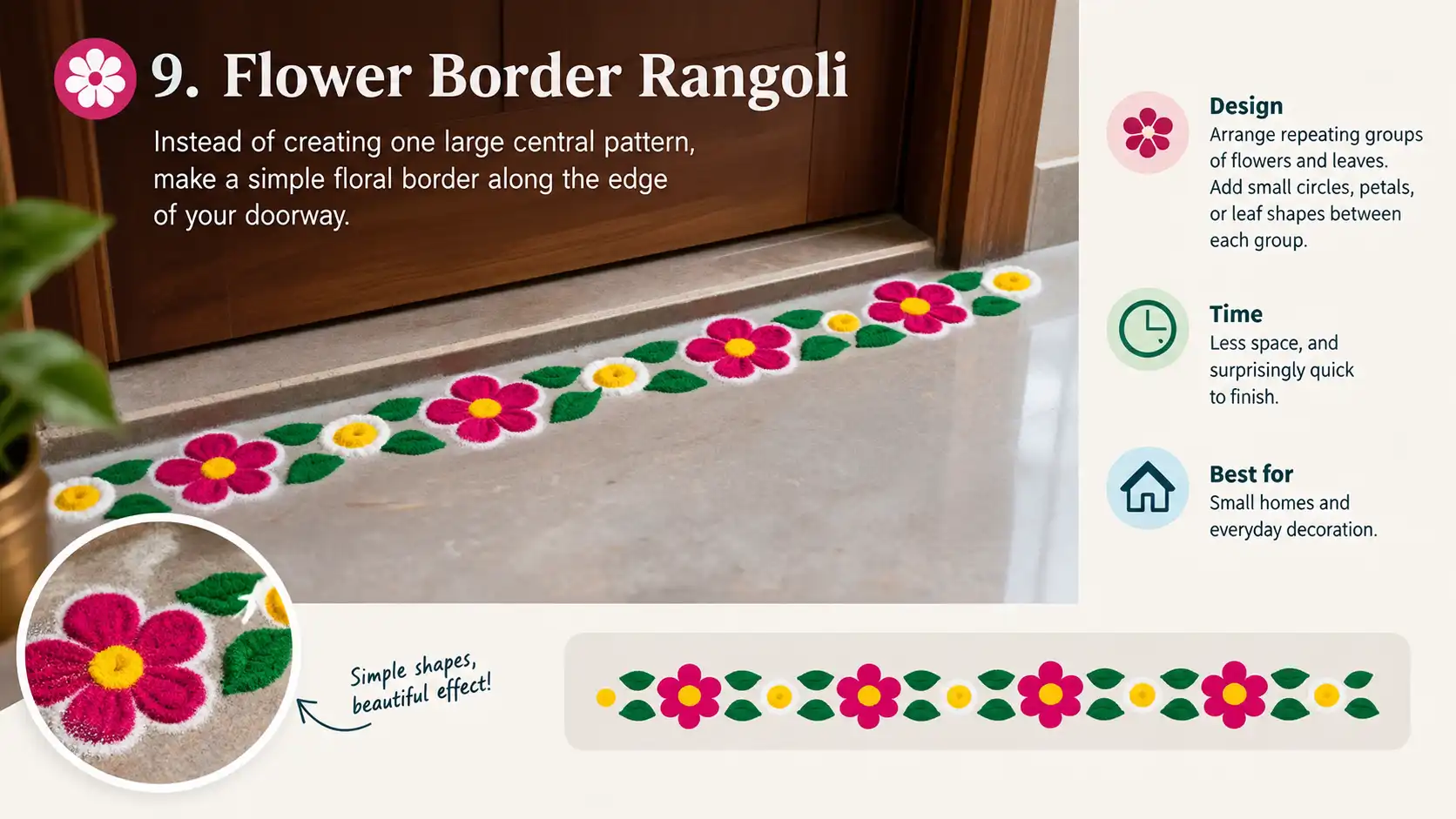
Instead of creating one large central pattern, make a simple floral border along the edge of your doorway.
Arrange repeating groups of flowers and leaves. You can create small circles, petals, or leaf shapes between each group.
This style takes less space and can be surprisingly quick to finish.
Small homes and everyday decoration.
10. Two-Color Flower Rangoli
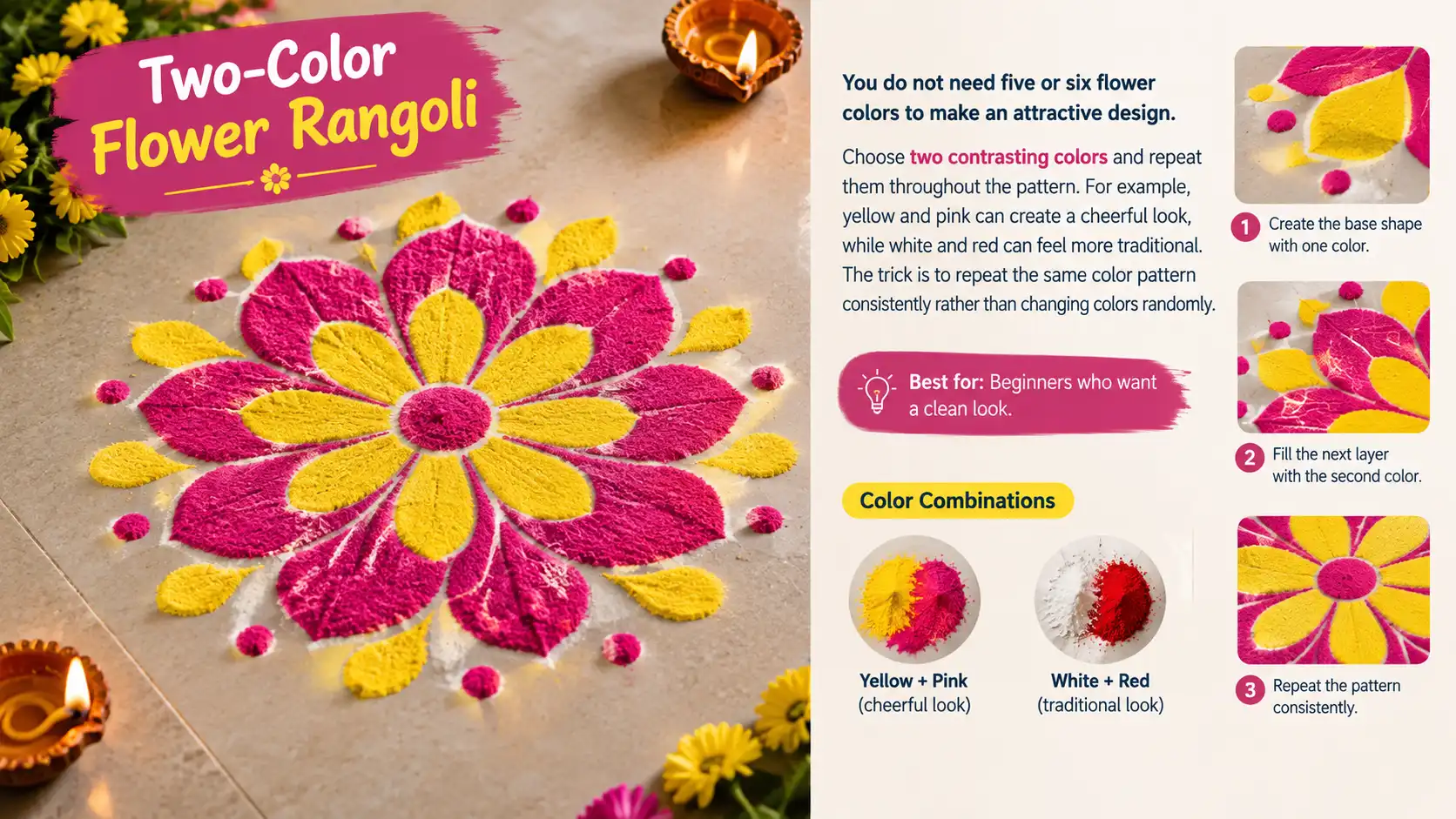
You do not need five or six flower colors to make an attractive design.
Choose two contrasting colors and repeat them throughout the pattern.
For example, yellow and pink can create a cheerful look, while white and red can feel more traditional.
The trick is to repeat the same color pattern consistently rather than changing colors randomly.
Beginners who want a clean look.
11. Flower and Diya Trail
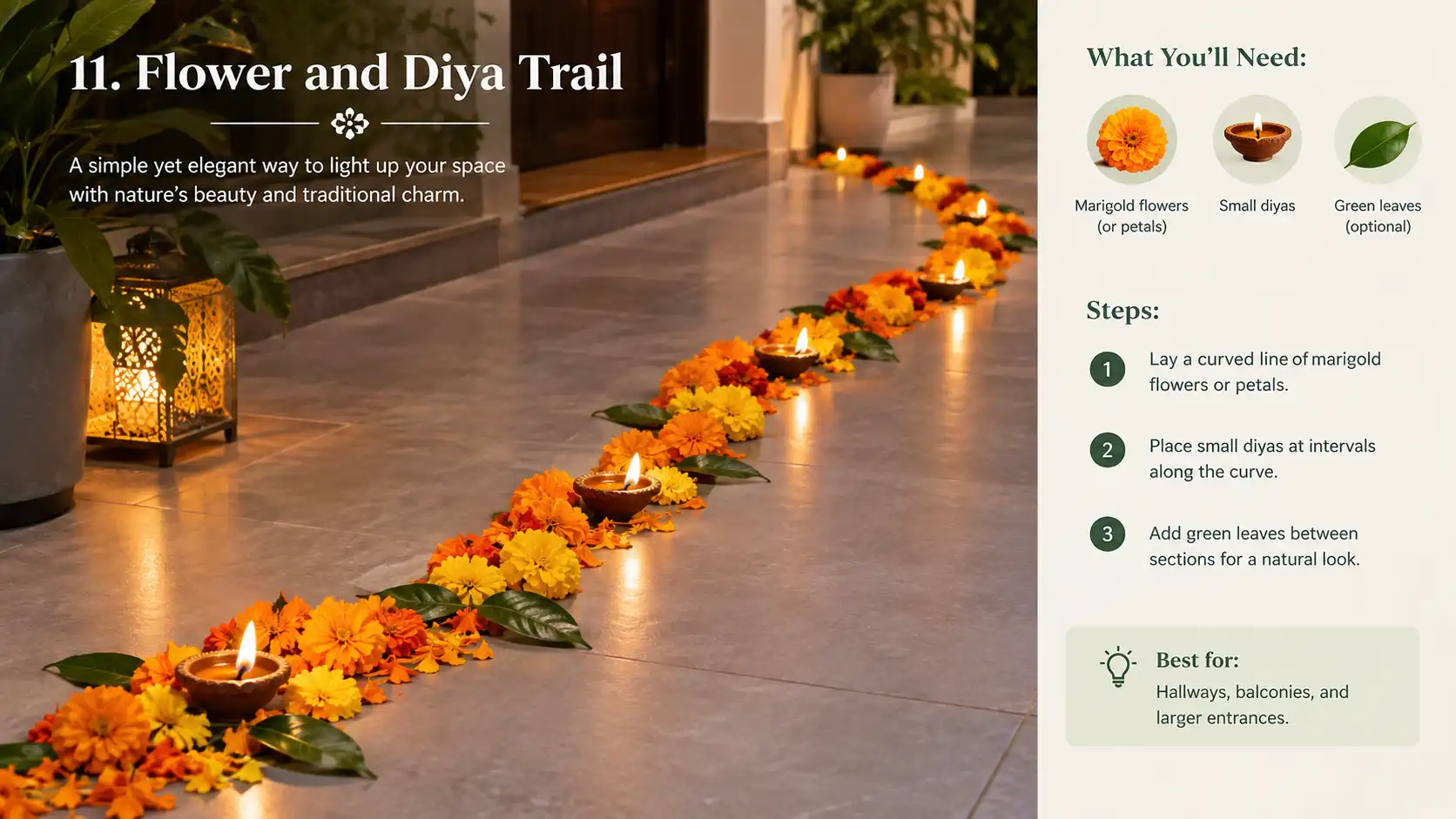
For a different approach, create a curved trail of flowers rather than a large circular rangoli.
Lay down a line of marigold flowers or petals and place small diyas at intervals along the curve.
You can add green leaves between sections to give the trail a more natural appearance.
Hallways, balconies, and larger entrances.
12. Small Daily Flower Rangoli
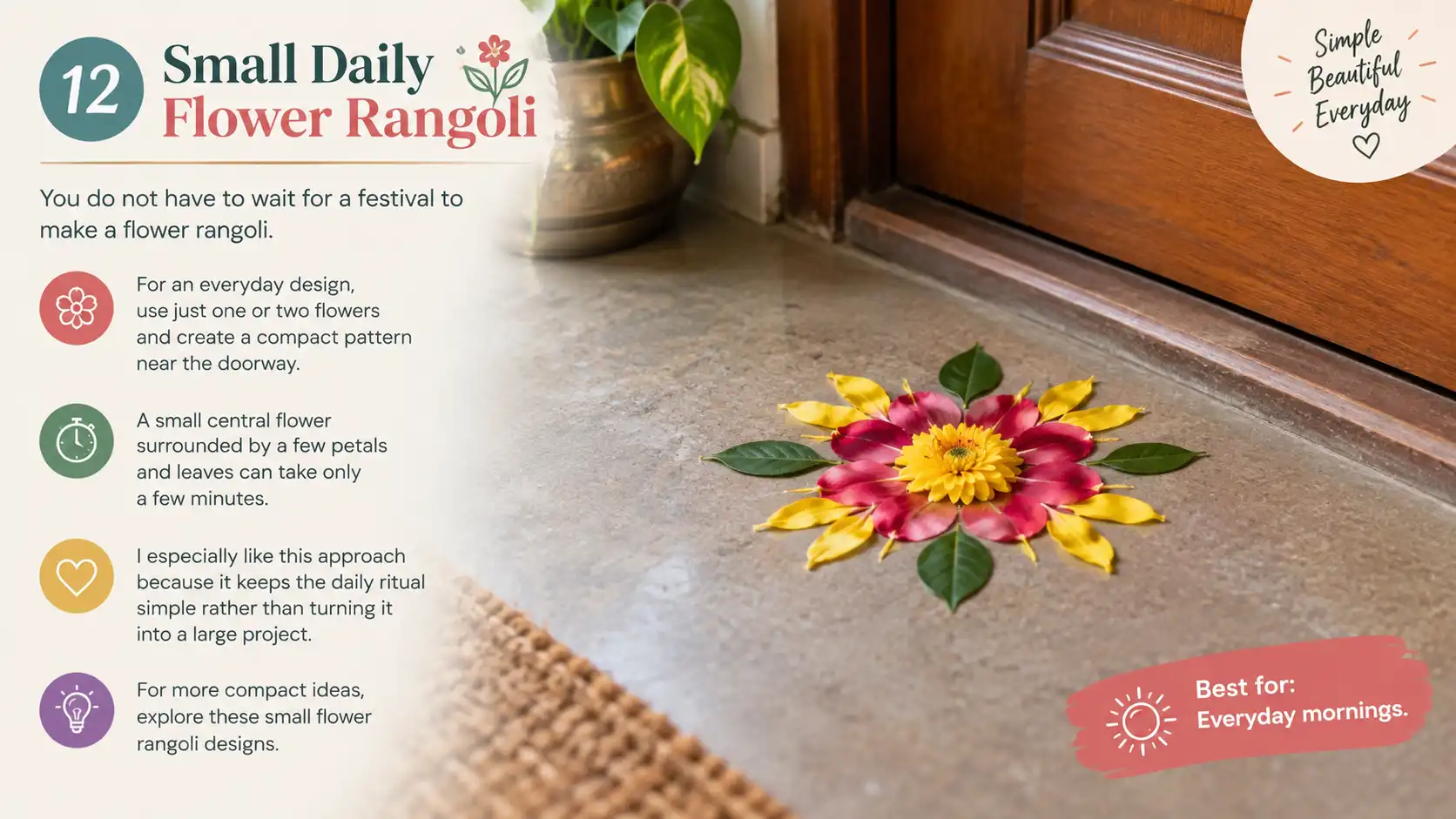
You do not have to wait for a festival to make a flower rangoli.
For an everyday design, use just one or two flowers and create a compact pattern near the doorway.
A small central flower surrounded by a few petals and leaves can take only a few minutes.
I especially like this approach because it keeps the daily ritual simple rather than turning it into a large project.
For more compact ideas, explore these small flower rangoli designs.
Everyday mornings.
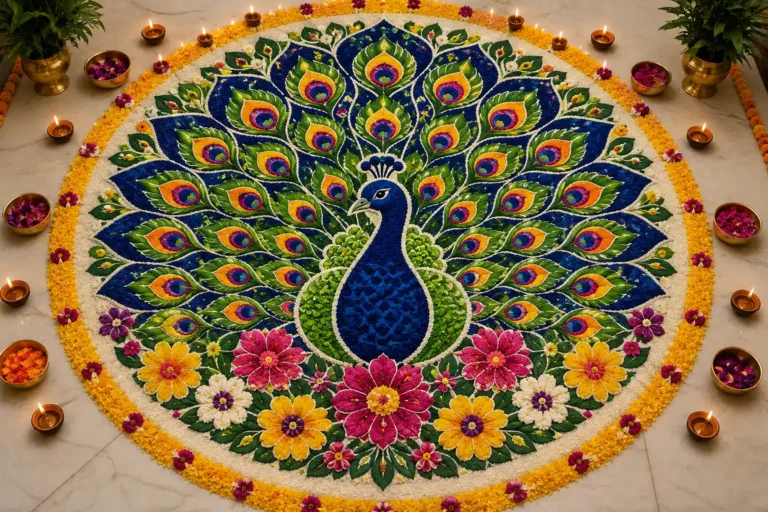
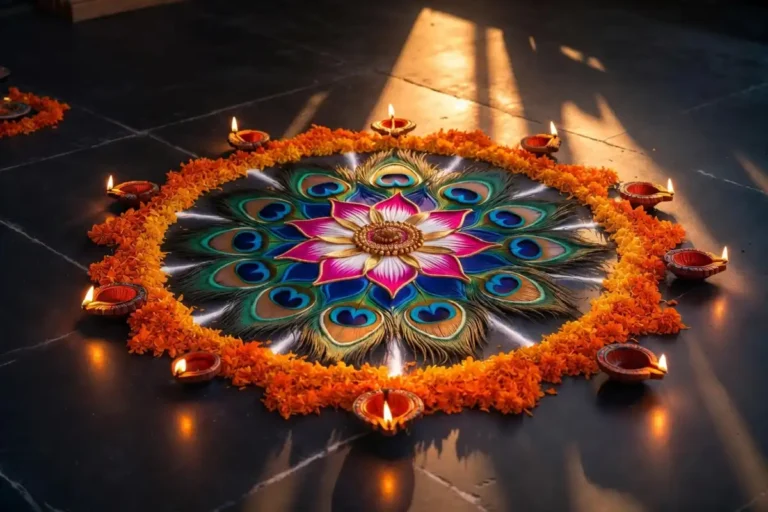
13. Peacock-Inspired Flower Rangoli
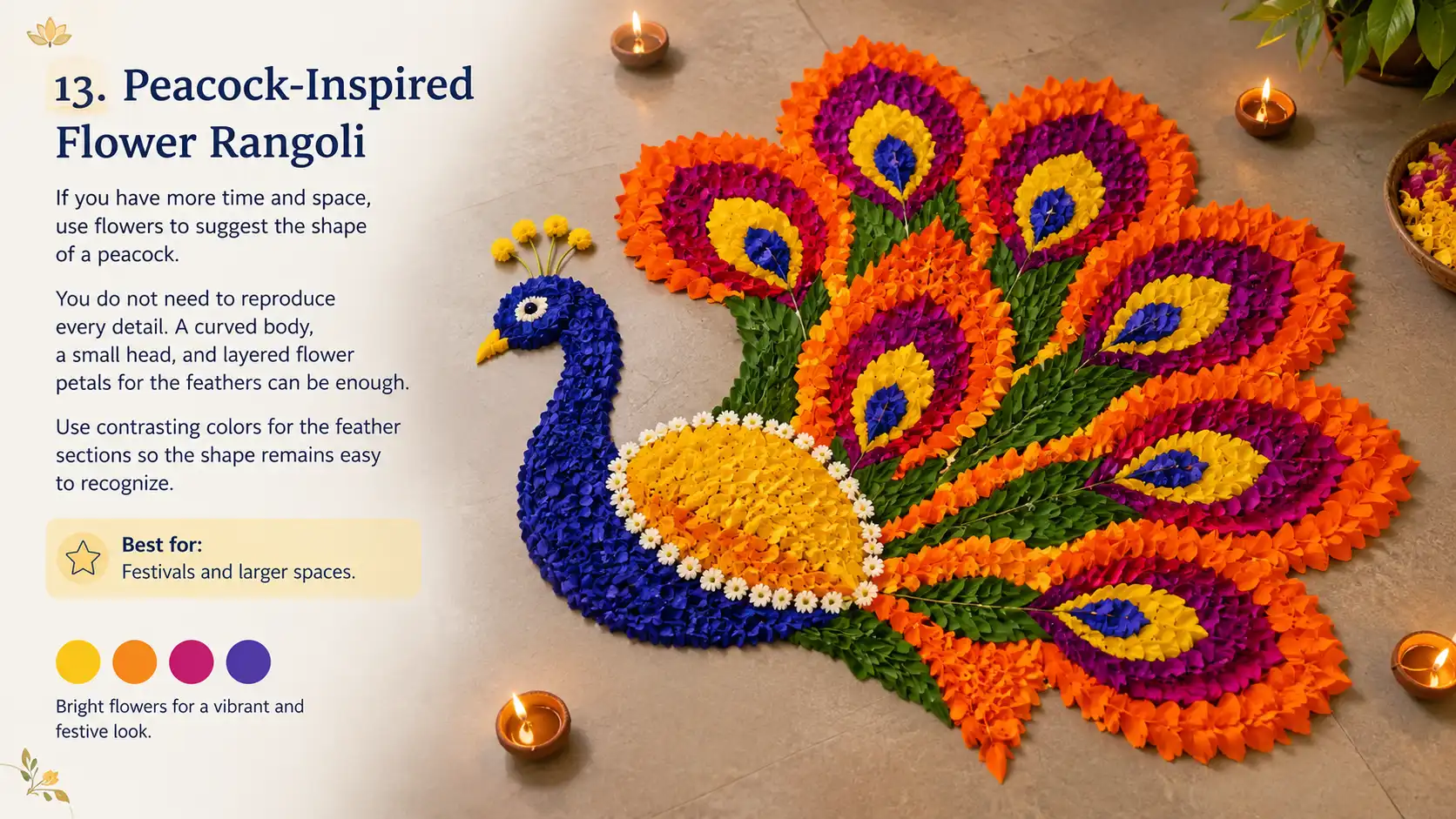
If you have more time and space, use flowers to suggest the shape of a peacock.
You do not need to reproduce every detail. A curved body, a small head, and layered flower petals for the feathers can be enough.
Use contrasting colors for the feather sections so the shape remains easy to recognize.
Festivals and larger spaces.
14. Flower Swastik Rangoli
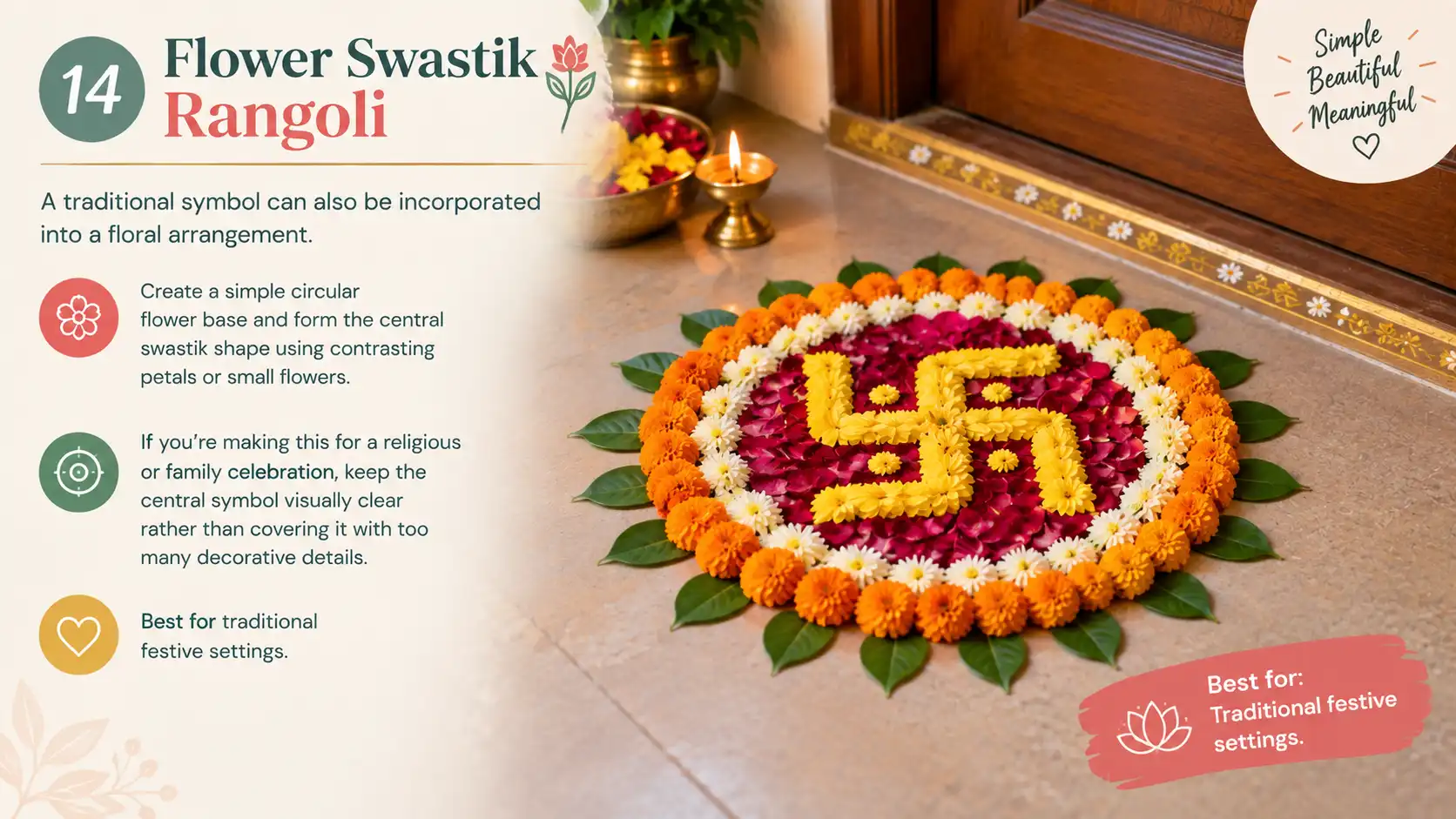
A traditional symbol can also be incorporated into a floral arrangement.
Create a simple circular flower base and form the central swastik shape using contrasting petals or small flowers.
If you are making this for a religious or family celebration, keep the central symbol visually clear rather than covering it with too many decorative details.
Traditional festive settings.
15. Mixed Flower Rangoli With Leaves
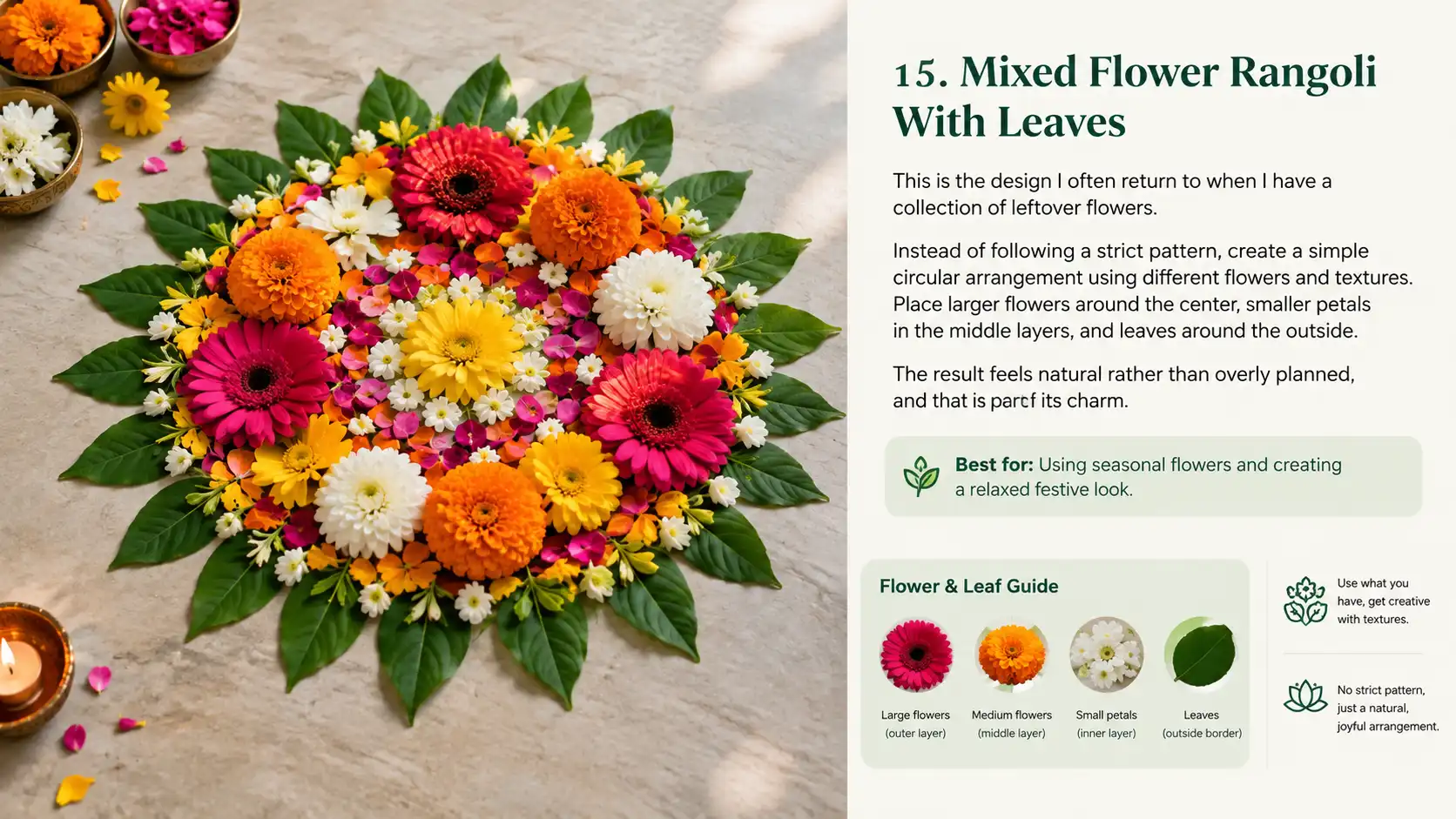
This is the design I often return to when I have a collection of leftover flowers.
Instead of following a strict pattern, create a simple circular arrangement using different flowers and textures.
Place larger flowers around the center, smaller petals in the middle layers, and leaves around the outside.
The result feels natural rather than overly planned, and that is part of its charm.
Using seasonal flowers and creating a relaxed festive look.
7 Tips to Make Flower Rangoli Look Neater
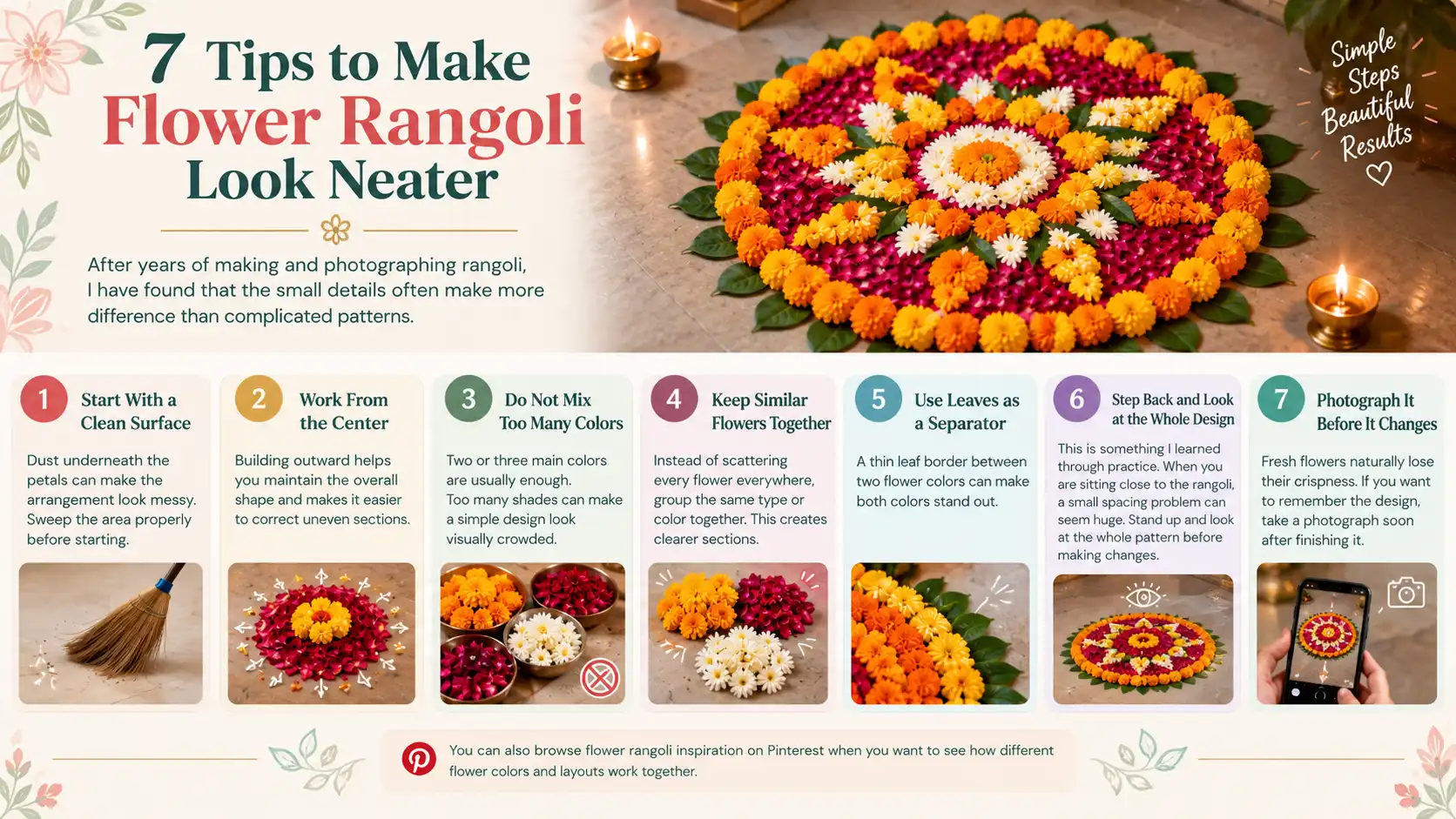
After years of making and photographing rangoli, I have found that the small details often make more difference than complicated patterns.
Start With a Clean Surface
Dust underneath the petals can make the arrangement look messy. Sweep the area properly before starting.
Work From the Center
Building outward helps you maintain the overall shape and makes it easier to correct uneven sections.
Do Not Mix Too Many Colors
Two or three main colors are usually enough. Too many shades can make a simple design look visually crowded.
Keep Similar Flowers Together
Instead of scattering every flower everywhere, group the same type or color together. This creates clearer sections.
Use Leaves as a Separator
A thin leaf border between two flower colors can make both colors stand out.
Step Back and Look at the Whole Design
When you are sitting close to the rangoli, a small spacing problem can seem huge. Stand up and look at the whole pattern before making changes.
Photograph It Before It Changes
Fresh flowers naturally lose their crispness. If you want to remember the design, take a photograph soon after finishing it.
You can also browse flower rangoli inspiration on Pinterest when you want to see how different flower colors and layouts work together.
Common Mistakes to Avoid
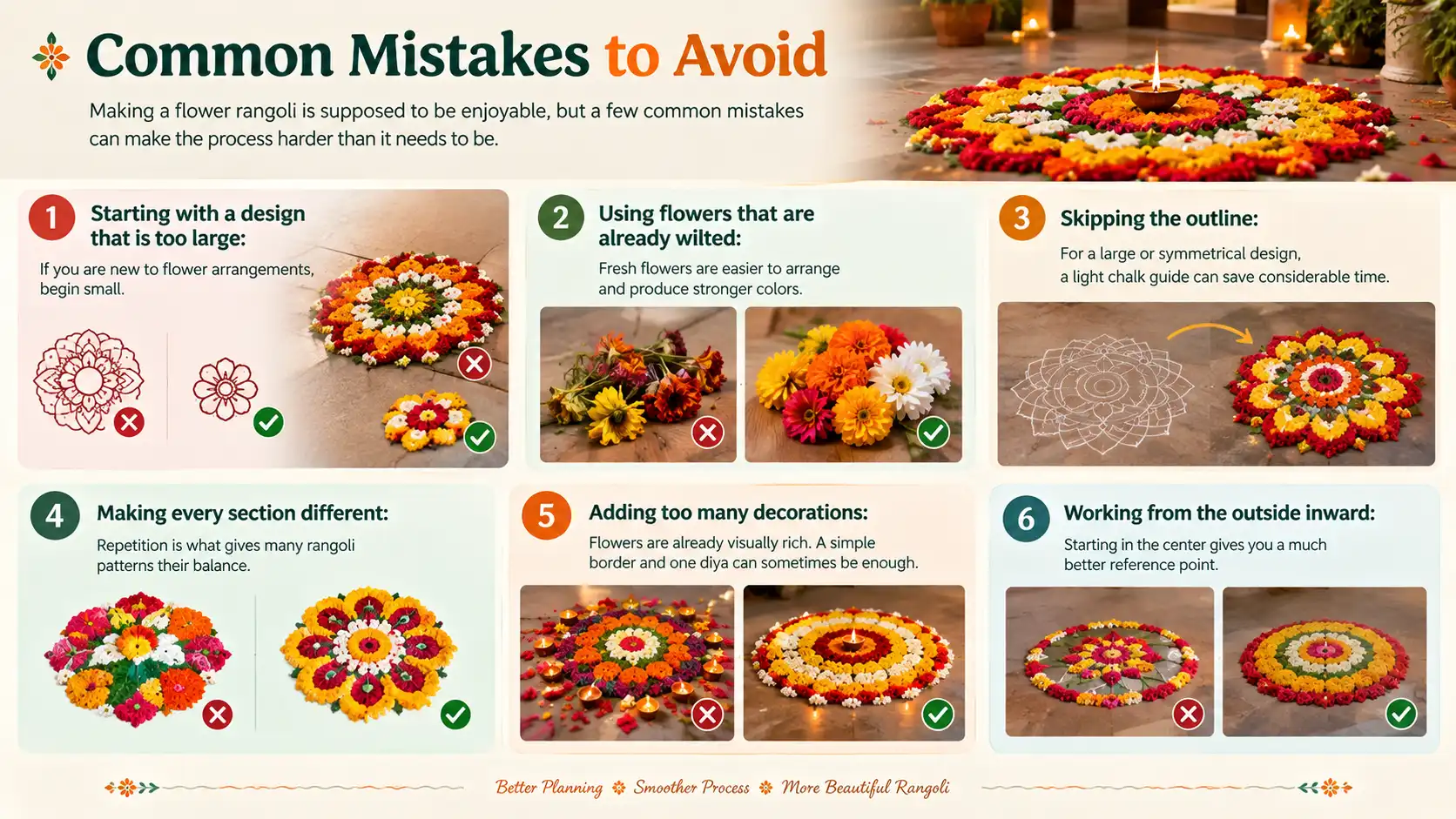
Making a flower rangoli is supposed to be enjoyable, but a few common mistakes can make the process harder than it needs to be.
- Starting with a design that is too large: If you are new to flower arrangements, begin small.
- Using flowers that are already wilted: Fresh flowers are easier to arrange and produce stronger colors.
- Skipping the outline: For a large or symmetrical design, a light chalk guide can save considerable time.
- Making every section different: Repetition is what gives many rangoli patterns their balance.
- Adding too many decorations: Flowers are already visually rich. A simple border and one diya can sometimes be enough.
- Working from the outside inward: Starting in the center gives you a much better reference point.
How Long Does It Take to Make a Flower Rangoli?
The time depends mainly on the size and complexity of your design.
Around 10 to 15 minutes.
Around 20 to 40 minutes.
An hour or more.
If this is your first attempt, give yourself extra time. The more you practice, the faster you will become at judging spacing and arranging petals.
Can You Make Flower Rangoli Without Fresh Flowers?
Fresh flowers are not required to create a floral-inspired rangoli.
If fresh flowers are not available, you can create a floral rangoli using colored rangoli powder. Draw flower shapes and fill them with different colors, or combine powder outlines with a few real petals.
You can also use dried petals for certain decorative arrangements.
The basic principle remains the same: start with a central shape, repeat the pattern outward, and use color and spacing to create balance.
After eight years of drawing, trying, and documenting rangoli, I still think the simplest flower designs are some of the most enjoyable to make.
A few petals around a doorway can become a small tradition worth looking forward to.
From Simple Petals to a Lasting Tradition
I have seen how a few petals placed around a doorway can change the feeling of a space. And whenever I work with flowers, I am reminded of those early mornings in Kolkata when I would sit on the steps and watch my mother and grandmother work quietly before the day began.
That is what I like most about flower rangoli. It does not ask for perfection. You can make a tiny design with five petals or spend an hour creating a layered floral mandala. Both can feel equally special when you make them yourself.
And perhaps, just like it happened with me, the design you make today will become a small tradition you look forward to tomorrow.
FAQs
What flowers are best for making flower rangoli?
Marigold, rose, jasmine, and chrysanthemum are popular choices for flower rangoli. Marigold is especially beginner-friendly because its petals are sturdy, colorful, and easy to arrange.
How do you make flower rangoli for beginners?
Start by cleaning the floor and marking a small center point. Arrange petals around the center, build outward in simple layers, and finish with leaves or a border. Two or three colors are usually enough for a beginner design.
Can I make flower rangoli without rangoli powder?
Yes. You can make a complete flower rangoli using fresh petals, whole flowers, and leaves. Rangoli powder is optional and can be added when you want sharper outlines or extra details.
How long does a fresh flower rangoli last?
A fresh flower rangoli generally looks best for several hours. Keeping it in a cool, shaded area and lightly misting the petals can help maintain their freshness for longer.
What is the easiest flower rangoli design to make?
A simple circular design with two flower colors is one of the easiest options for beginners. You can start with a small center, add one or two petal rings, and finish with a thin leaf or flower border.
Start With One Simple Flower
Choose two colors, add a few leaves, and build your rangoli outward slowly. Simple petals can become beautiful patterns with a little practice.