Symmetrical Rangoli Design Ideas for Every Festival
Symmetrical Rangoli Design Ideas for Every Festival
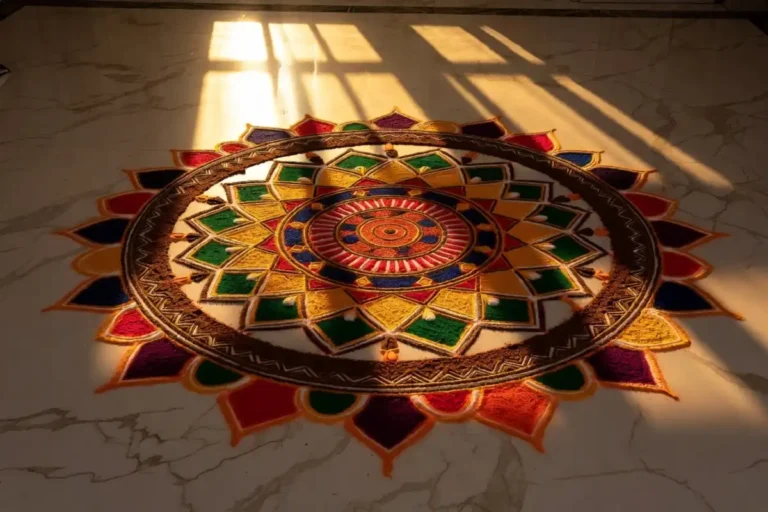
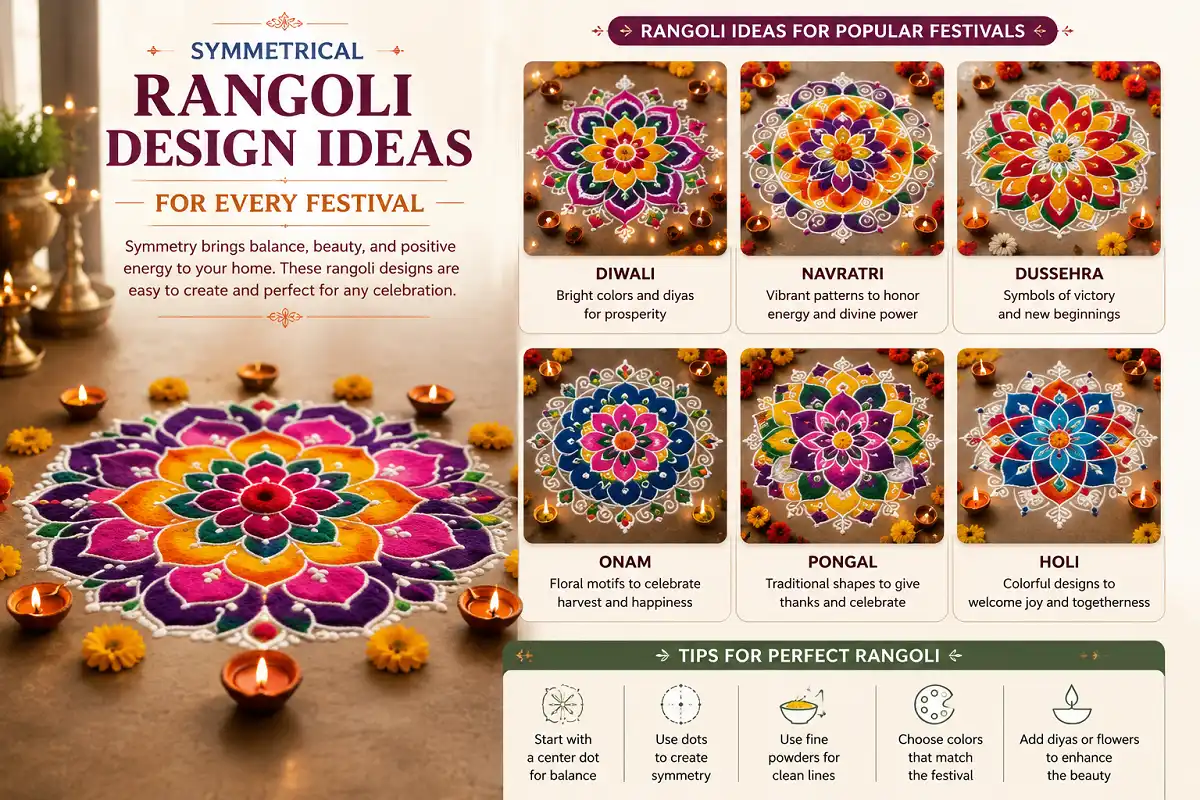
Symmetrical rangoli designs can turn an ordinary floor into a beautifully balanced piece of traditional art. When shapes, lines, dots, and colors repeat evenly around a center or mirror each other across a line, the finished pattern immediately feels more polished.
The easiest way to create symmetrical rangoli design ideas is to begin with a fixed center and build the pattern outward. A simple dot grid can help you keep the spacing consistent while you repeat one section around the design.
Fix the center, keep the spacing equal, create one clean section, then repeat or mirror it throughout the rangoli.
What Makes a Rangoli Design Symmetrical?
A rangoli is symmetrical when its shapes and spacing are balanced around a line or a central point. If you imagine folding the design through its middle, matching sections should line up closely in shape, size, and position.
Good symmetry depends on three simple foundations: a clearly defined center, evenly spaced reference points, and repeated shapes or angles. If one of these elements shifts, the finished pattern can begin to look uneven.
Why Symmetry Matters in Rangoli Art
Symmetry gives rangoli a natural sense of order and completeness. Repeated petals, lines, triangles, leaves, and borders create a rhythm that makes the eye move smoothly across the entire design.
A balanced pattern is especially effective near entrances because it can look organized from different viewing angles. Symmetrical rangoli is commonly adapted for festivals, weddings, housewarmings, pooja spaces, and everyday decoration.
Balanced Appearance
Repeated shapes give the floor design a naturally organized look.
Easier Planning
You can perfect one section and use it as the model for the others.
Festival Ready
The same structure can be enlarged for Diwali and other celebrations.
Types of Symmetry You Can Use in Rangoli
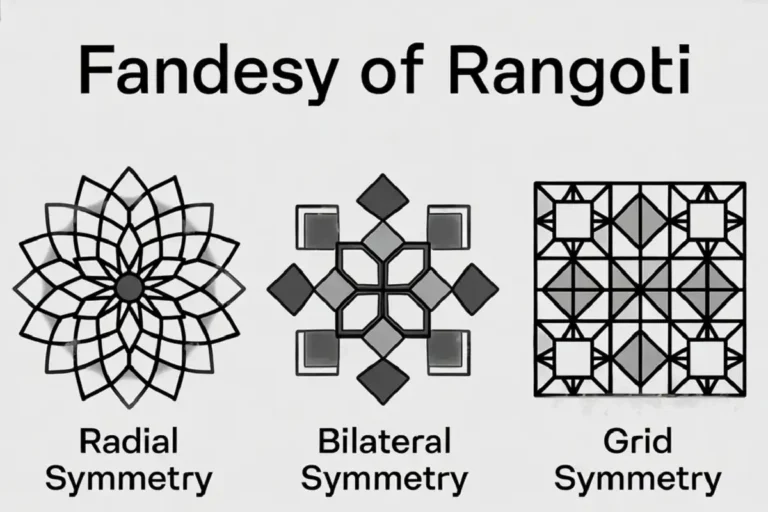
Three symmetry approaches are especially useful when planning rangoli: radial, bilateral, and grid symmetry. Each creates a different visual structure while following the same principle of balanced repetition.
Radial Symmetry
Radial symmetry spreads a motif around a central point. Petals, triangles, leaves, and other shapes can be repeated four, six, eight, or more times to create a mandala-like appearance.
Bilateral Symmetry
Bilateral symmetry mirrors one side across a straight line. It works particularly well for rectangular entrances, borders, floral arrangements, and designs where a clear left and right side is desired.
Grid Symmetry
Grid symmetry uses evenly positioned dots in rows and columns. Squares, diamonds, stars, and geometric patterns can then be built directly from those reference points.
How to Plan Symmetrical Rangoli Using Dots
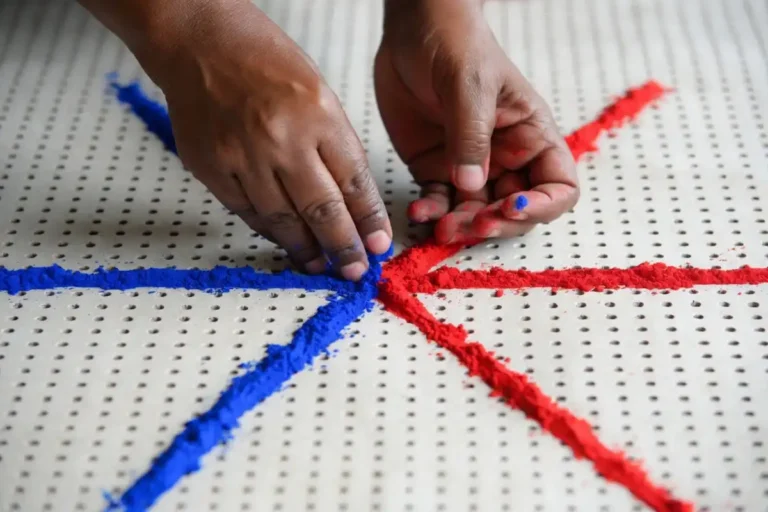
A dot grid removes much of the guesswork from symmetrical rangoli. Instead of estimating every distance by eye, use the dots as anchor points for the outline and repeated motifs.
Mark the Center
Place the central dot first because it becomes the reference point for the entire design.
Build Equal Rows
Add the same number of dots outward in each direction while keeping the distance between them consistent.
Create One Section
Draw a single petal, triangle, curve, or geometric unit between your reference points.
Repeat the Pattern
Copy or rotate the same section around the center instead of designing every section separately.
Check Before Coloring
Compare opposite sections and correct uneven lines before adding colored powder.
Simple Symmetrical Rangoli Design Ideas for Beginners
If you are new to symmetry, start with a small design instead of trying to fill a large floor immediately. A 5×5 dot grid can provide enough structure to practice the basic idea without becoming overwhelming.
Four-Petal Flower
Repeat one simple petal at four equal positions around the center.
Quarter-Turn Pattern
Draw one simple line or motif and repeat it after each 90-degree turn.
Circle and Triangles
Place a small circle in the center and surround it with evenly spaced triangles.
Increase the dot count only after you are comfortable keeping smaller patterns balanced.
Symmetrical Rangoli Design Ideas With Geometric Shapes
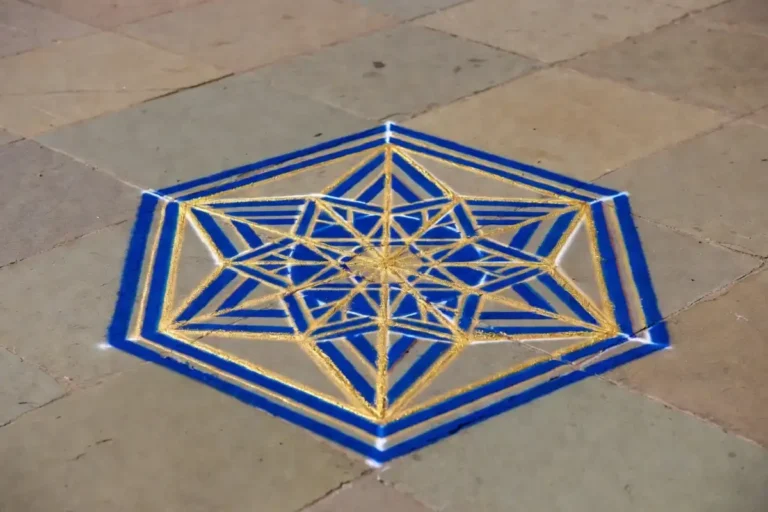
Geometric shapes are excellent for symmetry because their straight edges, repeated angles, and defined proportions make mistakes easier to spot. Squares, triangles, diamonds, and hexagons can all be repeated around a center point.
A hexagonal composition is especially effective for radial symmetry. Once one triangular or leaf-like section is created inside the hexagon, the same unit can be repeated around the center to produce a detailed pattern without having to invent every section separately.
Square
Strong four-direction symmetry with clean corners.
Triangle
Useful for stars, borders, and repeating geometric units.
Diamond
Creates a dynamic pattern while maintaining a centered structure.
Hexagon
A natural foundation for six-fold radial compositions.
Symmetrical Rangoli Design Ideas for Diwali and Festivals
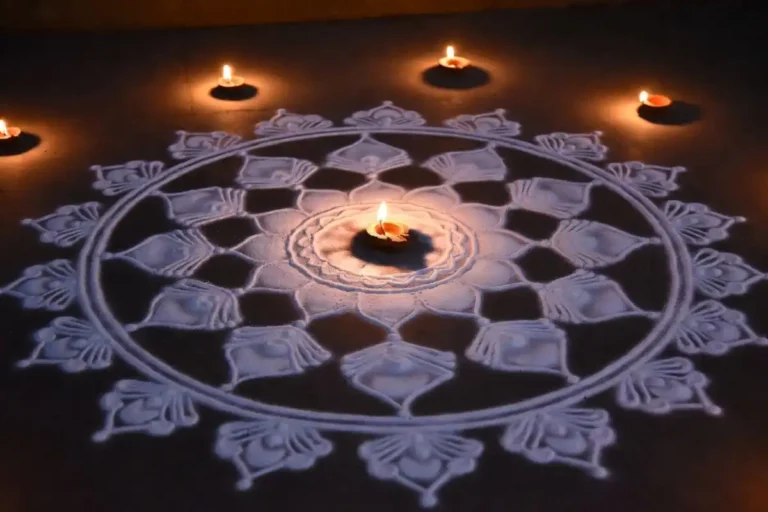
Larger festival rangoli can use the same symmetry principles as small beginner patterns. The difference is that a larger surface gives you room for layered borders, detailed centers, multiple motifs, and richer color combinations.
For Diwali, a lotus, diya, or geometric centerpiece can sit in the middle while two or three symmetrical borders expand outward. Each border can follow its own repeating pattern while remaining aligned with the main composition.
Layered Borders
Combine a strong center with repeated outer borders and diya-inspired details.
Floral Symmetry
Use softer floral motifs, petals, leaves, and balanced circular arrangements.
Welcoming Patterns
Choose centered designs that frame the entrance without overcrowding the walkway.
Grid Geometry
Dot grids, geometric repetition, and traditional white flour patterns work particularly well.
Tools That Help You Keep Rangoli Symmetrical
You can create symmetrical rangoli completely by hand, but a few simple tools can make spacing and repetition easier, especially for larger designs.
Dot Stencil
Helps create evenly spaced dots quickly before drawing the pattern.
String and Chalk
Useful for creating clean circles around a fixed central point.
Rangoli Comb
Helps produce consistent parallel lines for structured borders.
Measuring Tape
Useful for checking the spacing of larger outer dots and borders.
Common Mistakes That Break Symmetry
Uneven Dot Spacing
If the first grid is uneven, every shape built from it can inherit the imbalance.
Moving the Center
A slightly misplaced center can make every repeated section appear shifted.
Copying Only by Eye
Counting dots and reference points is generally more reliable than estimating the second section visually.
Ignoring the Surface
An uneven or sloped floor can make an otherwise accurate pattern look distorted.
Try Square-Based Symmetrical Patterns
Once you are comfortable with a central dot and repeated motifs, square compositions are a natural next step. Their four equal sides make it easier to understand bilateral and four-direction symmetry.
Build From Four Equal Directions
Start with a central motif, establish the four main directions, then repeat the same shape in each section. Add a square border afterward to reinforce the structure.
Explore square rangoli design ideasPlan the Center, Then Repeat With Discipline
Symmetrical rangoli design ideas become much easier when you stop trying to create the whole pattern at once. Establish the center, create one section carefully, and use the same measurements or reference points for every repetition.
Frequently Asked Questions
01 Can symmetrical rangoli be made without dots?
02 Which symmetry type is best for small spaces?
03 Do symmetrical rangoli designs take longer to make?
04 What dot grid should a beginner start with?
05 Are geometric shapes good for symmetrical rangoli?
Start with a small grid, establish a clear center, and focus on repeating one simple shape accurately. Once the basic rhythm becomes familiar, you can scale the same method into larger geometric, floral, and festival rangoli designs.