Flower Rangoli Designs forCompetition: 15 Creative Ideas
There is something special about watching a rangoli slowly come to life. I grew up in Kolkata watching my mother and grandmother draw rangoli at our doorway every morning before sunrise. I would sit quietly on the steps and watch them place each dot, shape each curve, and fill the pattern with color. At that age, I did not realize I was watching a tradition that would eventually become such an important part of my own life.
Over the past eight years, I have been drawing, collecting, and photographing rangoli designs. I have tried simple patterns at home, experimented with different colors, and spent plenty of time learning how small changes in symmetry, spacing, and color can completely change the final look.
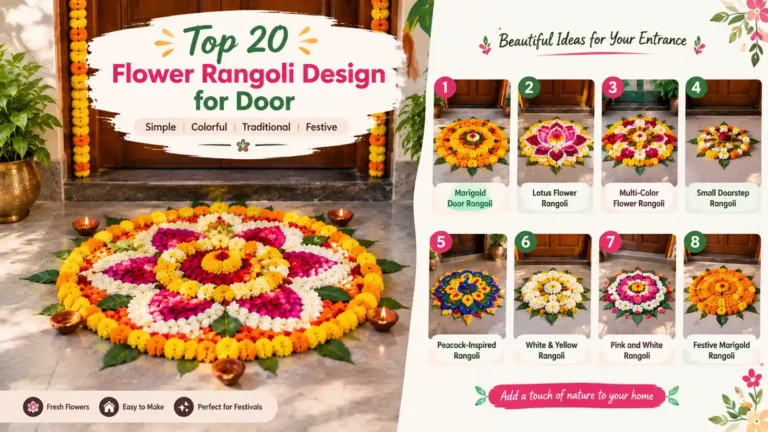
When it comes to a competition, however, a beautiful rangoli needs something more than bright colors. The design has to catch attention from a distance while still looking neat and balanced up close. That is why flower rangoli designs for competition are such a wonderful choice. Flowers give you endless possibilities, from simple petal patterns to large layered designs with lotus, roses, marigolds, leaves, and geometric details.
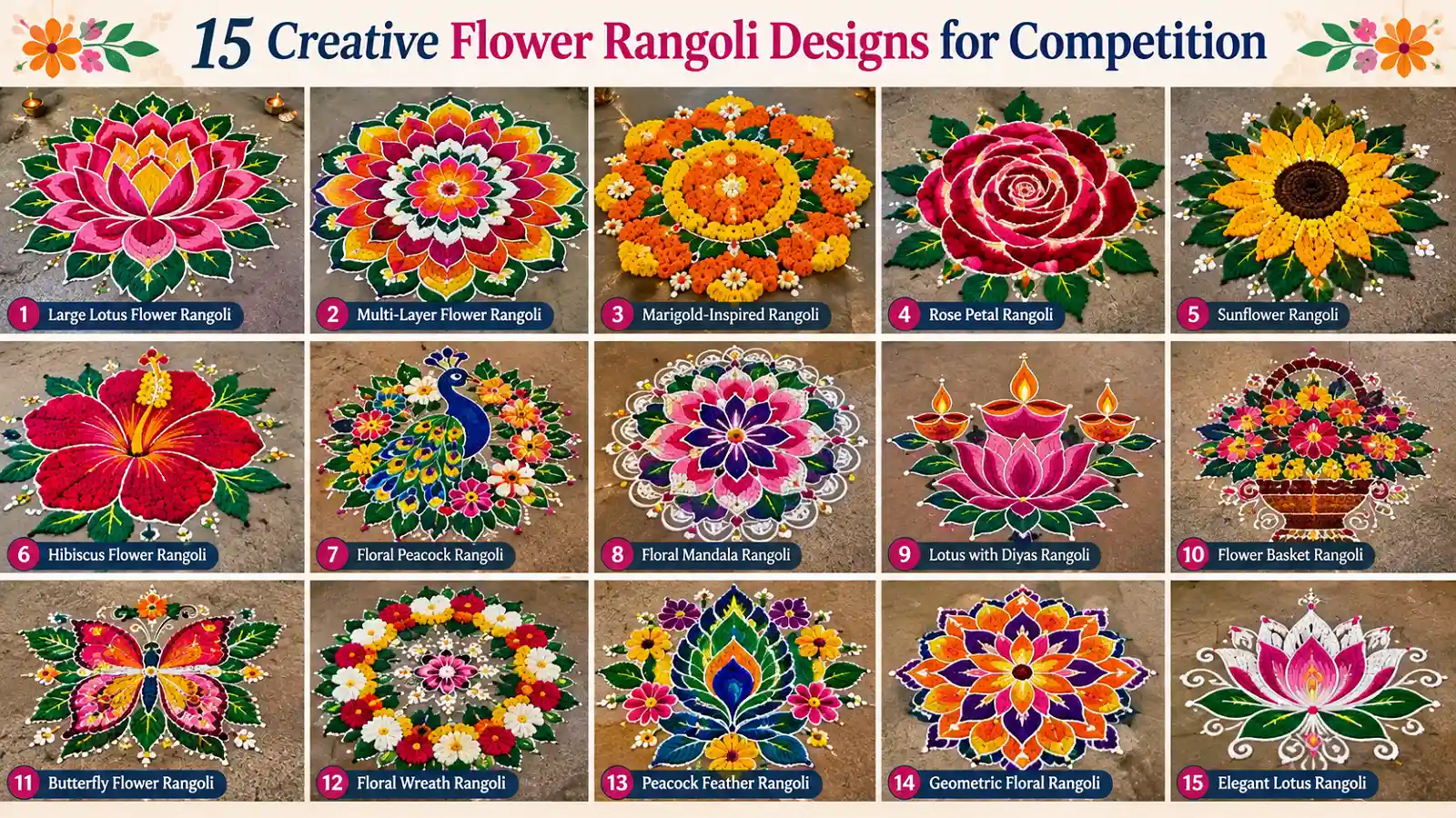
In this guide, I am sharing 15 creative flower rangoli ideas that you can consider for a rangoli competition. Some are relatively simple, while others are better suited to people who are comfortable working with larger and more detailed designs.
Why Choose a Flower Rangoli for a Competition?
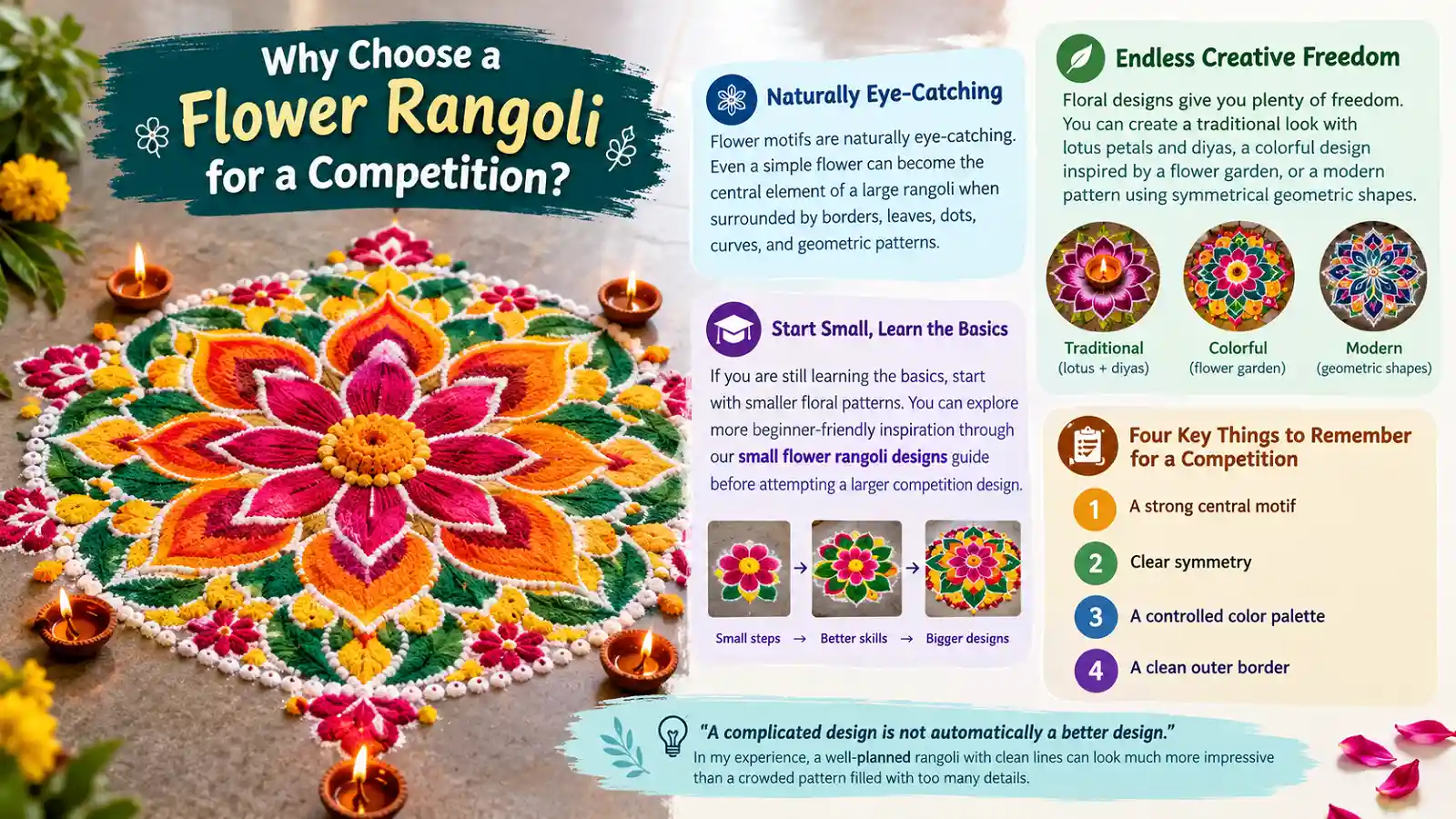
Flower motifs are naturally eye-catching. Even a simple flower can become the central element of a large rangoli when surrounded by borders, leaves, dots, curves, and geometric patterns.
I also like floral designs because they give you plenty of freedom. You can create a traditional look with lotus petals and diyas, a colorful design inspired by a flower garden, or a more modern pattern using symmetrical geometric shapes.
If you are still learning the basics, starting with smaller floral patterns can help. You can explore more beginner-friendly inspiration through our small flower rangoli designs guide before attempting a larger competition design.
- A strong central motif
- Clear symmetry
- A controlled color palette
- A clean outer border
A complicated design is not automatically a better design. In my experience, a well-planned rangoli with clean lines can look much more impressive than a crowded pattern filled with too many details.
15 Flower Rangoli Designs for Competition
1. Large Lotus Flower Rangoli
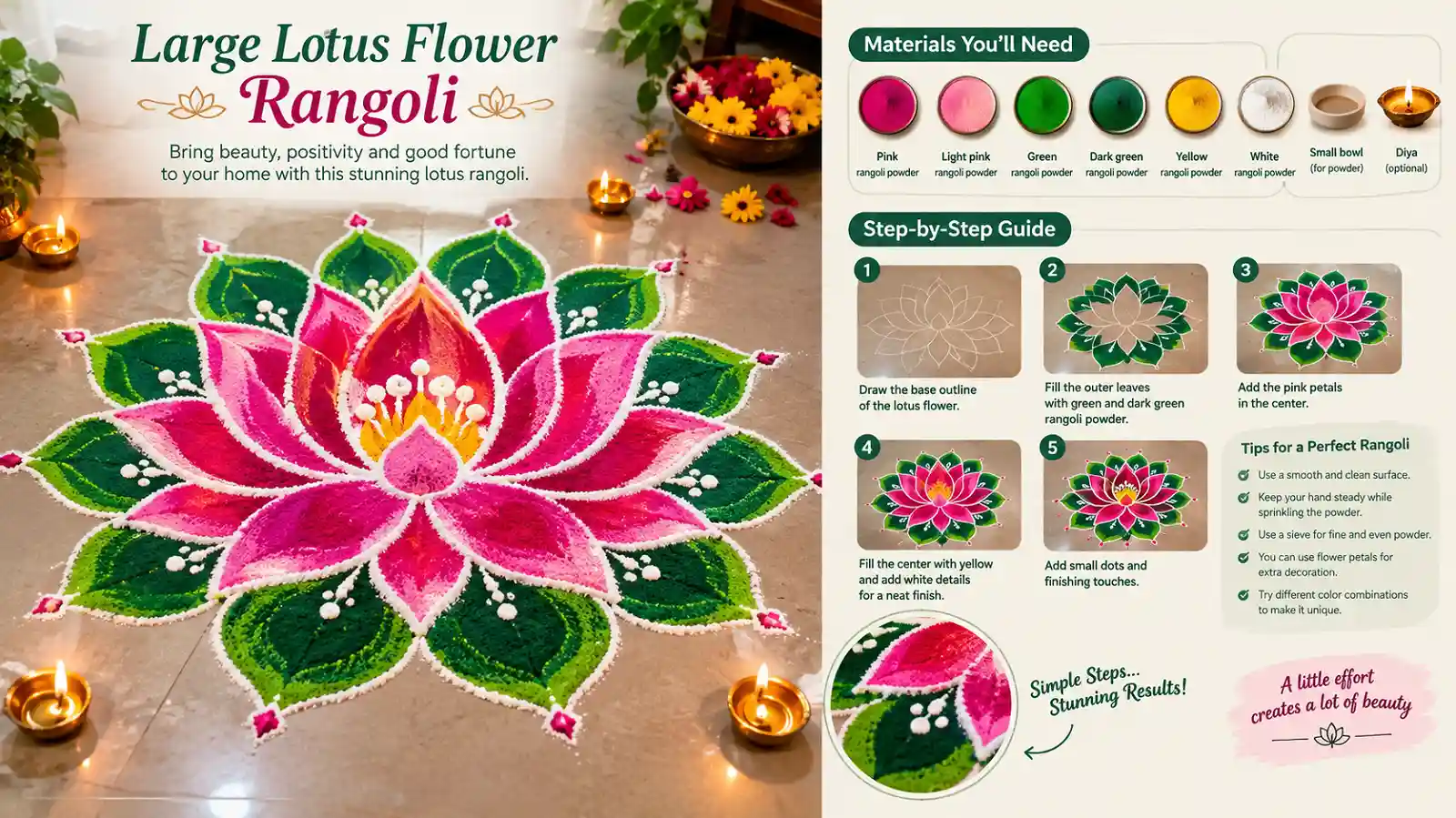
A large lotus is one of my favorite choices when the competition space is wide enough to accommodate a bigger design.
Start with a large central lotus and build several layers of petals around it. You can use pink and red for the inner petals, yellow or orange around the center, and green for leaves.
To make the design more competition-ready, add small white dots between the petals and create a circular border around the flower.
The key is to keep every petal similar in size. If one side becomes noticeably larger than the other, the symmetry of the entire rangoli can suffer.
Large floor spaces and traditional competitions.
2. Multi-Layer Flower Rangoli
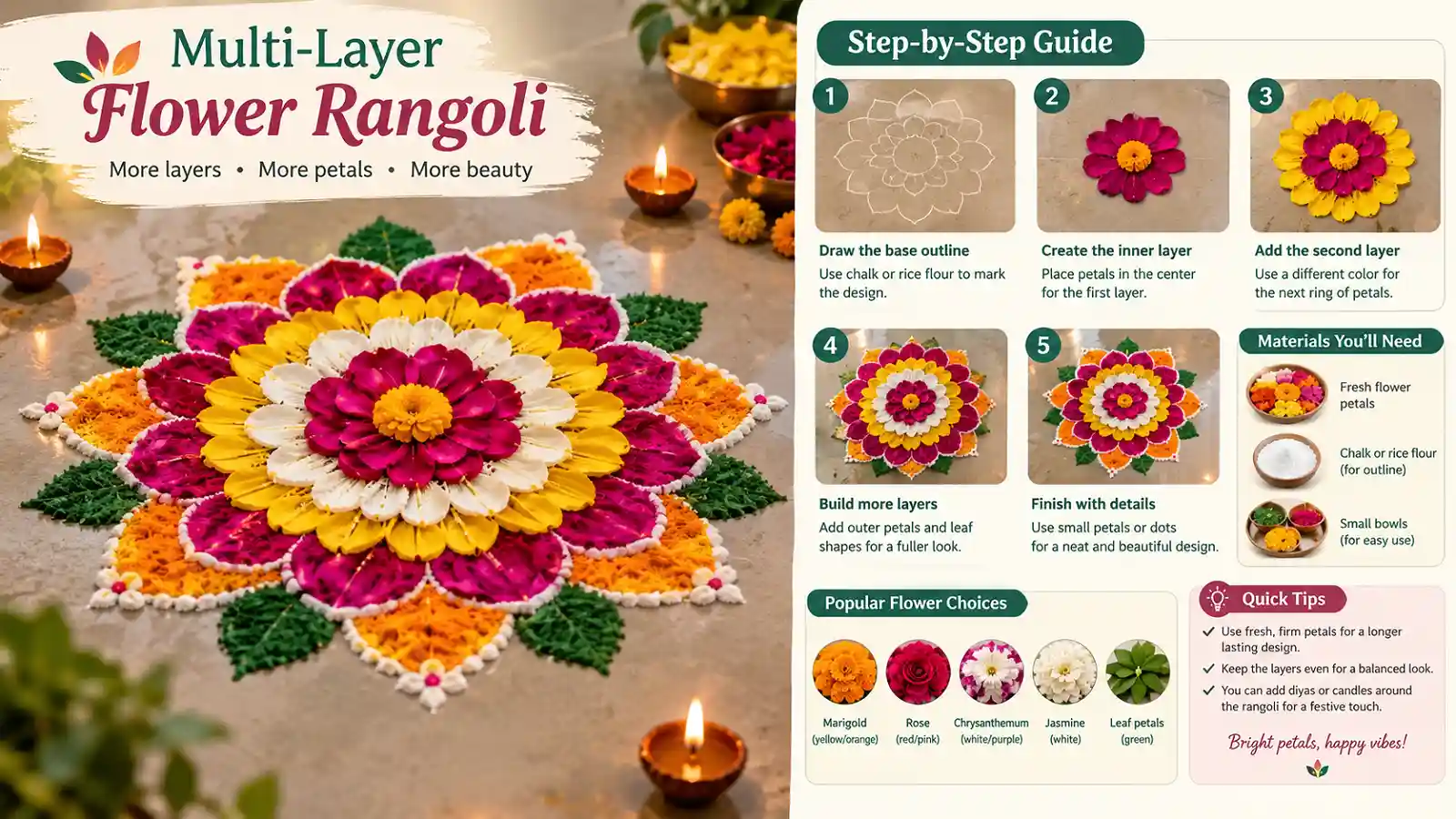
Instead of creating one large flower, try building several layers of flowers.
You can place a small flower in the center, surround it with larger petals, and then create another floral layer outside it. This produces a mandala-like appearance while keeping the flower theme strong.
Use alternating colors for each layer. For example, the center can be yellow, followed by pink petals, white details, orange petals, and a green outer layer.
This design looks especially attractive when viewed from above because the repeated layers create depth.
3. Marigold-Inspired Rangoli
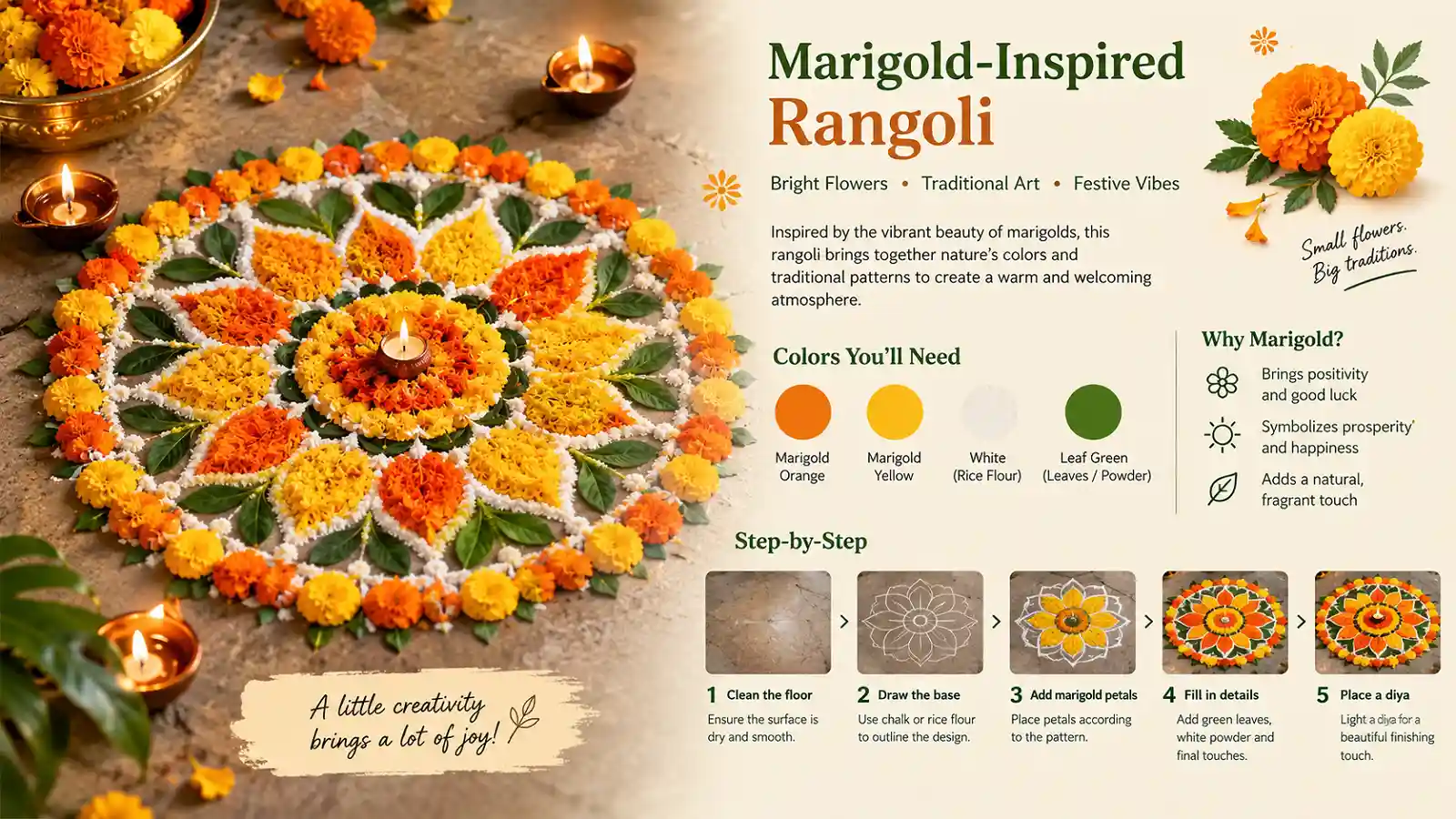
Growing up in Kolkata, I have always loved the warm colors of marigold flowers. Their yellow and orange shades immediately make a rangoli feel festive.
For this design, create a large circular floral pattern inspired by marigold petals. You can use orange as the dominant color and add yellow, white, and green details.
Small marigold-like flowers can also be placed around the main design to create a fuller composition.
If you want to use real flowers instead of rangoli powder, marigold petals work beautifully for this idea.
4. Rose Petal Rangoli
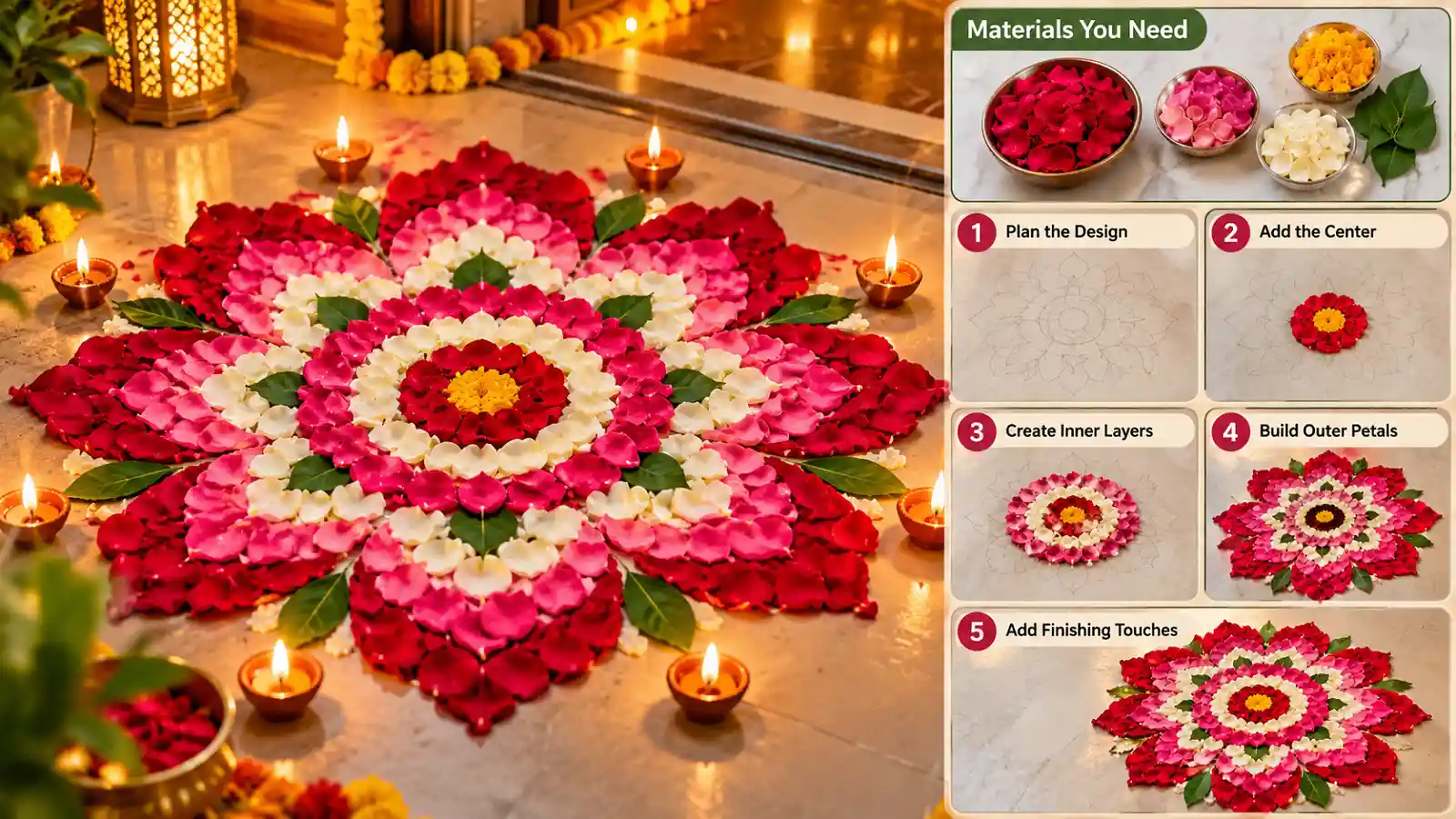
A rose-inspired rangoli gives you an opportunity to move away from the traditional geometric look.
Create several layers of curved petals starting from the center. Use red, pink, and white for the petals, then add green leaves around the outside.
You do not have to draw a realistic rose. A stylized rose with repeated curved petals can actually look cleaner and more decorative in a competition setting.
One tip from my own experience is to avoid making every petal too narrow. Wider petals are easier to fill evenly and can be seen more clearly from a distance.
5. Flower and Peacock Rangoli
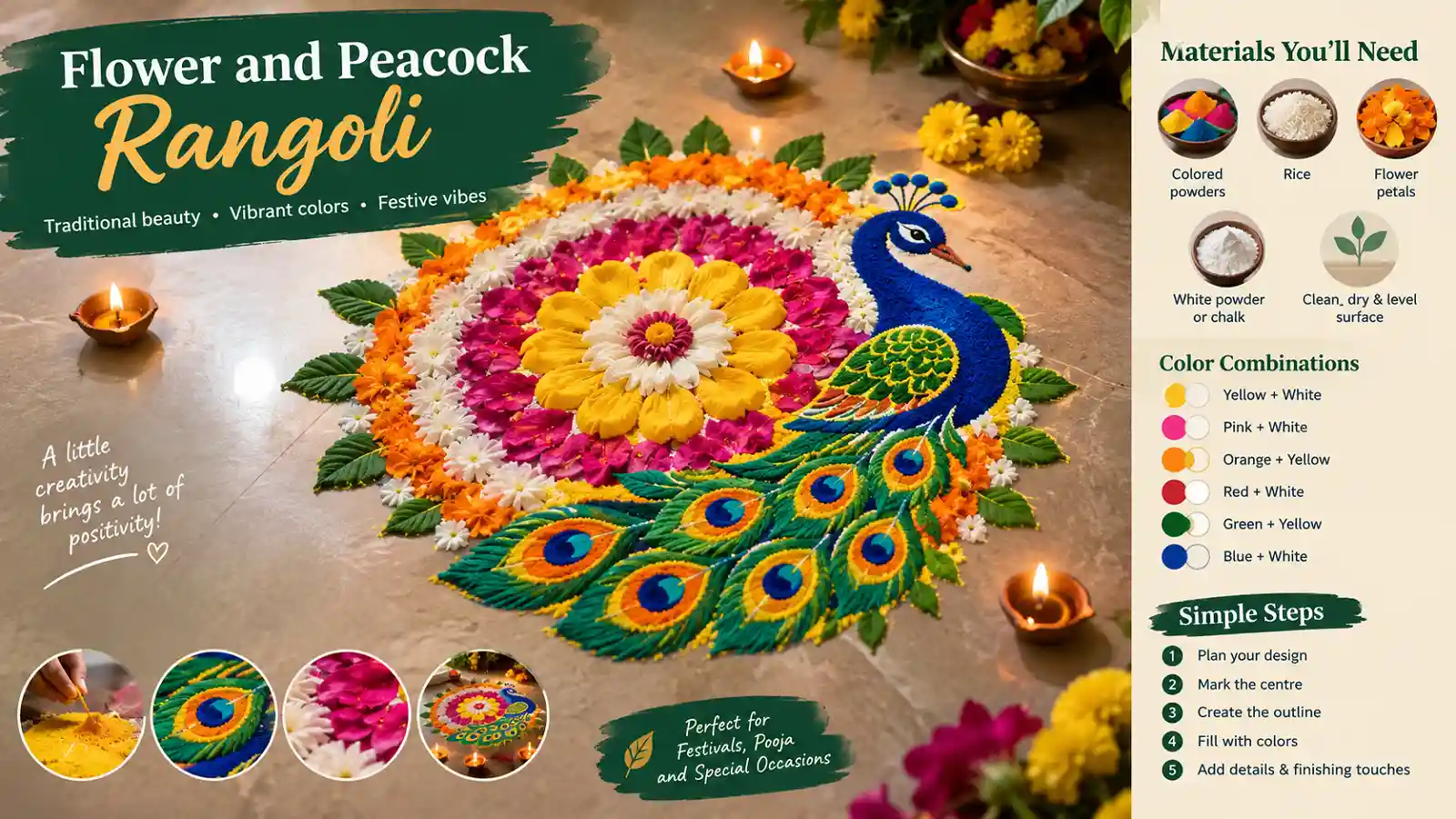
If you want a design with a stronger visual story, combine flowers with a peacock.
Place the peacock slightly to one side and use large flowers to balance the opposite side. Add floral details inside the peacock’s feathers and surround the entire design with leaves and small decorative patterns.
Blue, green, yellow, pink, and white can work well together here.
The important thing is balance. The peacock should not overpower the floral section, and the flowers should not make the design feel crowded.
6. Floral Mandala Rangoli
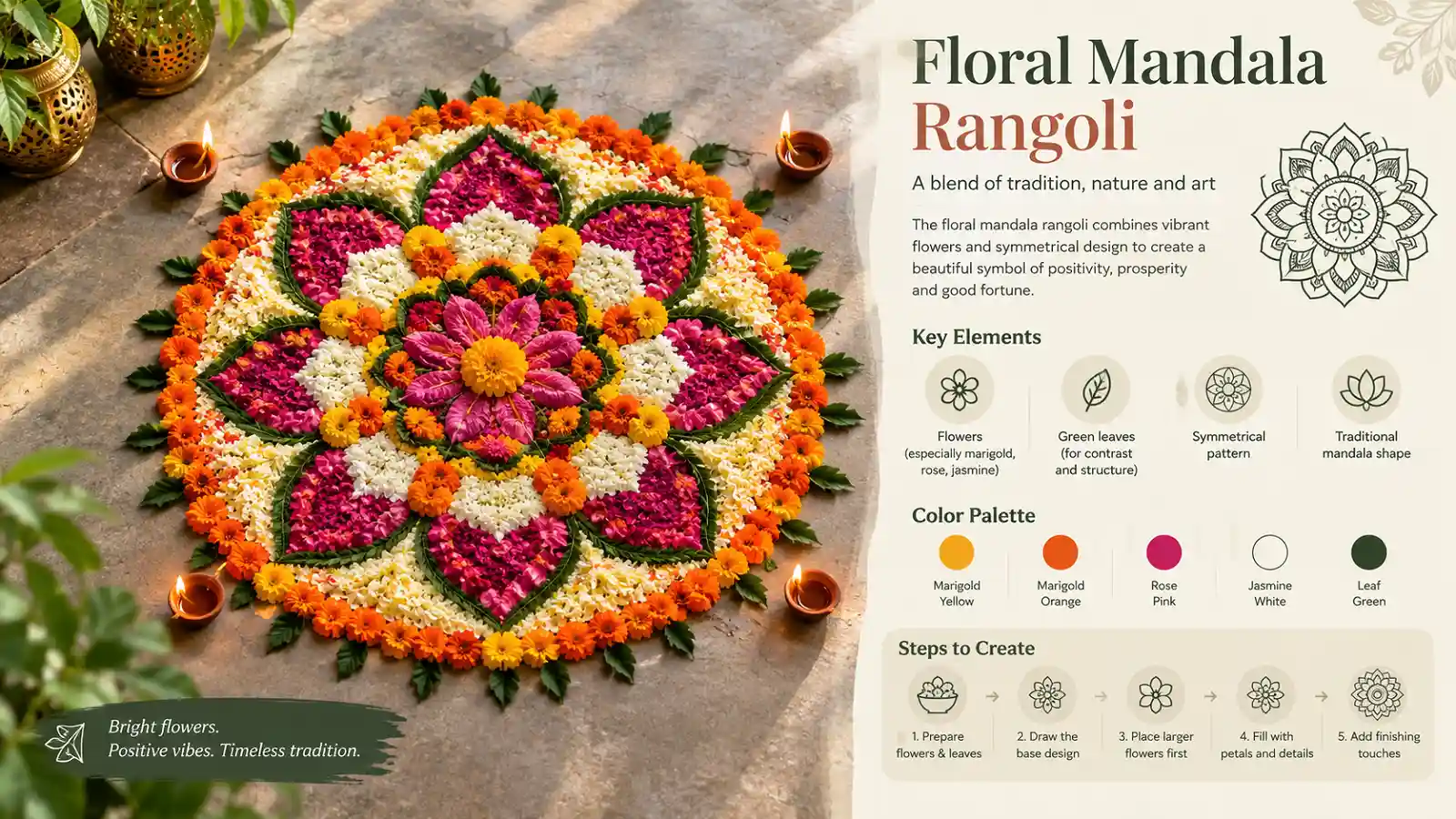
A floral mandala is a great choice if you enjoy working with symmetry.
Begin with a small central circle and gradually build outward using petals, dots, leaves, and curved borders. Each layer should repeat around the center.
This is one of those designs where planning matters more than speed. Before putting down the colors, lightly mark the main sections so you know exactly where each layer will go.
A floral mandala can look extremely detailed without requiring dozens of different motifs.
7. Lotus and Diya Rangoli
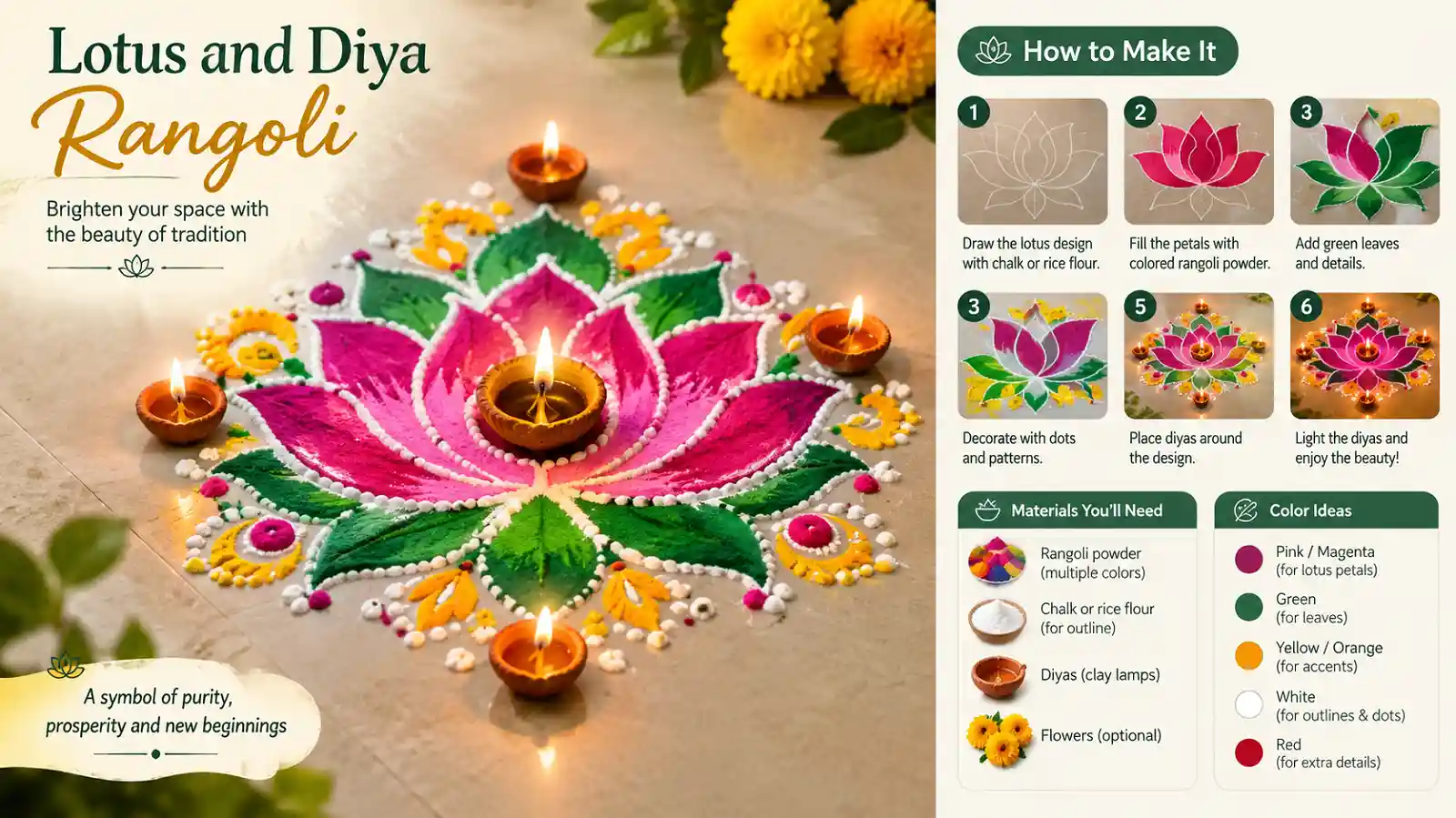
For a traditional festive competition, combine a lotus with diyas.
Place a large lotus in the center and arrange small diya shapes around it. Add flower petals, dots, and curved borders to connect the two elements.
Use warm shades such as orange, yellow, red, and pink, with white outlines for contrast.
This design works particularly well for competitions held around Diwali or other festive occasions.
8. Five-Petal Flower Pattern
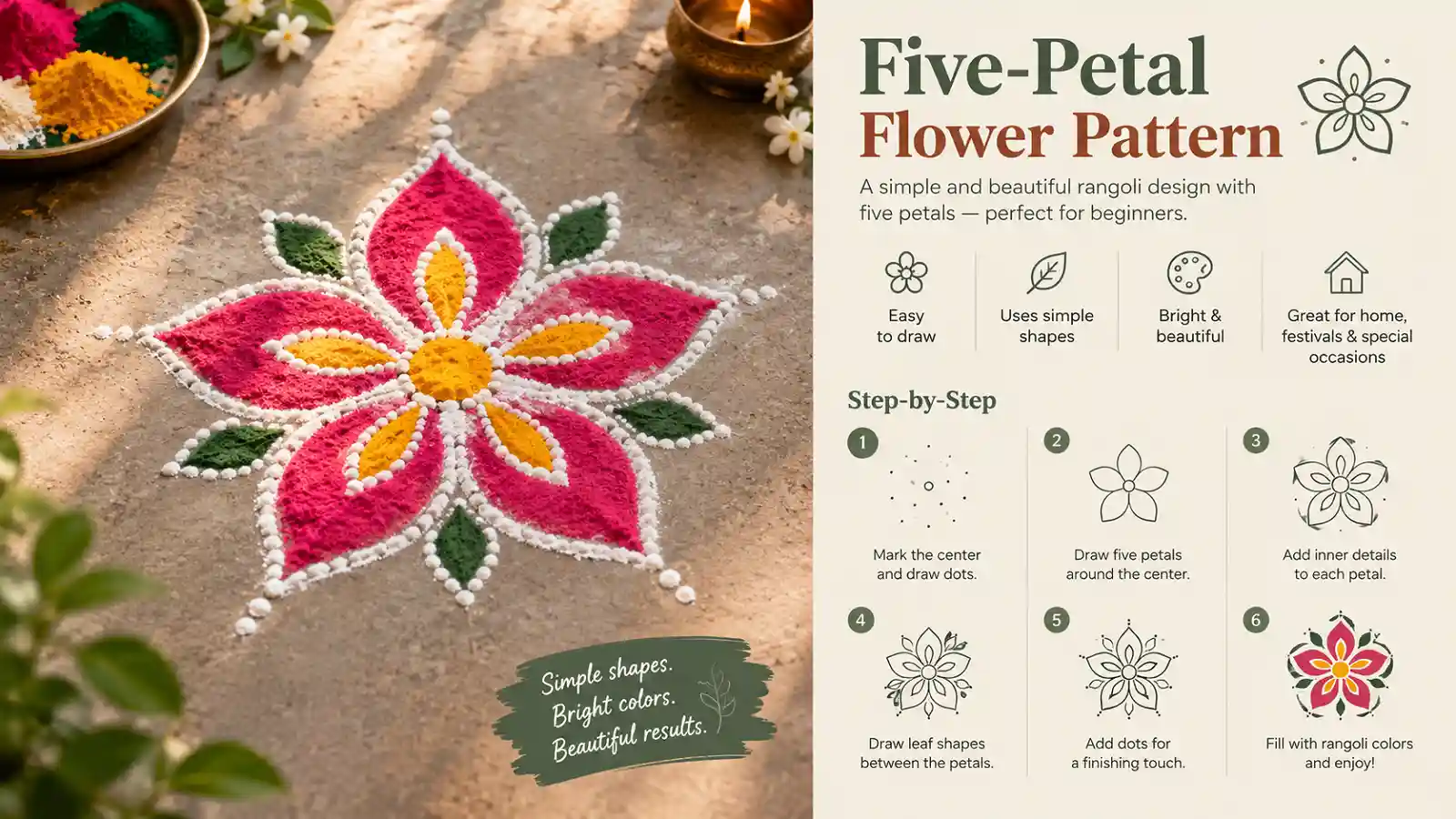
Not every competition design needs to be huge or extremely complicated.
A repeated five-petal flower pattern can create a beautiful composition when arranged carefully. Start with one flower in the center and repeat smaller flowers around it.
Use two or three colors for the petals and add a contrasting center to each flower.
The trick is repetition. If every flower follows the same shape and spacing, even a relatively simple design can look polished and intentional.
9. Flower and Dot Rangoli
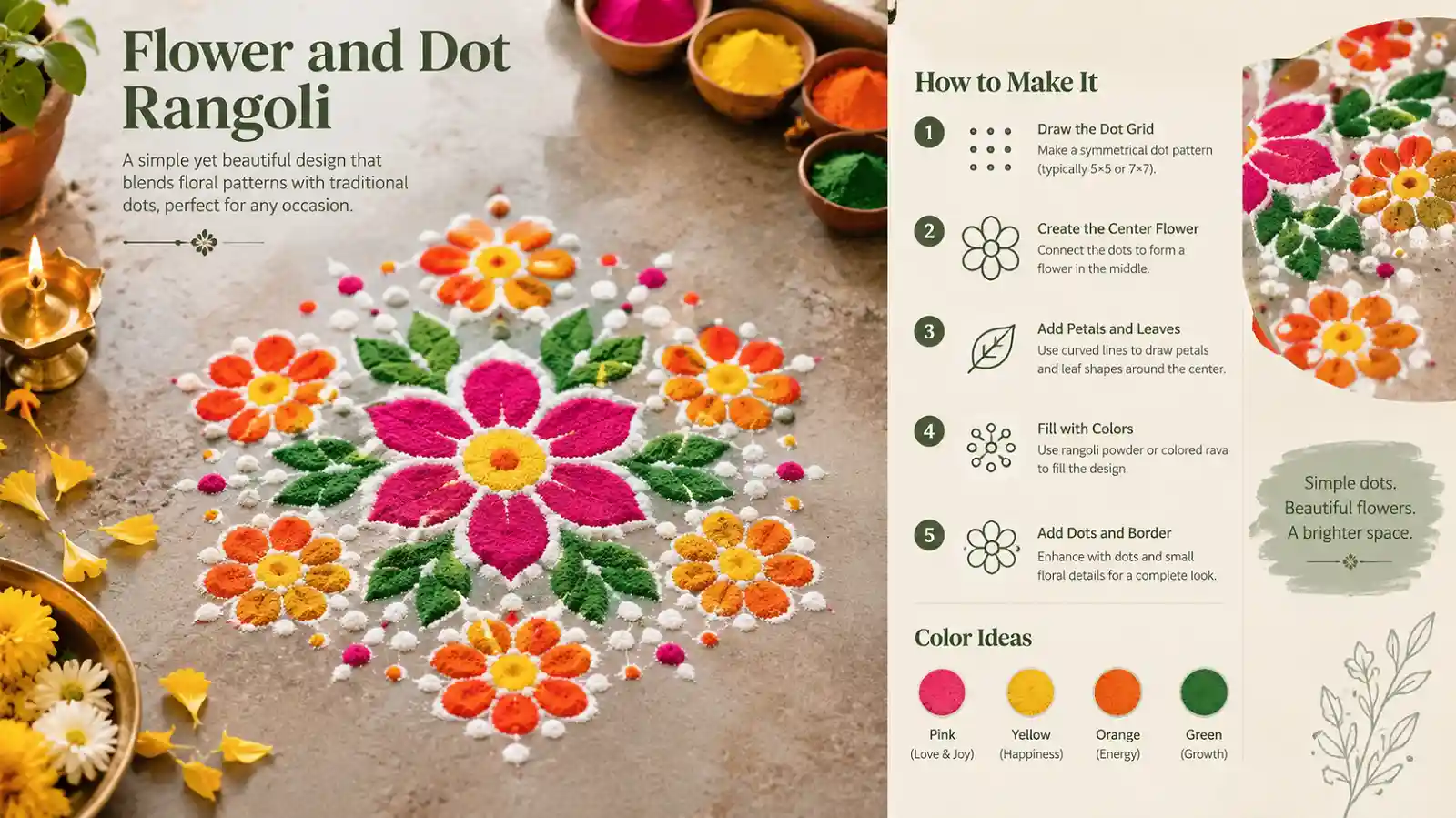
If you are comfortable with dot-based rangoli, combine dots with floral shapes.
Create a symmetrical dot grid first, then use the dots as guides for petals and curves. You can place a large flower in the center and surround it with smaller floral motifs.
Dot-based designs are particularly useful when you are worried about symmetry because the grid gives you a visual structure to follow.
You can find more inspiration in our guide to Small Rangoli Designs With Dots , especially if you want to practice your spacing before the competition.
10. Circular Flower Garden Rangoli
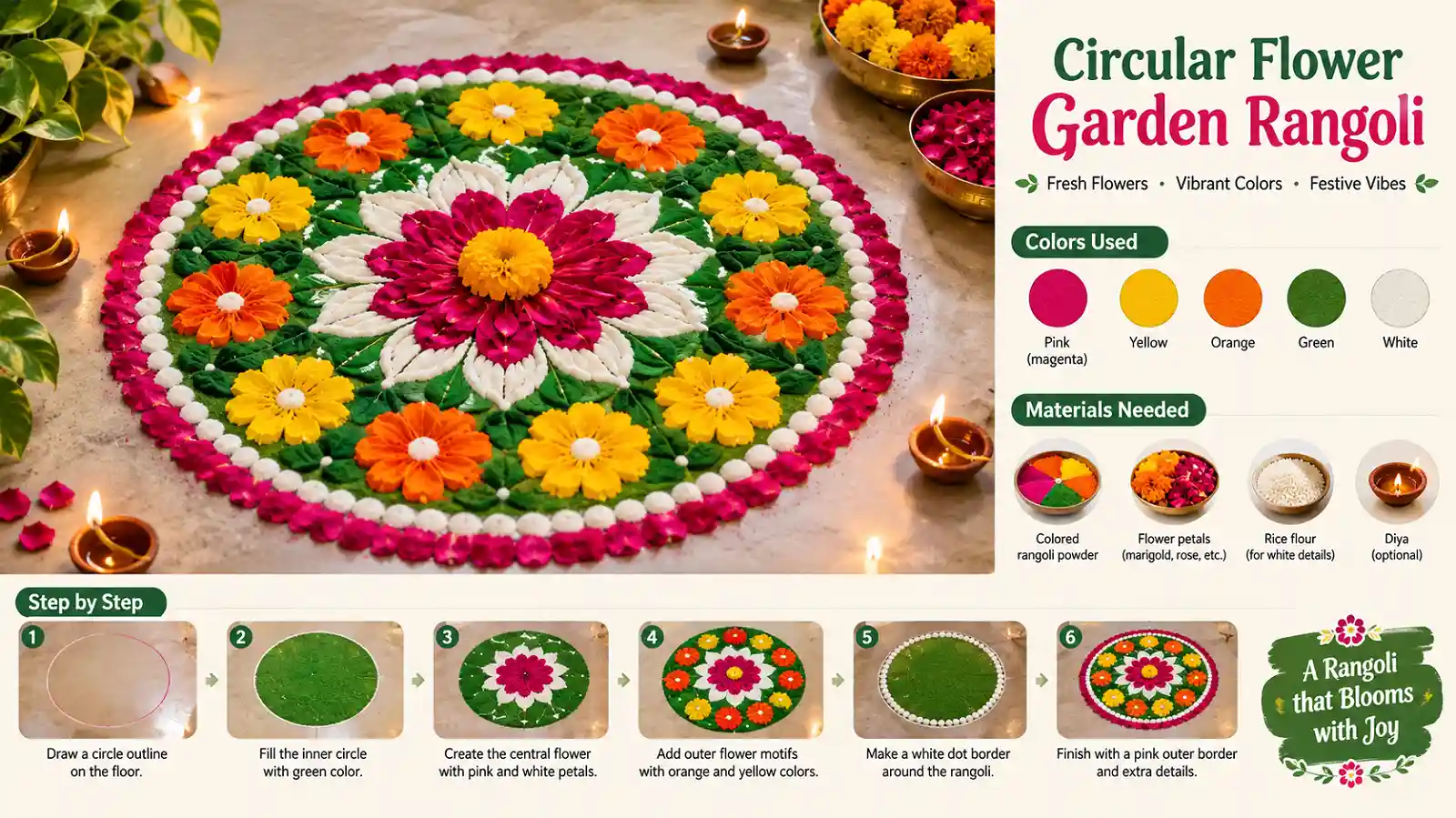
Imagine looking down at a colorful flower garden and turning that idea into rangoli.
Create several different flowers inside one large circular composition. You can combine lotus, small five-petal flowers, leaves, buds, and decorative dots.
Do not use too many colors randomly. Instead, choose a few shades and repeat them throughout the design.
For example, pink flowers can appear alongside yellow flowers, while green leaves and white outlines connect everything together.
This type of rangoli feels lively without becoming visually confusing.
11. Geometric Flower Rangoli
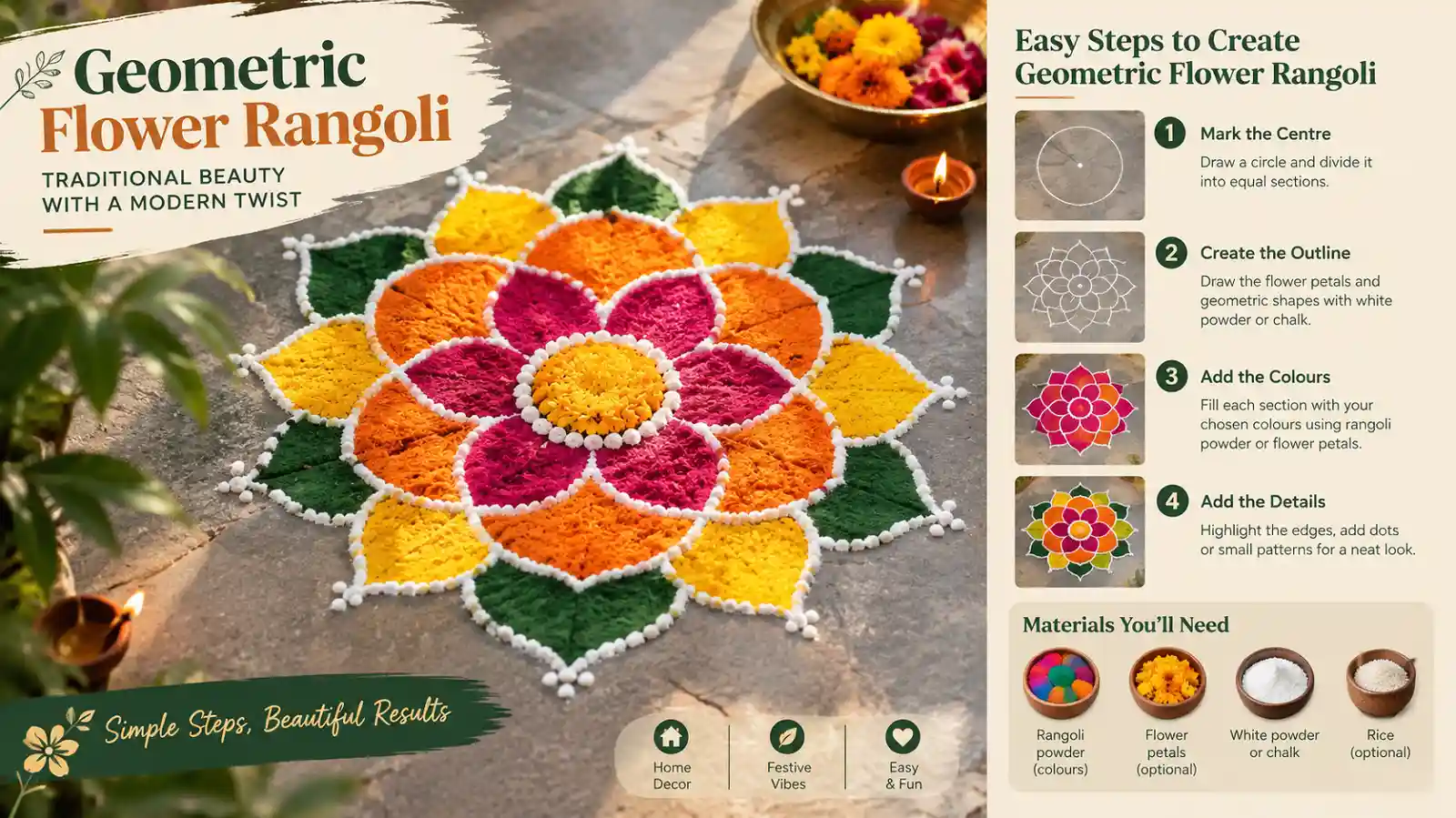
For something more modern, combine geometric shapes with floral elements.
You can build the basic structure using circles, diamonds, triangles, or hexagons and then place flowers inside or around those shapes.
The contrast between straight geometric lines and soft flower petals creates an interesting visual effect.
This is also a useful approach if you want your design to look different from several traditional floral rangolis in the competition.
12. Floral Border Rangoli
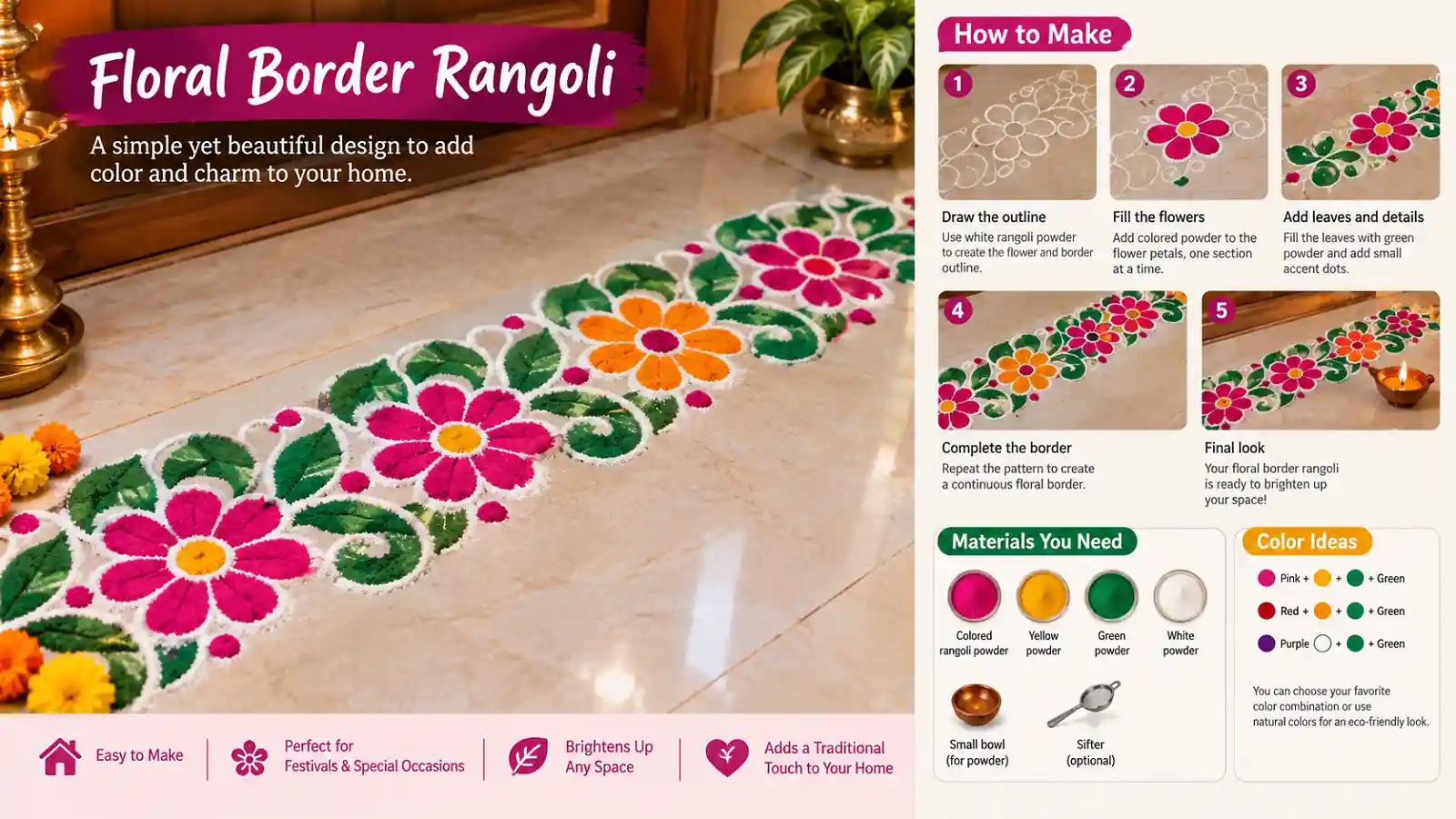
Instead of putting one large flower in the center, create a strong floral border around the entire rangoli.
The middle can contain a simple lotus, diya, mandala, or geometric pattern. Around it, create repeated flowers connected with leaves and curved lines.
A good border can make even a relatively simple central design look complete.
Make sure the corners and curves of the border remain consistent. Uneven spacing becomes especially noticeable in a competition.
13. Four-Corner Flower Rangoli
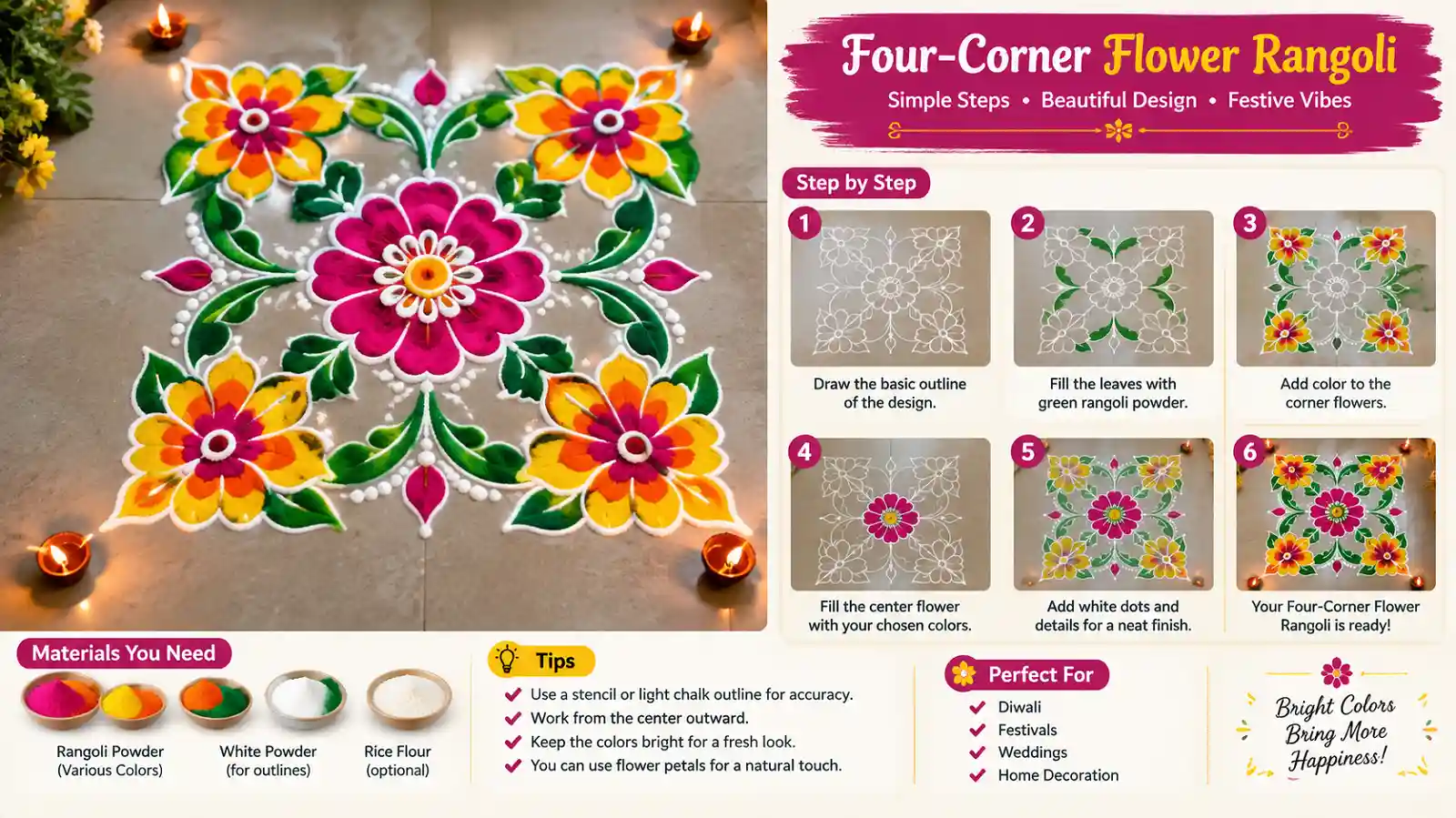
This design is perfect for a square competition area.
Place one large flower motif in each corner and connect the four sections through a central circular or diamond-shaped pattern.
Try to keep all four flowers identical or very similar. This creates strong visual symmetry.
You can use different colors for each flower while keeping the shape the same. Another option is to use the same colors throughout and change only the central details.
14. Freehand Floral Rangoli
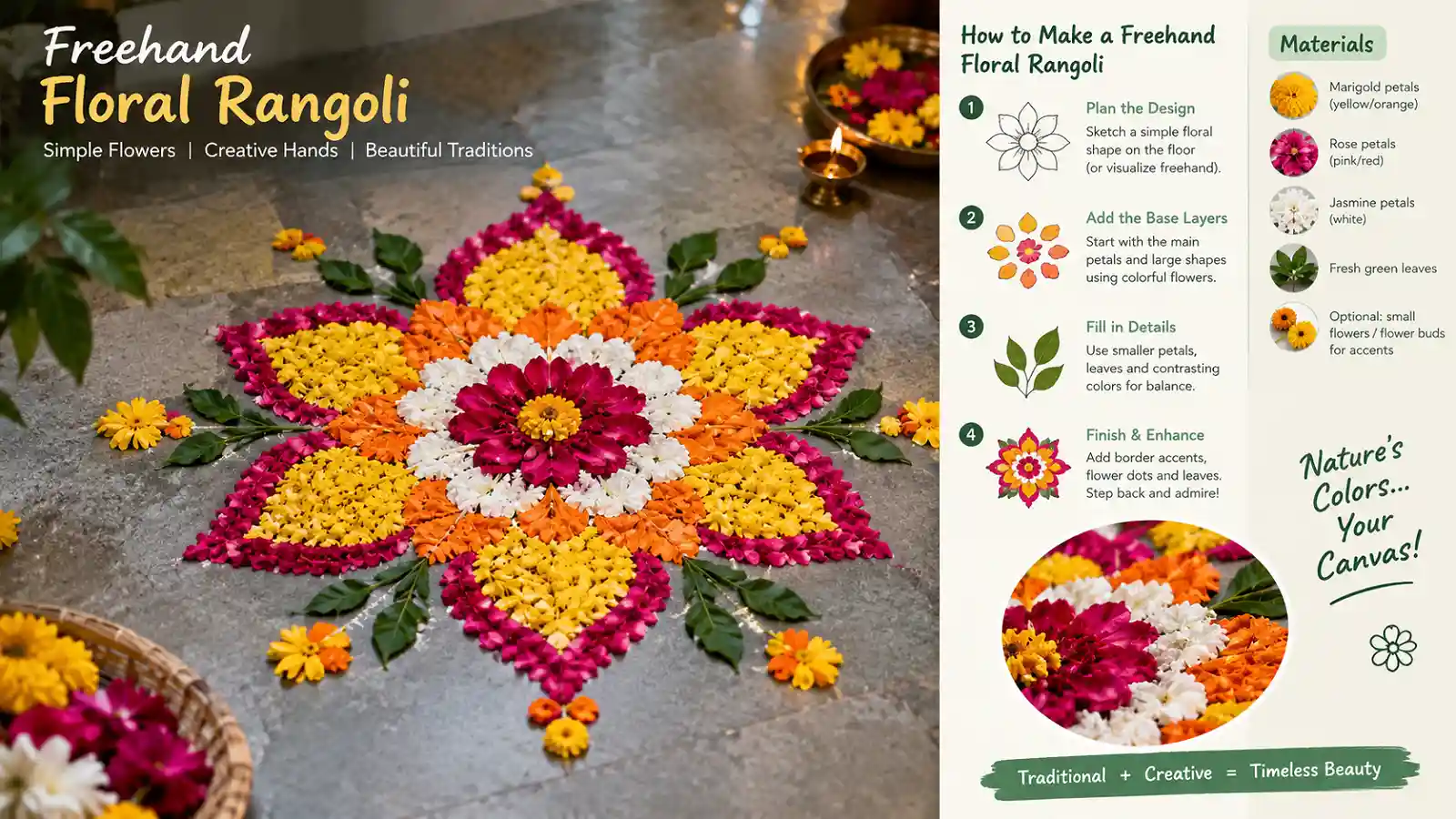
If you are confident with your drawing skills, try a freehand design instead of relying heavily on dots or grids.
Start with one main flower and allow the pattern to develop naturally around it. Add leaves, curved vines, smaller flowers, petals, and decorative elements as you move outward.
Freehand rangoli can feel more personal because every line comes directly from your own hand.
However, I would recommend practicing the complete design at least once before the competition. It is much easier to discover spacing problems on paper or on a practice surface than in the middle of the competition.
15. Grand Floral Competition Rangoli
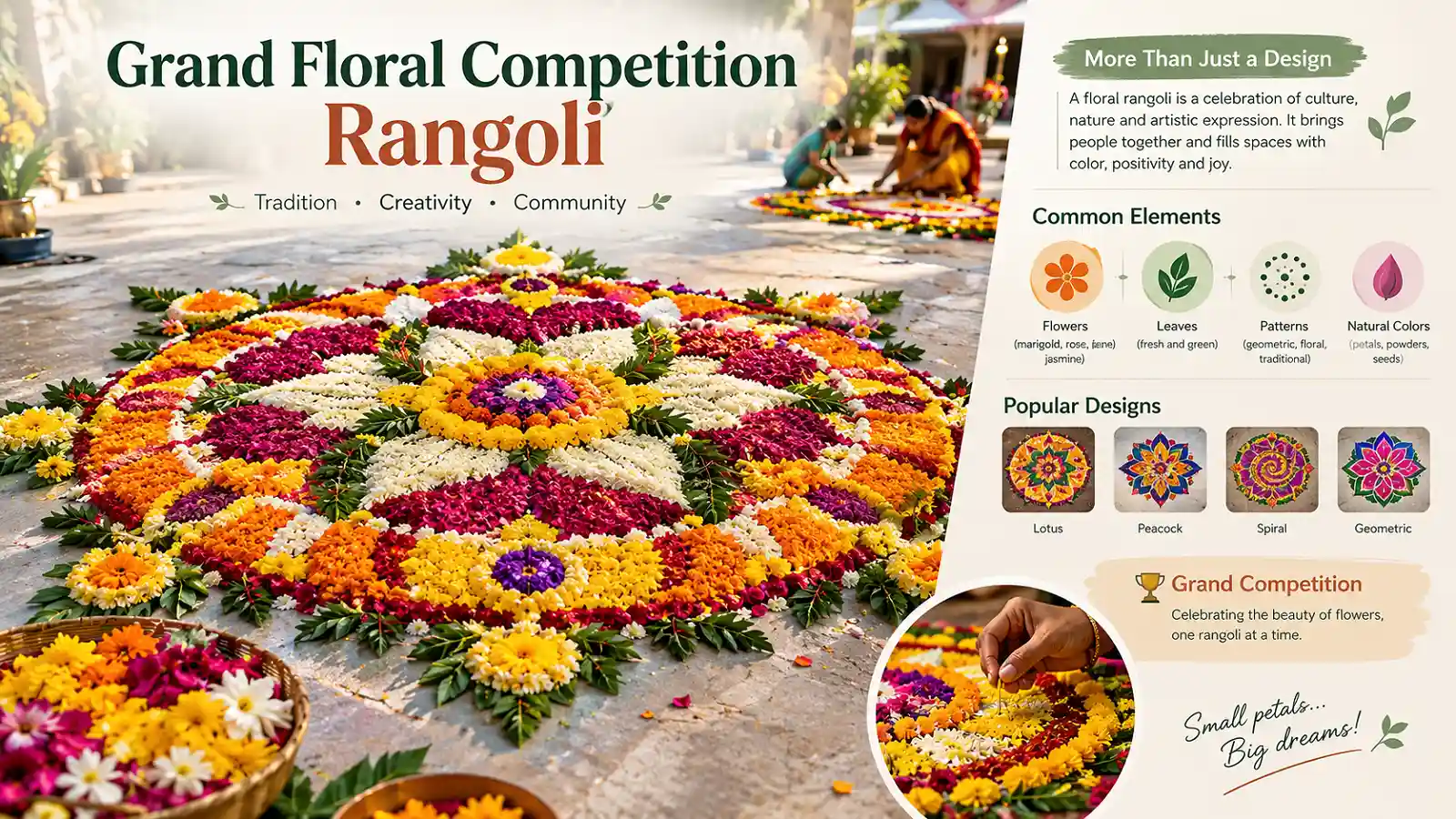
For a large competition, you can combine several of the ideas above into one complete composition.
Imagine a large lotus at the center, surrounded by a floral mandala. Add marigold-inspired flowers around the middle section, leafy patterns toward the outside, and a bold decorative border.
You can also include small diyas, dots, petals, or geometric shapes as supporting details.
Main flower → secondary flowers → decorative details → outer border
When everything has equal visual importance, the design can become difficult to read. A competition rangoli usually looks stronger when the viewer’s eye is naturally drawn toward one main feature.
How to Make Your Flower Rangoli Stand Out in a Competition
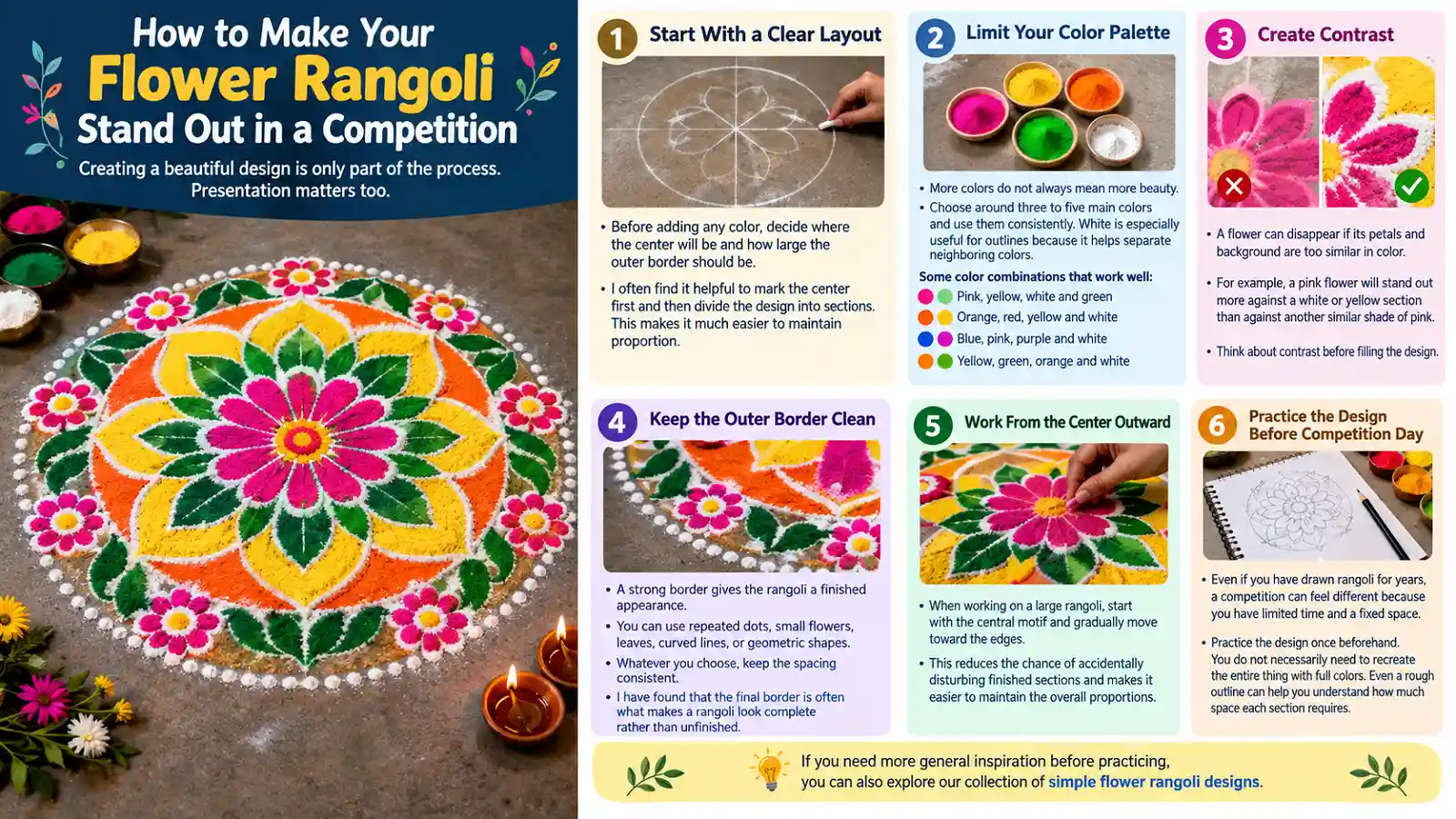
Creating a beautiful design is only part of the process. Presentation matters too.
Start With a Clear Layout
Before adding any color, decide where the center will be and how large the outer border should be.
I often find it helpful to mark the center first and then divide the design into sections. This makes it much easier to maintain proportion.
Limit Your Color Palette
More colors do not always mean more beauty.
Choose around three to five main colors and use them consistently. White is especially useful for outlines because it helps separate neighboring colors.
Create Contrast
A flower can disappear if its petals and background are too similar in color.
For example, a pink flower will stand out more against a white or yellow section than against another similar shade of pink.
Think about contrast before filling the design.
Keep the Outer Border Clean
A strong border gives the rangoli a finished appearance.
You can use repeated dots, small flowers, leaves, curved lines, or geometric shapes. Whatever you choose, keep the spacing consistent.
I have found that the final border is often what makes a rangoli look complete rather than unfinished.
Work From the Center Outward
When working on a large rangoli, start with the central motif and gradually move toward the edges.
This reduces the chance of accidentally disturbing finished sections and makes it easier to maintain the overall proportions.
Practice the Design Before Competition Day
Even if you have drawn rangoli for years, a competition can feel different because you have limited time and a fixed space.
Practice the design once beforehand. You do not necessarily need to recreate the entire thing with full colors. Even a rough outline can help you understand how much space each section requires.
If you need more general inspiration before practicing, you can also explore our collection of simple flower rangoli designs .
Common Mistakes to Avoid
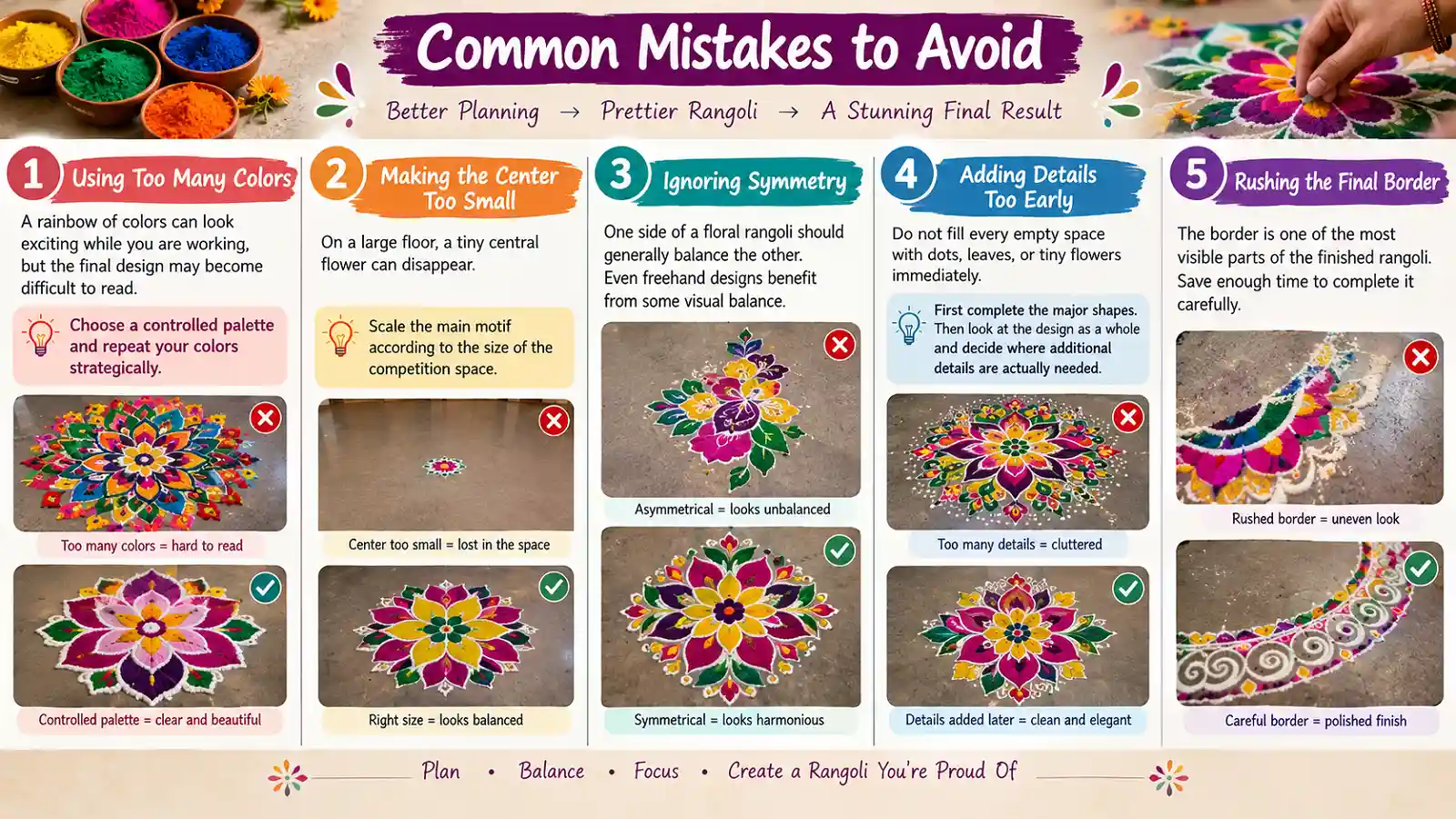
Using Too Many Colors
A rainbow of colors can look exciting while you are working, but the final design may become difficult to read.
Choose a controlled palette and repeat your colors strategically.
Making the Center Too Small
On a large floor, a tiny central flower can disappear.
Scale the main motif according to the size of the competition space.
Ignoring Symmetry
One side of a floral rangoli should generally balance the other. Even freehand designs benefit from some visual balance.
Adding Details Too Early
Do not fill every empty space with dots, leaves, or tiny flowers immediately.
First complete the major shapes. Then look at the design as a whole and decide where additional details are actually needed.
Rushing the Final Border
The border is one of the most visible parts of the finished rangoli. Save enough time to complete it carefully.
Flower Rangoli Materials for Competition
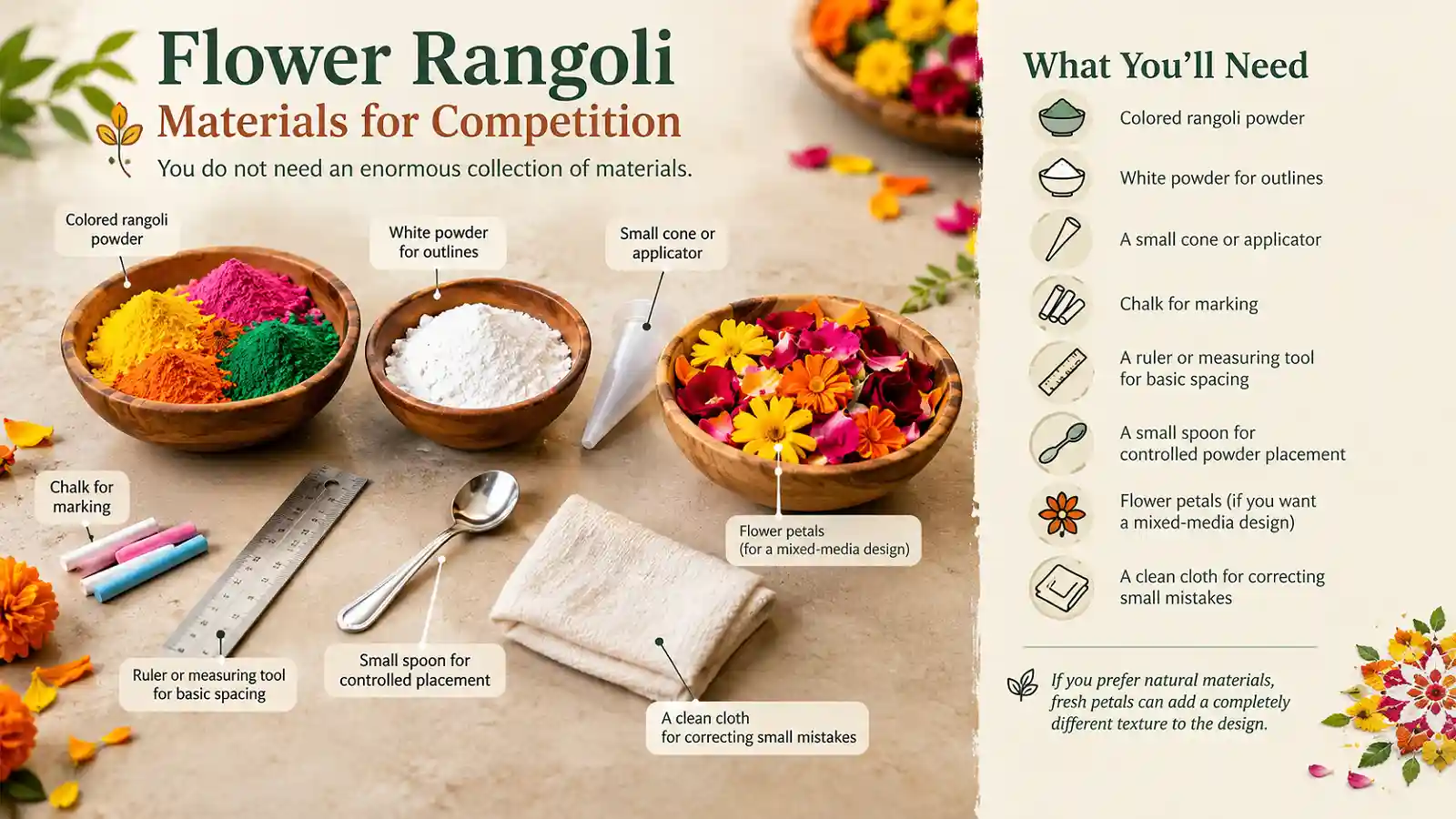
You do not need an enormous collection of materials.
For a traditional powder rangoli, you may need:
For filling the main floral patterns.
Useful for clean outlines and contrast.
For controlled powder placement.
For marking the main layout.
For basic spacing and alignment.
For controlled powder placement.
For mixed-media floral designs.
For correcting small mistakes.
If you prefer natural materials, fresh petals can add a completely different texture to the design.
How I Approach a Competition Rangoli
After eight years of drawing and documenting rangoli, one thing I have learned is that the most difficult part is not always drawing the individual flowers. It is deciding when to stop adding things.
When I was younger, I often thought a better rangoli meant adding more patterns, more colors, and more decoration. With experience, I have started to appreciate empty space much more.
A clean area around a flower can make that flower more noticeable. A simple white outline can make a bright color look stronger. A repeated pattern can create more impact than five unrelated motifs.
That is why I would suggest designing your rangoli around one clear idea rather than trying to show every technique you know.
My Take on Creating a Competition-Worthy Rangoli
Flower rangoli has been part of my life for much longer than I have been consciously studying it. Some of my earliest memories are of sitting on the steps in Kolkata and watching my mother and grandmother create patterns before sunrise. They were not making those designs for competitions or photographs. They were simply continuing something that had become part of their daily lives.
After eight years of drawing, collecting, and photographing rangoli myself, I have come to understand why that simple ritual stayed with me.
Choose a strong central flower, give your colors enough room to breathe, keep your symmetry under control, and let the details support the main idea.
When you are preparing flower rangoli designs for competition, it is easy to focus entirely on making the biggest, brightest, or most complicated design. But I think the most memorable rangoli is the one where the design feels intentional.
Whether you choose a lotus, rose, marigold, floral mandala, peacock combination, or your own original pattern, give yourself enough time to practice before competition day.
FAQs
Which flower rangoli design is best for a competition?
A large lotus, floral mandala, flower-and-peacock design, or layered flower pattern can work well for a competition. Choose a design that matches your available space, time, and drawing experience.
How many colours should I use in a flower rangoli?
Three to five main colours are usually enough. Using a limited colour palette can make the flowers and patterns easier to see and help the overall design look more balanced.
How can I make my flower rangoli look neat?
Start by marking the centre and main sections of the design. Keep the petals similar in size, maintain consistent spacing, use contrasting colours, and leave enough time to clean the edges and finish the border.
Should I practise my rangoli before the competition?
Yes. Practising the design beforehand helps you understand how much space and time it requires. Try completing a rough version with a timer so you know which sections may take the longest.
Can beginners make flower rangoli designs for competition?
Absolutely. Beginners can start with simple lotus, five-petal flower, or dot-based designs. A simple rangoli with clean symmetry, good colour choices, and neat finishing can look more effective than a complicated design that is rushed.
Create Your Flower Rangoli With Confidence
Choose one strong idea, plan your layout, control your colors, practice your design, and give your final border enough attention.