Rangoli Drawing: Easy Designs, How to Draw, Ideas & Inspiration
I grew up watching my mother and grandmother draw Rangoli at our doorway every morning before sunrise. While most of the neighborhood was still quiet, they would be outside, preparing the floor and carefully placing each dot.
I used to sit on the steps and watch. At first, I didn’t understand how a few small dots and handfuls of colored powder could turn into something so beautiful.
Over time, those quiet mornings became some of my favorite childhood memories. That daily ritual is where my love for Rangoli began.
Years later, I started learning different designs, trying them myself, photographing the ones I liked, and collecting ideas whenever I came across something interesting.
That’s also why I created this site. I wanted a place where I could collect the Rangoli designs I’ve learned and tried over the years and share them with anyone who wants to bring a little bit of this beautiful tradition into their own home.
Whether you’re completely new to Rangoli or you’ve been drawing it for years, I hope these designs give you something to try.
What Is Rangoli Drawing?
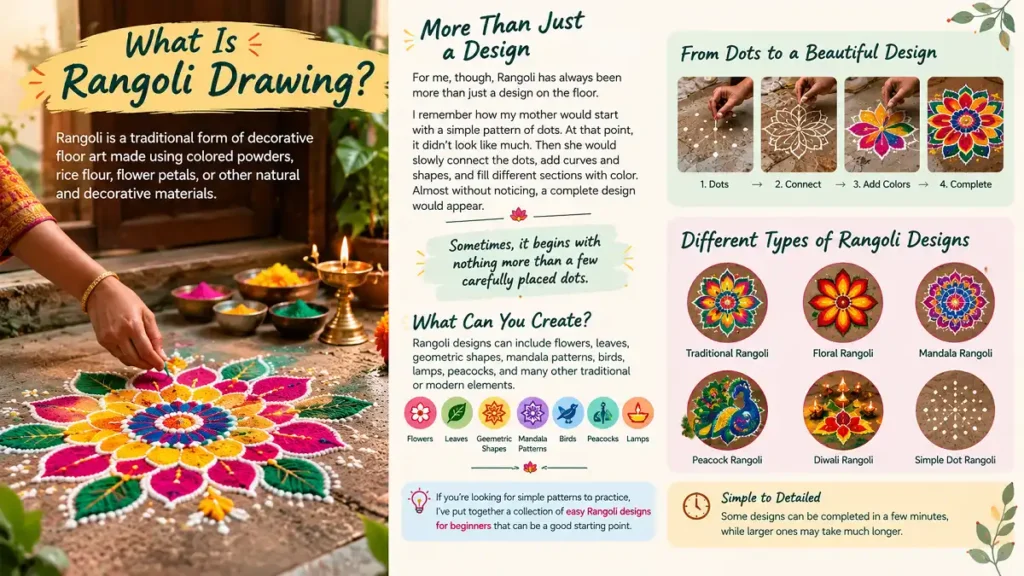
Rangoli is a traditional form of decorative floor art made using colored powders, rice flour, flower petals, or other natural and decorative materials.
For me, though, Rangoli has always been more than just a design on the floor.
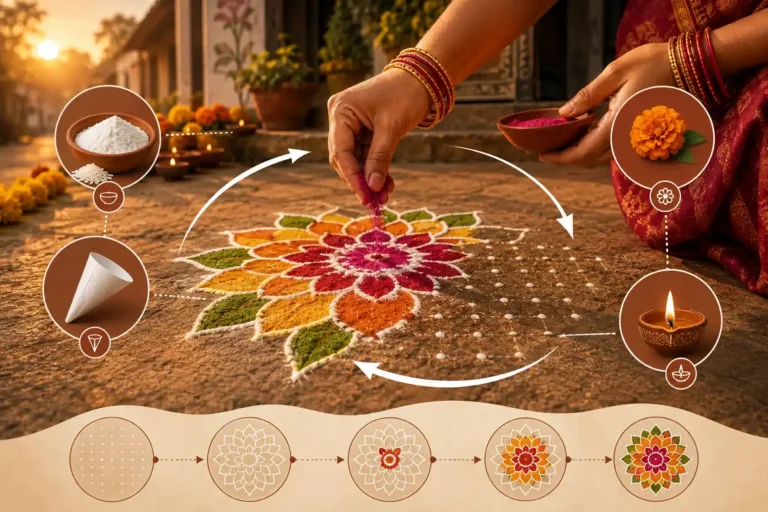
I remember how my mother would start with a simple pattern of dots. At that point, it didn’t look like much. Then she would slowly connect the dots, add curves and shapes, and fill different sections with color.
Almost without noticing, a complete design would appear.
A beautiful Rangoli doesn’t necessarily begin with complicated artwork. Sometimes it begins with nothing more than a few carefully placed dots.
Rangoli designs can include flowers, leaves, geometric shapes, mandala patterns, birds, lamps, peacocks, and many other traditional or modern elements.
If you’re looking for simple patterns to practice, explore our easy Rangoli designs for beginners .
Some designs can be completed in a few minutes, while larger ones may take much longer.
Why Is Rangoli Drawn?
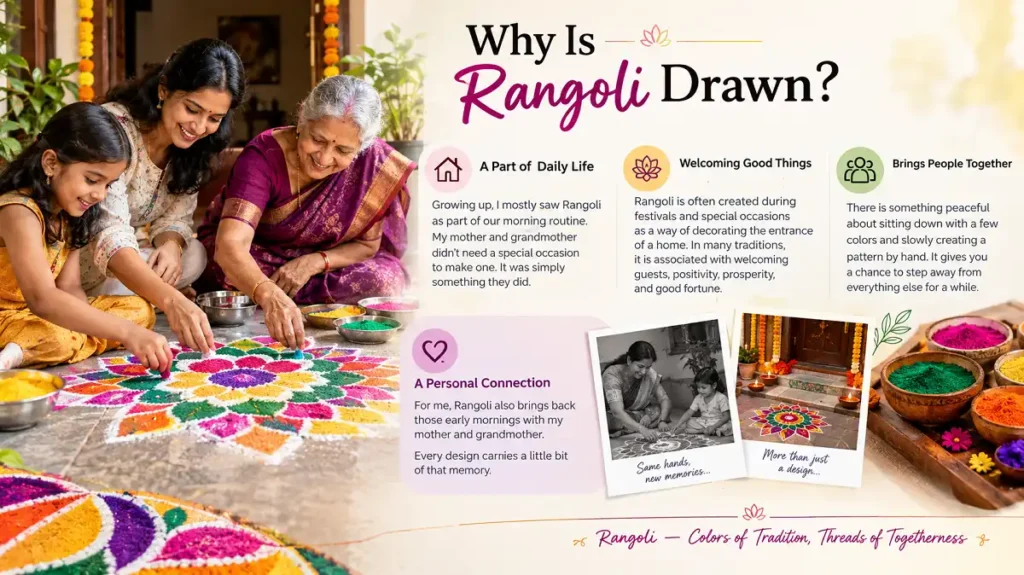
Growing up, I mostly saw Rangoli as part of our morning routine. My mother and grandmother didn’t need a special occasion to make one. It was simply something they did.
As I got older, I began to understand the deeper meaning behind the tradition.
- Welcoming guests into the home
- Creating a positive atmosphere
- Celebrating festivals and special occasions
- Expressing creativity through traditional art
- Bringing family members together
Rangoli is often created during festivals and special occasions as a way of decorating the entrance of a home. In many traditions, it is associated with welcoming guests, positivity, prosperity, and good fortune.
But I think there is another reason people continue to make Rangoli.
It brings people together.
There is something peaceful about sitting down with a few colors and slowly creating a pattern by hand. It gives you a chance to step away from everything else for a while.
For me, Rangoli also brings back those early mornings with my mother and grandmother.
Every design carries a little bit of that memory.
What Materials Do You Need for Rangoli Drawing?
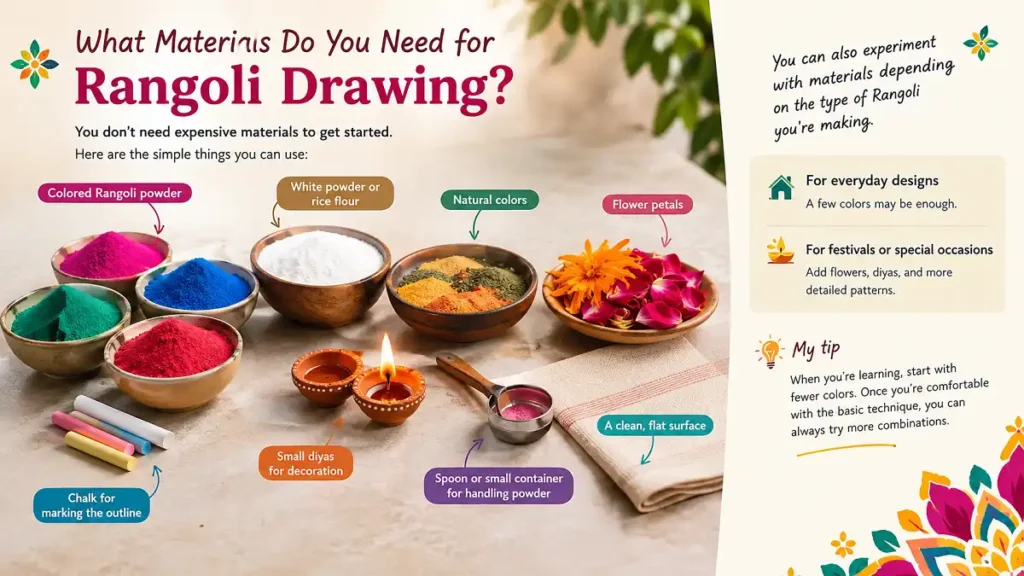
One of the best things about Rangoli is that you don’t need expensive materials to get started.
When I first watched my family make Rangoli, they used simple materials that were easily available at home.
Depending on the design, you can use:
For creating colorful sections and patterns.
Useful for dots, outlines, and traditional designs.
Perfect for natural and festive Rangoli.
Helpful for marking the basic outline.
Add warmth and decoration to festive designs.
Makes handling and placing powder easier.
Start with fewer colors when you’re learning. Once you become comfortable with the basic technique, you can experiment with more combinations.
How to Draw a Rangoli Step by Step
When I started trying to draw Rangoli myself, I quickly realized that watching someone else do it and doing it yourself are two very different things.
My first attempts weren’t perfect. Some lines were uneven. Some patterns didn’t look as symmetrical as I wanted. And, of course, there were plenty of moments when the powder ended up somewhere it wasn’t supposed to be.
But that’s part of learning.
Over time, I found that breaking the process into a few simple steps made things much easier.
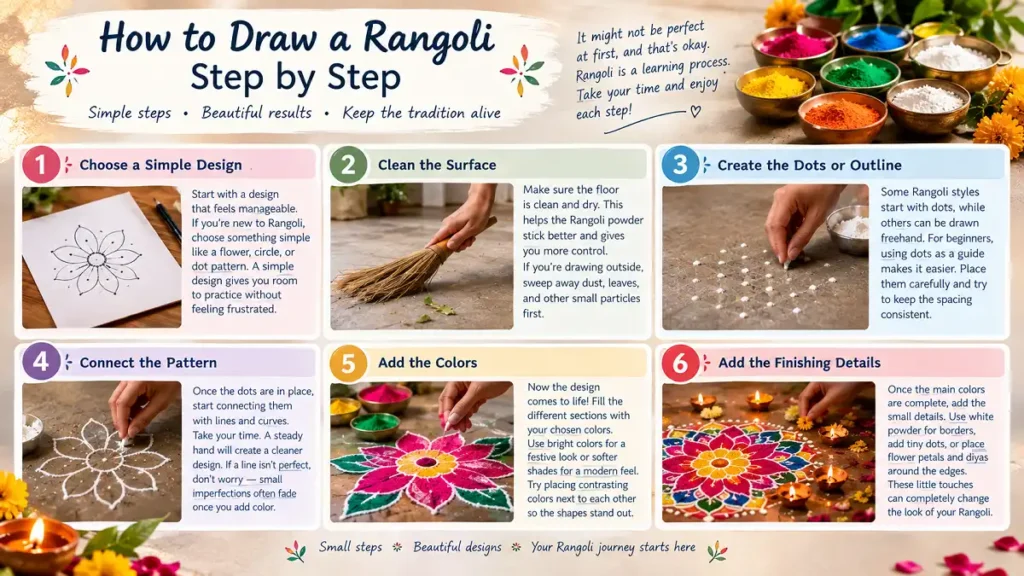
Choose a Simple Design
Start with a design that feels manageable.
If this is your first Rangoli, don’t start with a huge, highly detailed peacock or mandala design. Choose something simple, such as a flower, circle, or dot pattern.
A simple design gives you room to practice without becoming frustrated.
Clean the Surface
Before drawing, make sure the floor is clean and dry.
Rangoli powder is much easier to control when you’re working on a clean surface.
If you’re drawing outside, sweep away dust, leaves, and other small particles first.
Create the Dots or Outline
This is where the design really begins.
Some Rangoli styles start with dots, while others can be drawn freehand.
If you’re a beginner, using dots as a guide can make the process much easier. Place them carefully and try to keep the spacing consistent.
Connect the Pattern
Once the dots are in place, start connecting them with lines and curves.
Take your time. There’s no need to rush this part. A steady hand will usually produce a cleaner design than trying to finish quickly.
Small imperfections can disappear once you add the colors and details.
Add the Colors
Now comes the part that makes Rangoli feel alive.
Fill the different sections with your chosen colors. You can use bright colors for a traditional festive appearance or softer combinations for a more modern look.
Try placing contrasting colors next to each other so the individual shapes remain easy to see.
Add the Finishing Details
Once the main colors are complete, add the small details.
You can use white powder to create borders, add tiny dots around the design, or place flower petals and diyas around the edges.
These little details can completely change the appearance of a simple Rangoli.
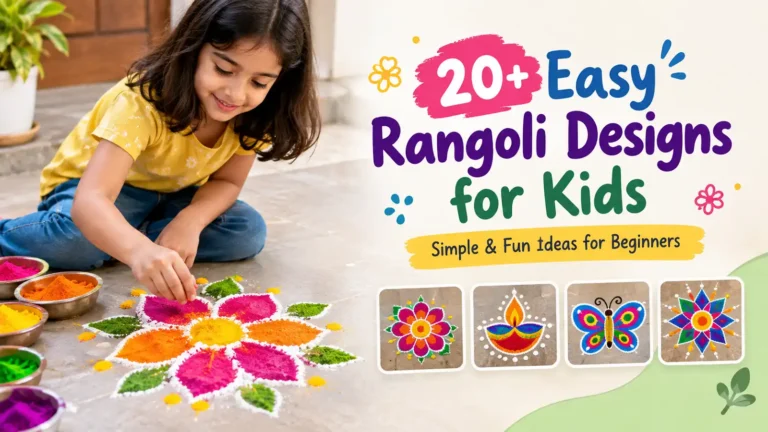
Easy Rangoli Designs for Beginners
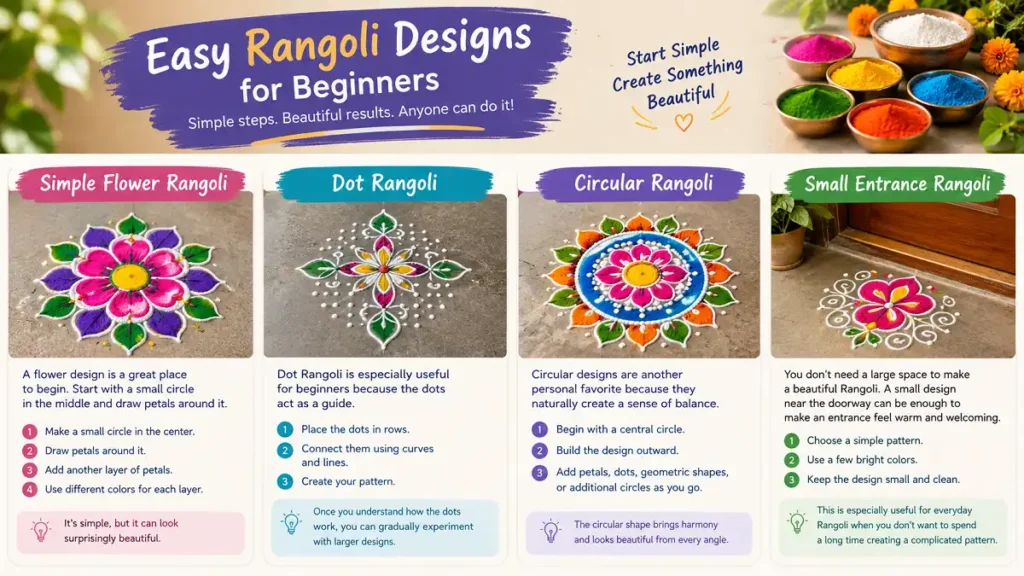
If you’re just starting out, don’t feel pressured to create something complicated.
Some of my favorite Rangoli designs are actually the simplest ones.
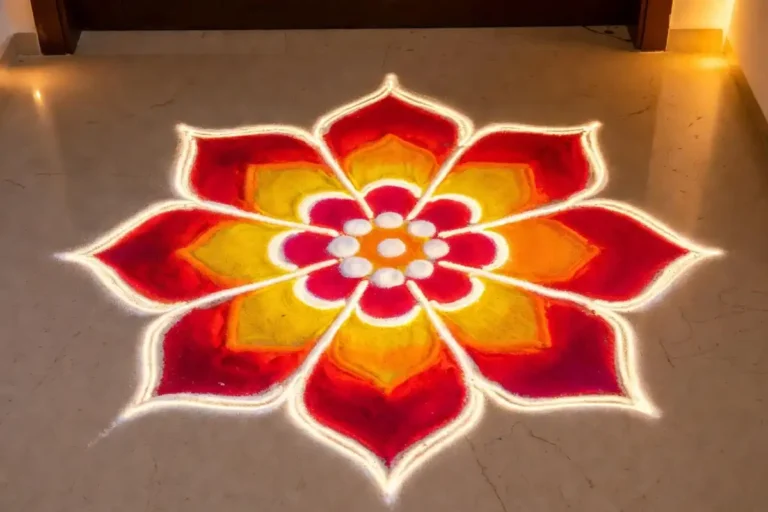
Simple Flower Rangoli
Start with a small circle in the middle and draw petals around it. You can create another layer of petals around the first one and use different colors for each layer.
Beginner FriendlyDot Rangoli
Place the dots in rows, then connect them using curves and lines to create your pattern. Once you understand the structure, gradually experiment with larger designs.
Easy PracticeCircular Rangoli
Begin with a central circle and build the design outward. Add petals, dots, geometric shapes, or additional circles as you go.
Balanced DesignSmall Entrance Rangoli
You don’t need a large space to make a beautiful Rangoli. A small design near the doorway can make an entrance feel warm and welcoming.
Small SpaceDifferent Types of Rangoli Designs
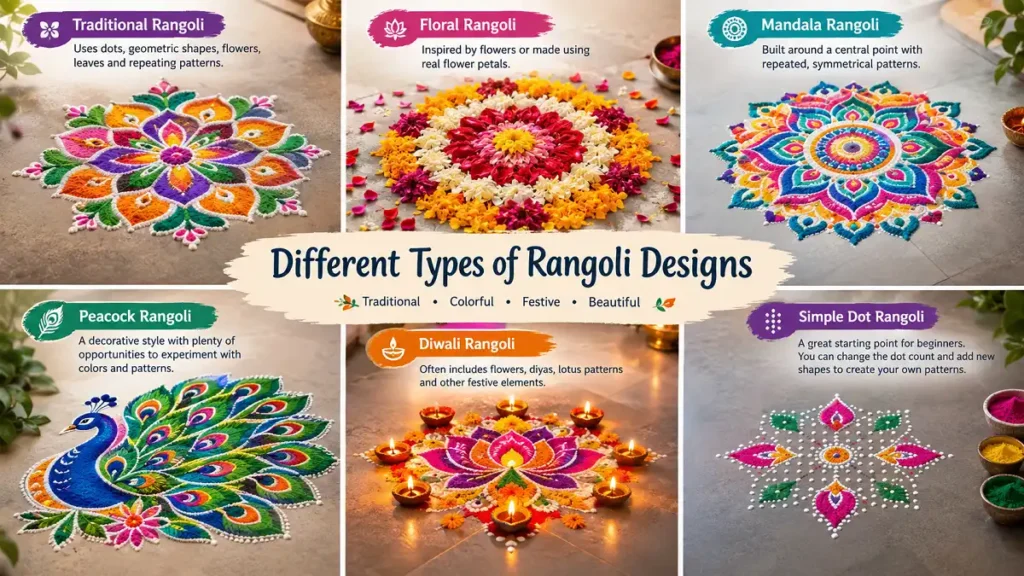
Over the years, I’ve tried many different styles, and each one has something different to offer.
Traditional Rangoli
Traditional Rangoli designs often use dots, geometric shapes, flowers, leaves, and repeating patterns.
Floral Rangoli
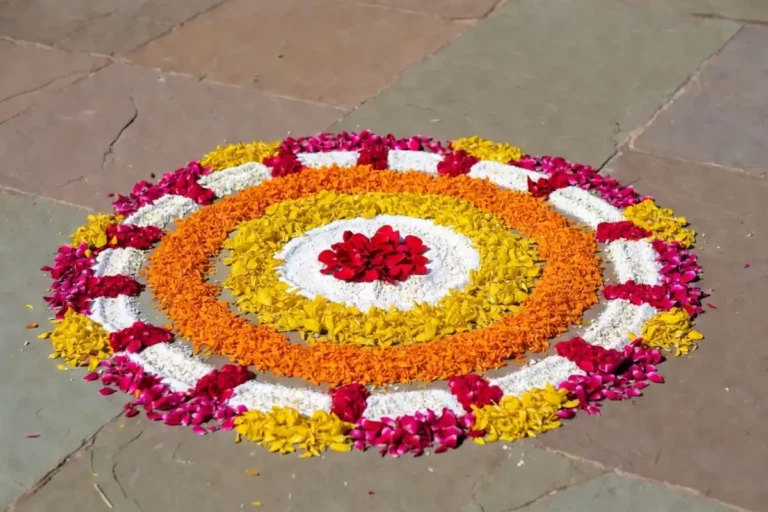
Floral Rangoli can refer to designs inspired by flowers or Rangoli made using real flower petals.
Explore simple flower Rangoli ideas →Mandala Rangoli
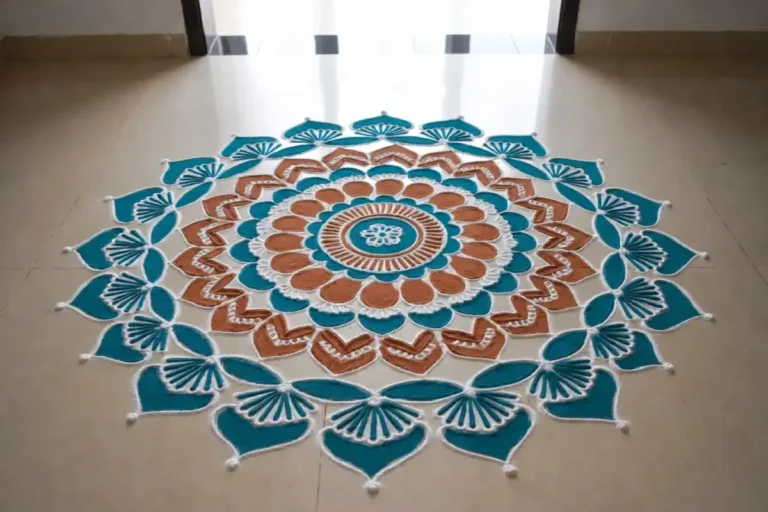
Mandala Rangoli is built around a central point and usually features repeated, symmetrical patterns.
Peacock Rangoli
Peacock Rangoli is one of the more decorative styles. The feathers give you plenty of opportunities to experiment with colors and patterns.
Diwali Rangoli
Diwali designs often include flowers, diyas, lotus patterns, and other festive elements.
Explore easy Diwali Rangoli ideas →Simple Dot Rangoli
A simple dot Rangoli is traditional but easy to practice. Once you understand the structure, you can gradually create your own patterns.
Which Festivals and Occasions Use Rangoli?
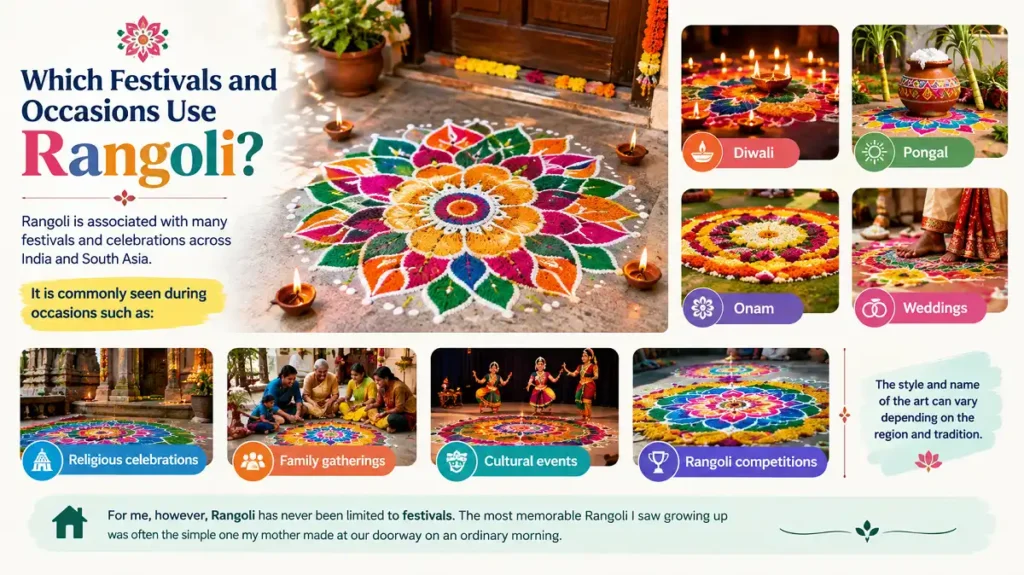
Rangoli is associated with many festivals and celebrations across India and South Asia.
It is commonly seen during occasions such as:
The style and name of the art can vary depending on the region and tradition.
For me, however, Rangoli has never been limited to festivals. The most memorable Rangoli I saw growing up was often the simple one my mother made at our doorway on an ordinary morning.
That’s one of the reasons I believe you don’t need to wait for a special occasion to make one.
How to Make Your Rangoli Look Better
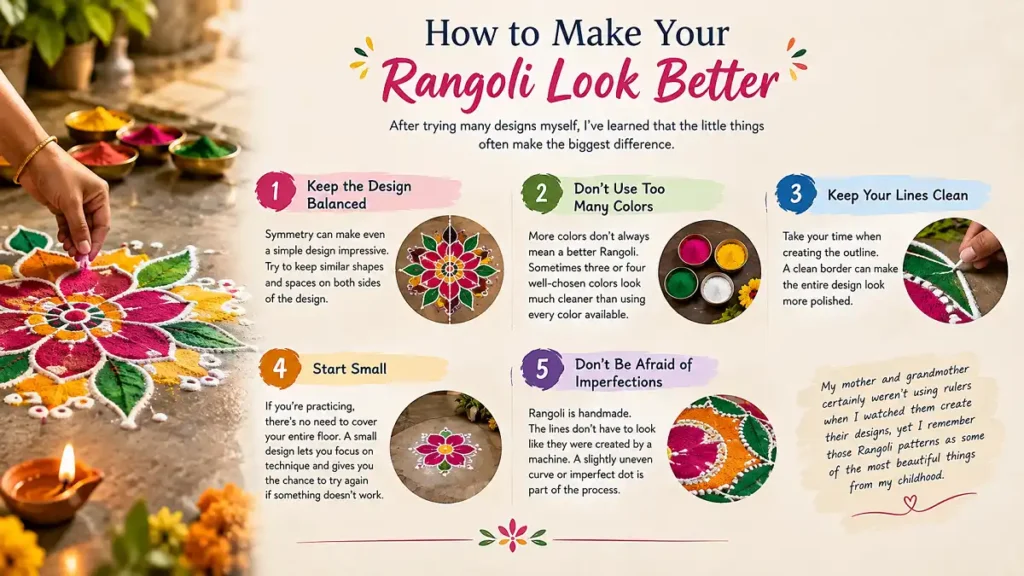
After trying many designs myself, I’ve learned that the little things often make the biggest difference.
Keep the Design Balanced
Symmetry can make even a simple design look impressive. Try to keep similar shapes and spaces on both sides of the design.
Don’t Use Too Many Colors
More colors don’t always mean a better Rangoli. Sometimes three or four well-chosen colors look much cleaner.
Keep Your Lines Clean
Take your time when creating the outline. A clean border can make the entire design look more polished.
Start Small
If you’re practicing, there’s no need to cover your entire floor. A small design lets you focus on technique.
Don’t Be Afraid of Imperfections
This is probably the most important lesson I’ve learned. Rangoli is handmade. The lines don’t have to look like they were created by a machine.
A slightly uneven curve or imperfect dot is part of the process. My mother and grandmother certainly weren’t using rulers when I watched them create their designs, yet I remember those Rangoli patterns as some of the most beautiful things from my childhood.
My Favorite Part of Making Rangoli
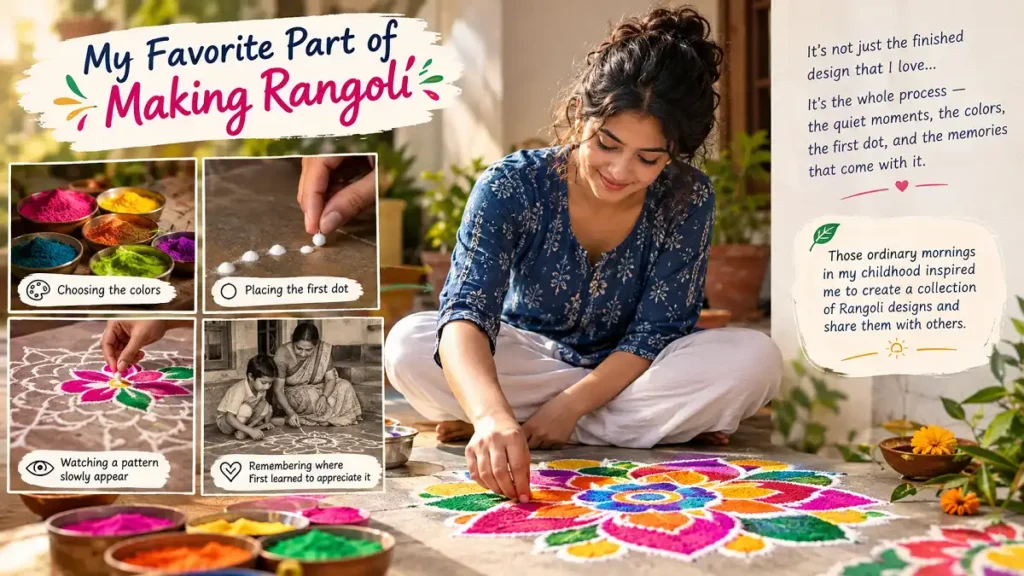
It’s the process.
It’s the quiet moment before starting.
It’s choosing the colors.
It’s placing the first dot.
It’s watching a pattern slowly appear where there was nothing before.
And sometimes, it’s remembering where I first learned to appreciate it.
When I sit down to create a Rangoli today, I often think about those mornings when I was a child, sitting on the steps and watching my mother and grandmother work.
I didn’t know then that those ordinary mornings would eventually inspire me to create a collection of Rangoli designs and share them with other people.
But that’s exactly what happened.
My Take on Rangoli Drawing
My love for Rangoli started long before I understood its history or learned how to create the designs myself.
It started with two people I watched every morning — my mother and my grandmother.
I remember sitting on those steps, watching them turn a few simple dots into beautiful patterns. At the time, it was simply part of everyday life. Looking back now, I realize that those mornings gave me something much more valuable than an appreciation for colorful designs.
They gave me a connection to a tradition that I still carry with me today.
If you’d like to see more Rangoli ideas and visual inspiration, you can also visit my Rangoli Designs Pinterest page .
FAQs
What is Rangoli Drawing?
Rangoli Drawing is a traditional form of floor art made with colored powder, rice flour, flower petals, or similar materials. Designs can include flowers, geometric patterns, dots, mandalas, birds, and other decorative elements.
Why do people draw Rangoli?
People draw Rangoli to decorate their homes during festivals, celebrations, and special occasions. In many traditions, Rangoli is also associated with welcoming guests, positivity, prosperity, and good fortune.
What is the easiest Rangoli design for beginners?
Simple flower, circular, and Dot Rangoli designs are good choices for beginners. They don’t require advanced drawing skills and are relatively easy to practice.
What materials are used to make Rangoli?
Common materials include colored Rangoli powder, white powder, rice flour, flower petals, and natural colors. Diyas and other decorations can also be added for special occasions.
Can I make Rangoli without Rangoli powder?
Yes. You can experiment with rice flour, flower petals, natural materials, or other suitable decorative powders depending on the type of design you want to create.
How can I make my Rangoli more colorful?
Try using contrasting colors and keeping the combinations balanced. Adding small details, white borders, flower petals, or diyas can also make the design more attractive.
Keep Creating, One Dot at a Time
Rangoli doesn’t have to be perfect to be beautiful. Start small, experiment with colors, and enjoy the process.
🪔 ✦ 🪷 ✦ 🪔