Easy Rangoli for Kids with Colour: Simple and Fun Rangoli Designs
I still remember how fascinated I was by Rangoli as a child. Whenever I saw colorful patterns taking shape on the floor, I would wonder how a few simple colors and shapes could turn into something so beautiful.
What caught my attention most was how every design seemed to begin with something small—just a few dots, lines, or simple shapes. Little by little, they turned into flowers, stars, diyas, butterflies, and beautiful patterns filled with color.
As I grew older, I started trying some of those designs myself. That’s when I realized that Rangoli doesn’t have to be complicated to be beautiful. In fact, simple designs are often the most fun to make, especially for children who are just discovering their creativity.
That is what inspired me to put together this collection of easy rangoli for kids with colour. I wanted to share simple ideas that children can actually try without feeling overwhelmed by complicated patterns or difficult techniques.
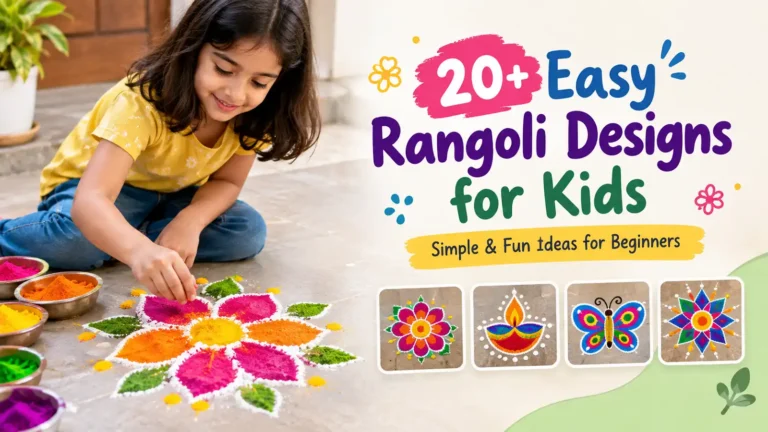
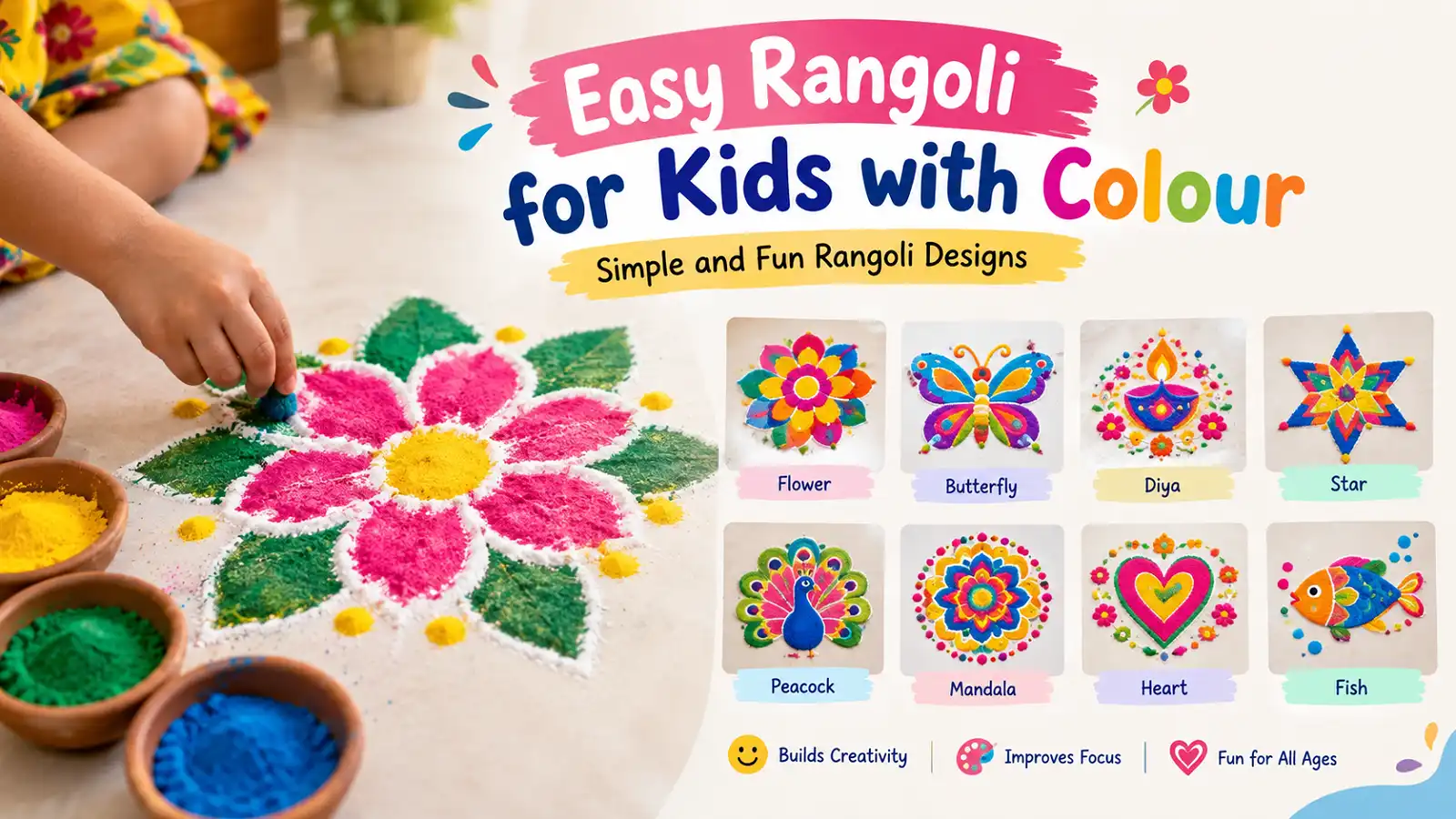
In this collection, you’ll find easy flowers, butterflies, diyas, stars, peacocks, geometric patterns, and more. Some designs are perfect for making with Rangoli powder, while others can be practiced on paper first with crayons, colored pencils, or sketch pens.
Whether you’re looking for a fun creative activity for your child, a simple Rangoli design for a festival, or just something colorful to make together, I hope these ideas give you an easy and enjoyable place to start.
So, grab a few colors, choose a design your child loves, and let the creativity begin!
20 Easy Rangoli for Kids With Colour
1. Simple Flower Rangoli
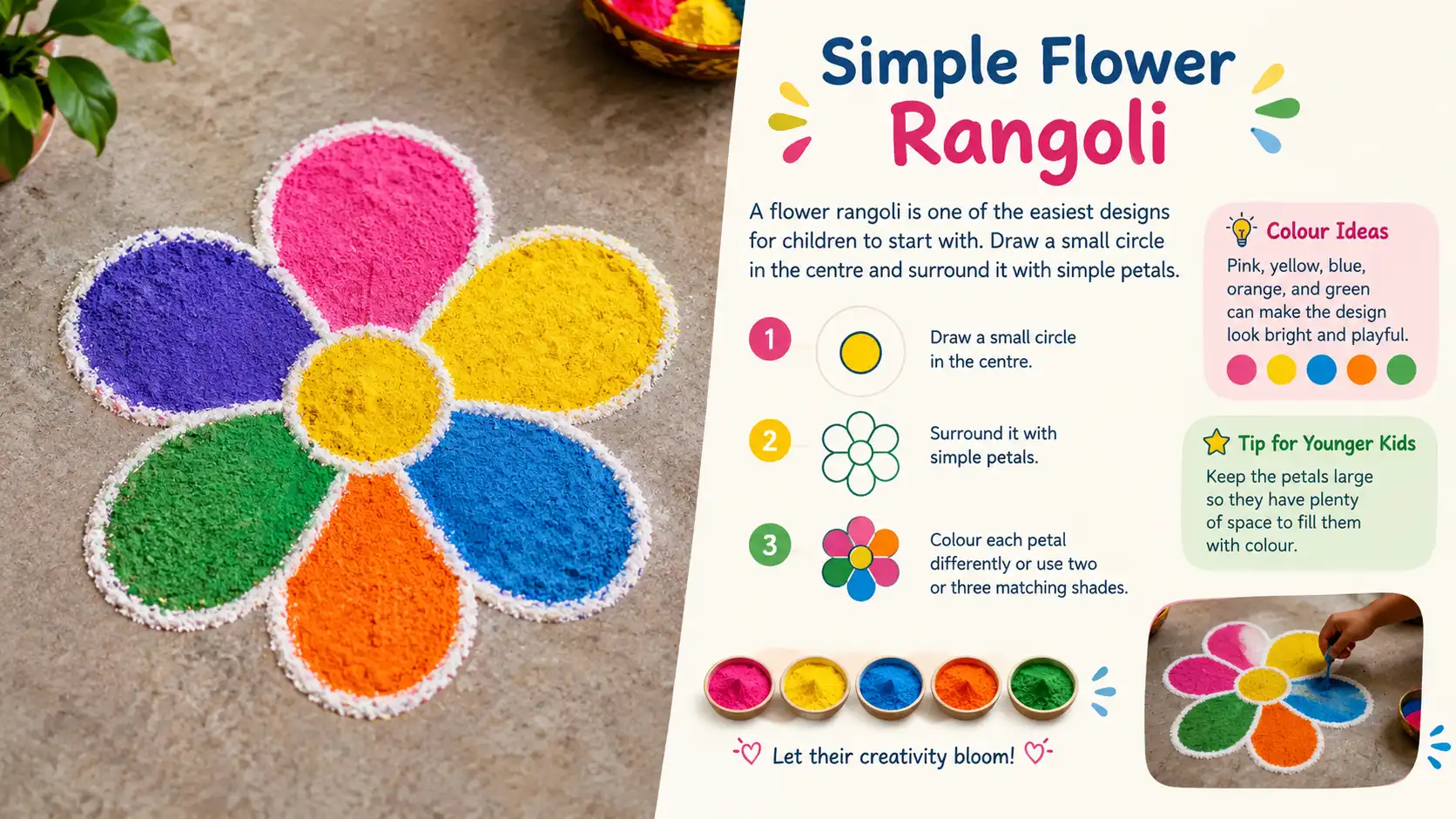
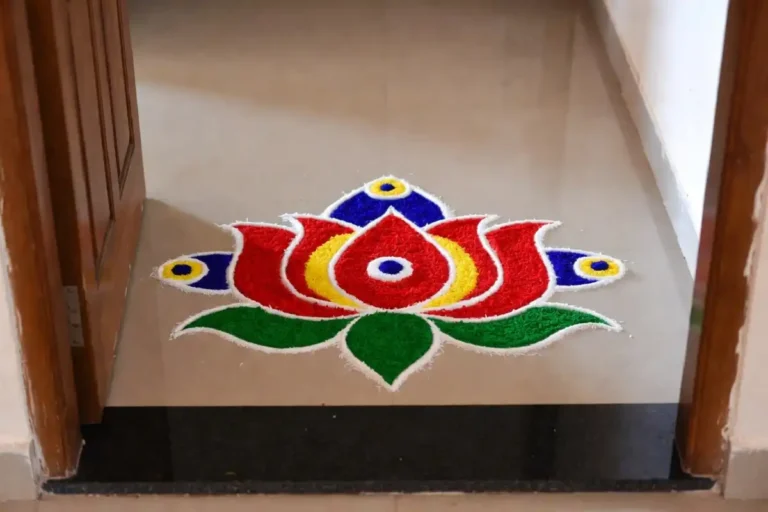
A flower rangoli is one of the easiest designs for children to start with. Draw a small circle in the centre and surround it with simple petals.
Kids can colour each petal differently or use two or three matching shades. Pink, yellow, blue, orange, and green can make the design look bright and playful.
For younger children, keep the petals large so they have plenty of space to fill them with colour.
2. Easy Dotted Rangoli
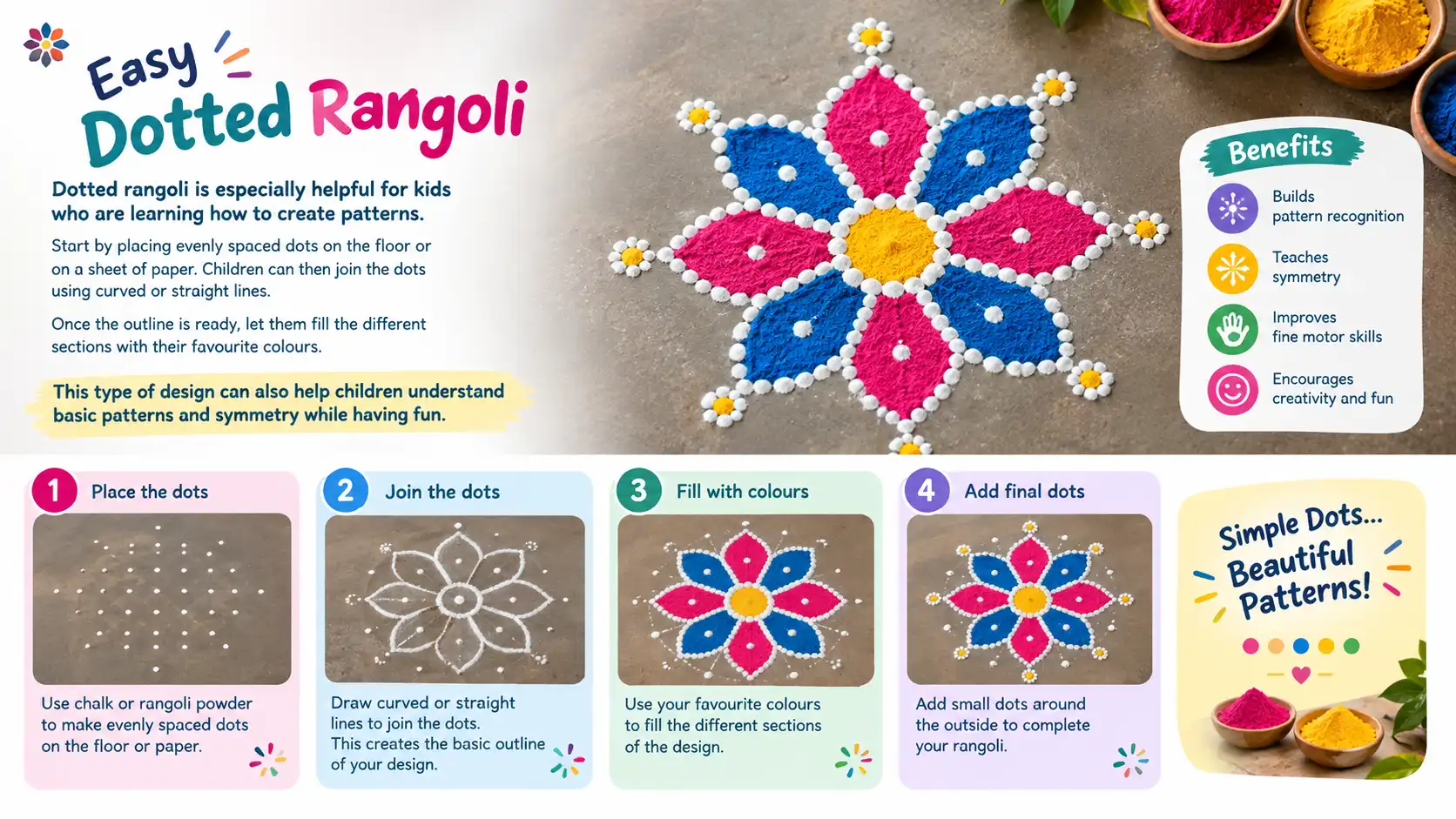
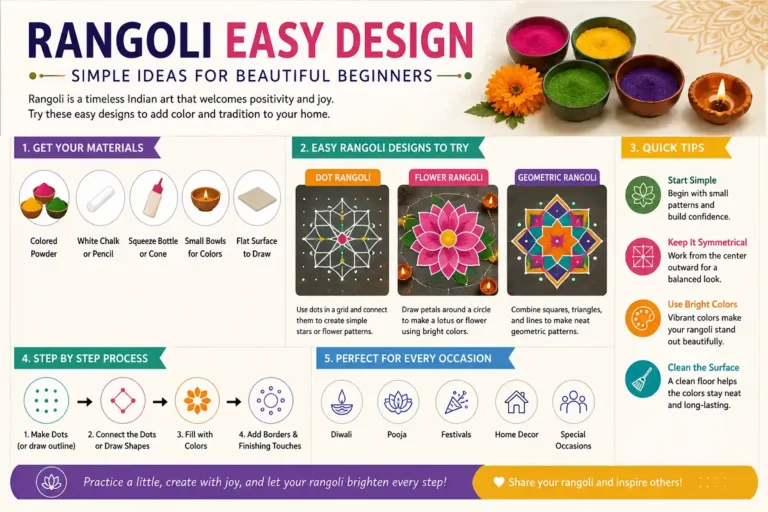
Dotted rangoli is especially helpful for kids who are learning how to create patterns.
Start by placing evenly spaced dots on the floor or on a sheet of paper. Children can then join the dots using curved or straight lines.
Once the outline is ready, let them fill the different sections with their favourite colours.
This type of design can also help children understand basic patterns and symmetry while having fun.
3. Colourful Butterfly Rangoli
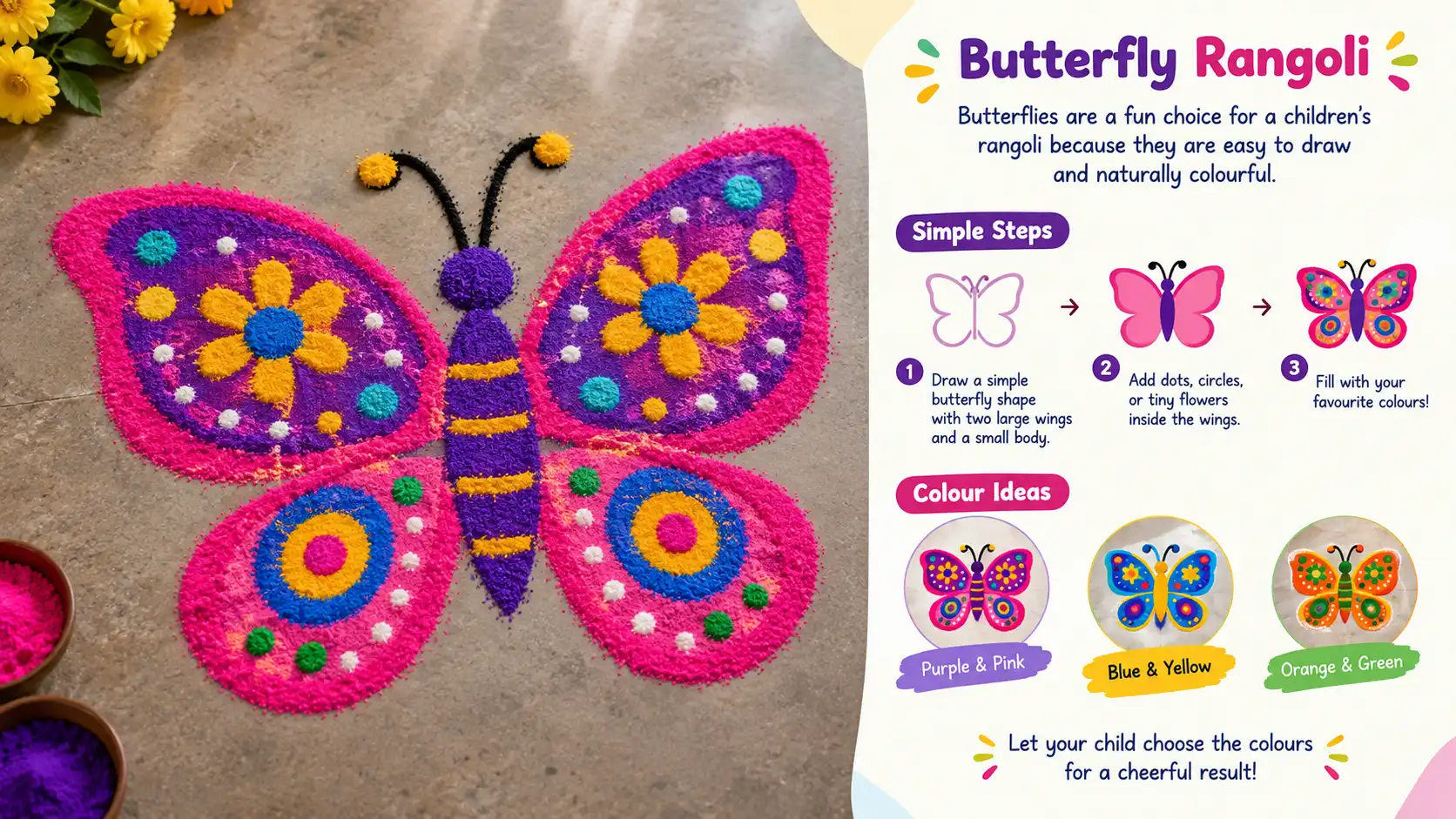
Butterflies are a fun choice for a children’s rangoli because they are easy to draw and naturally colourful.
Create a simple butterfly shape with two large wings and a small body in the centre. Add dots, circles, or tiny flowers inside the wings.
Let your child choose the colours. A combination of purple and pink, blue and yellow, or orange and green can create a cheerful result.
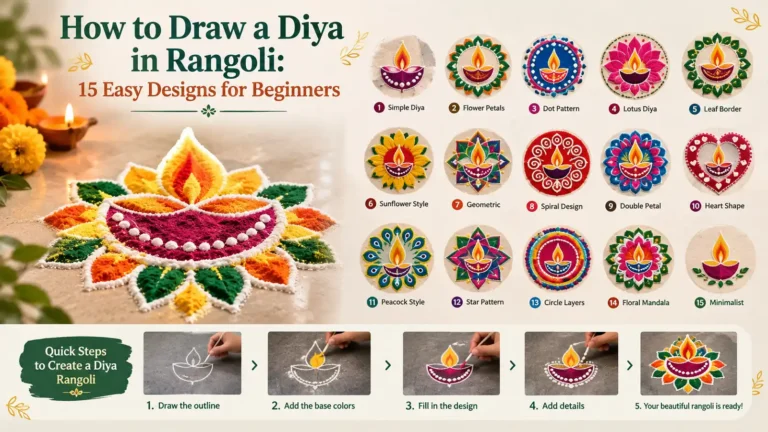
4. Easy Diya Rangoli
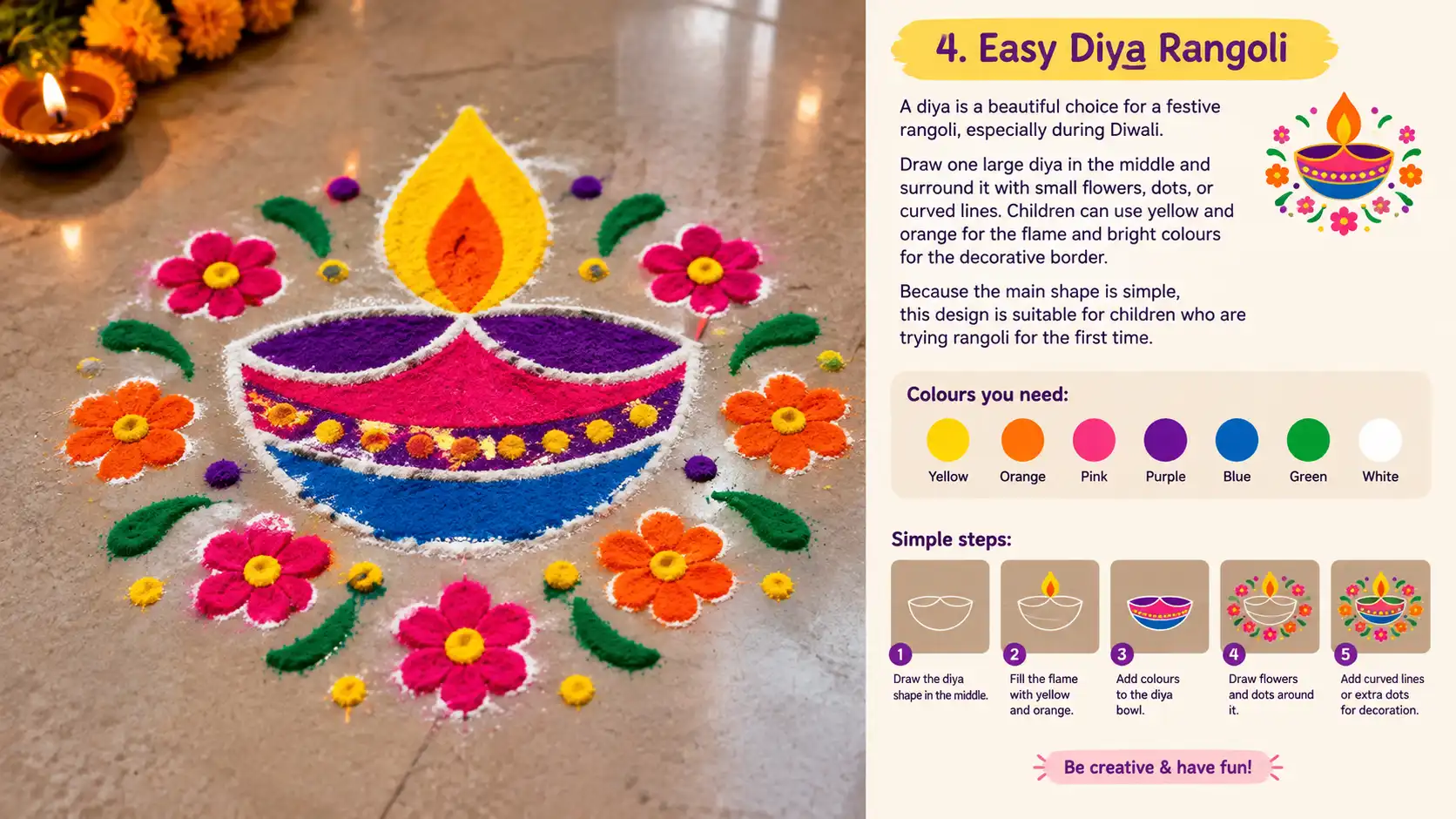
A diya is a beautiful choice for a festive rangoli, especially during Diwali.
Draw one large diya in the middle and surround it with small flowers, dots, or curved lines. Children can use yellow and orange for the flame and bright colours for the decorative border.
Because the main shape is simple, this design is suitable for children who are trying rangoli for the first time.
5. Rainbow Rangoli
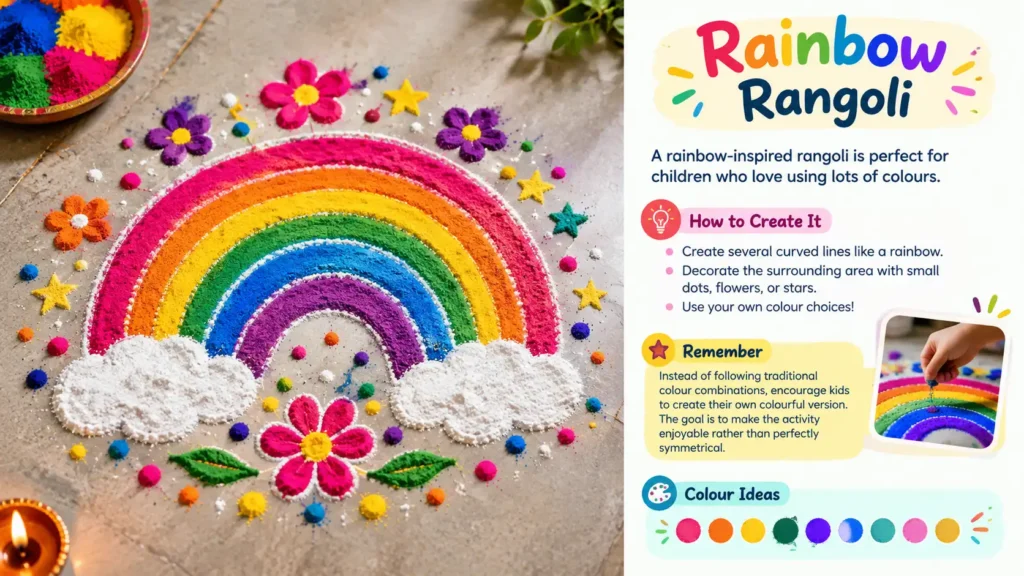
A rainbow-inspired rangoli is perfect for children who love using lots of colours.
Create several curved lines like a rainbow and decorate the surrounding area with small dots, flowers, or stars.
Instead of following traditional colour combinations, encourage kids to create their own colourful version. The goal is to make the activity enjoyable rather than perfectly symmetrical.
6. Easy Peacock Rangoli
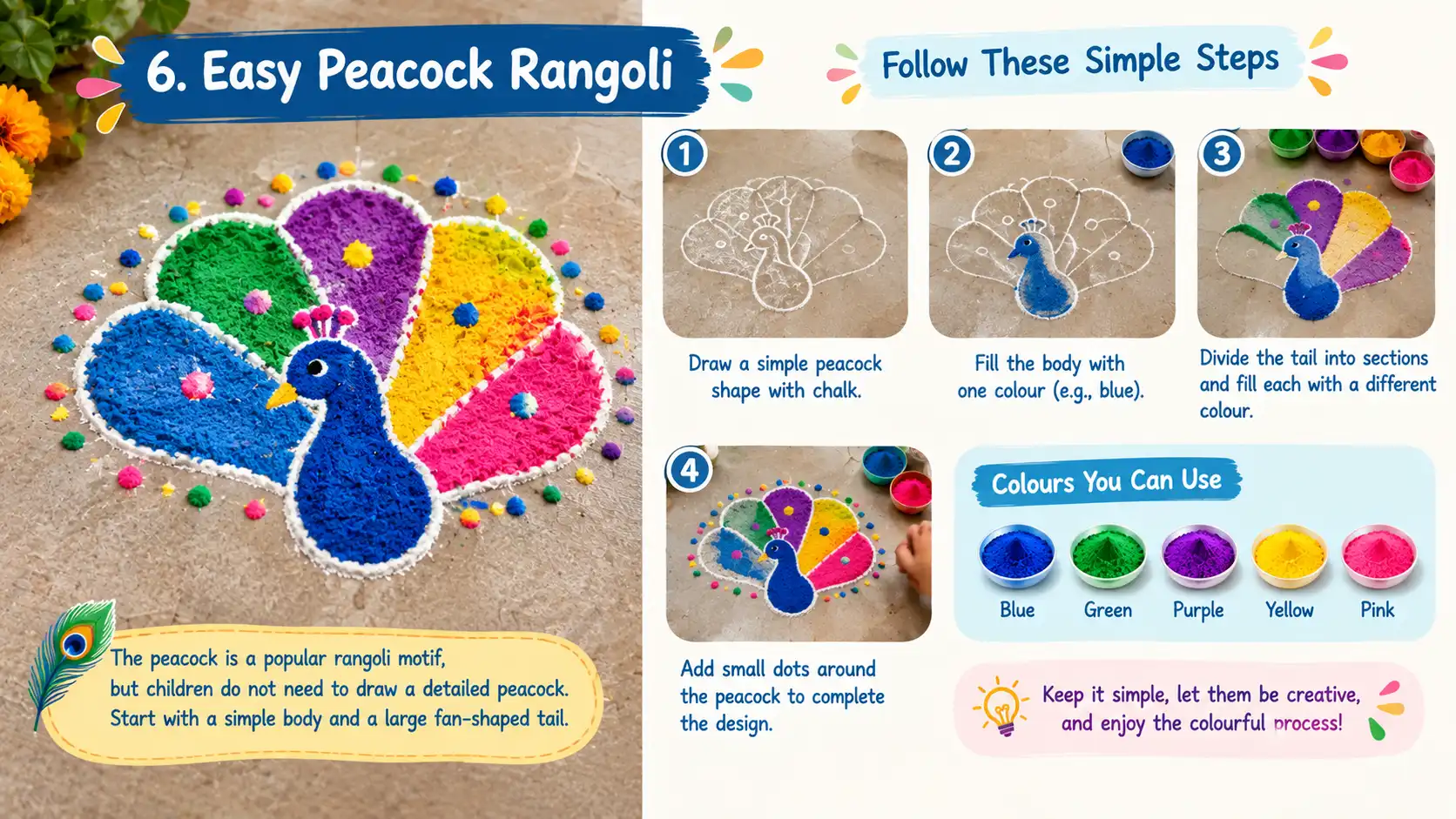
The peacock is a popular rangoli motif, but children do not need to draw a detailed peacock.
Start with a simple body and a large fan-shaped tail. Divide the tail into several sections and fill each section with a different colour.
Blue, green, purple, yellow, and pink can make the design look lively. You can also add small dots around the peacock to complete the rangoli.
7. Heart-Shaped Rangoli
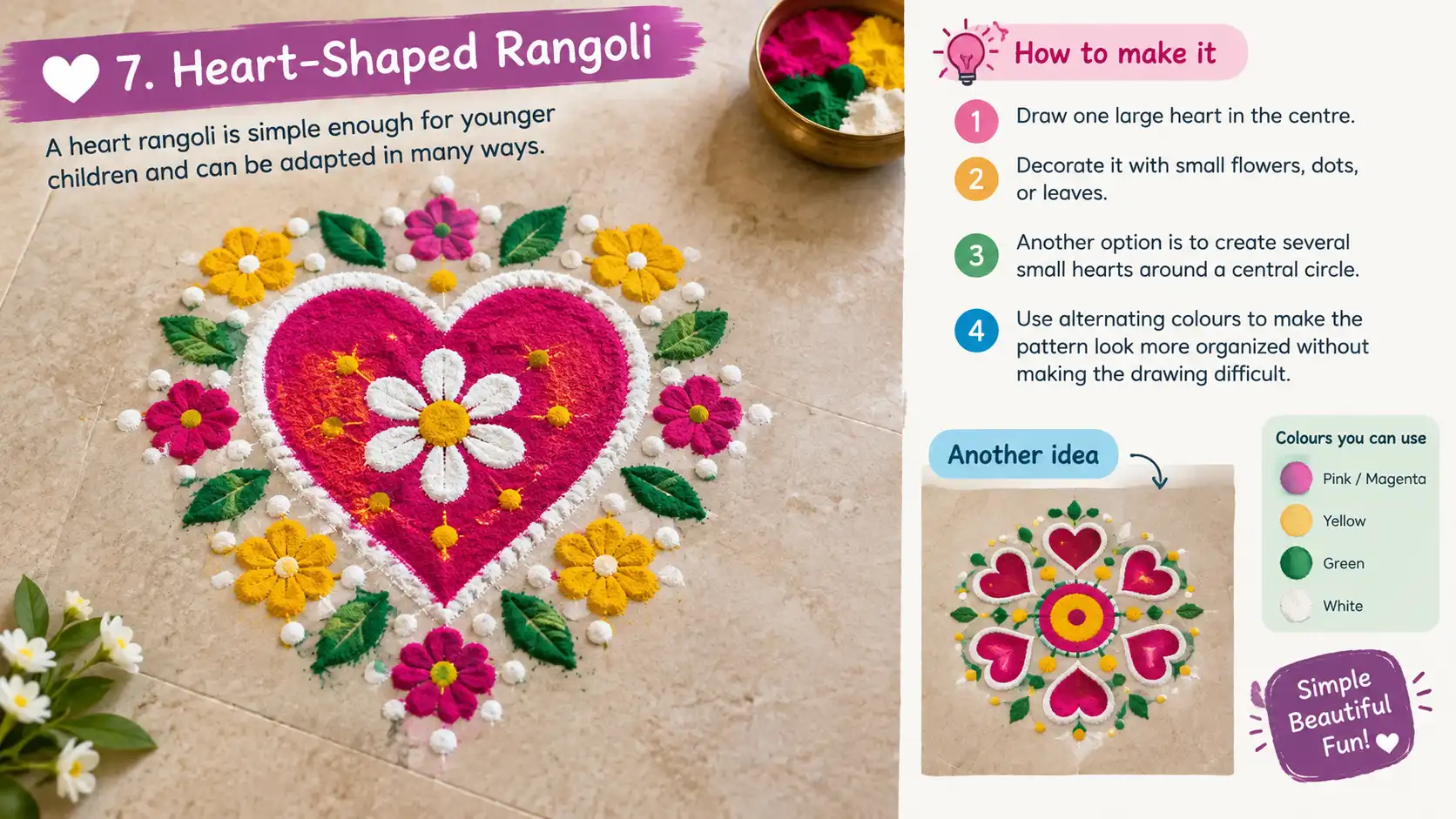
A heart rangoli is simple enough for younger children and can be adapted in many ways.
Draw one large heart in the centre and decorate it with small flowers, dots, or leaves. Another option is to create several small hearts around a central circle.
Using alternating colours makes the pattern look more organized without making the drawing difficult.
8. Easy Mandala Rangoli for Kids
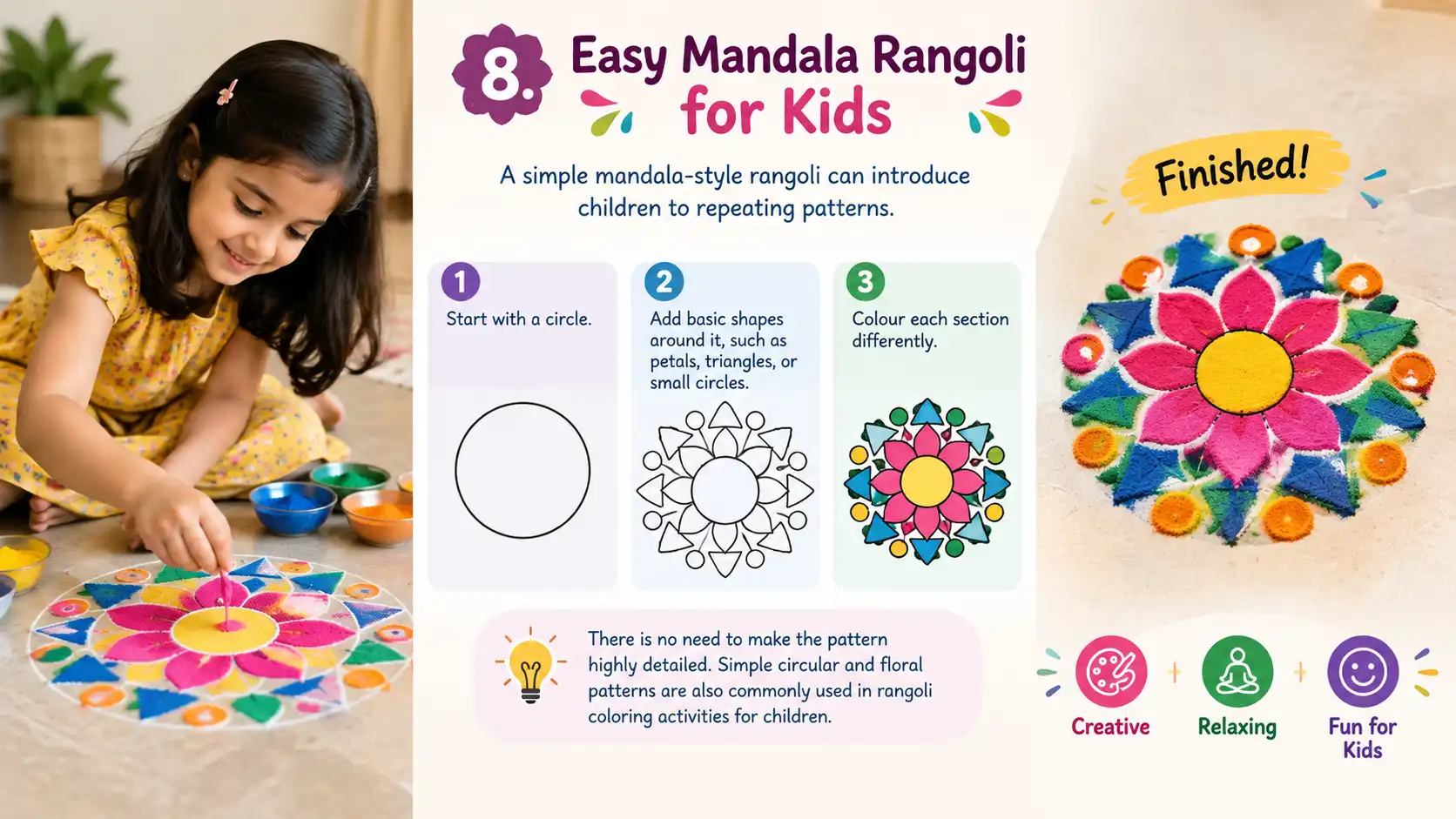
A simple mandala-style rangoli can introduce children to repeating patterns.
Begin with a circle and add basic shapes around it, such as petals, triangles, or small circles. There is no need to make the pattern highly detailed.
Once the outline is complete, children can colour each section differently. This makes the activity both creative and relaxing.
Simple circular and floral patterns are also commonly used in rangoli coloring activities for children.
9. Leaf Rangoli
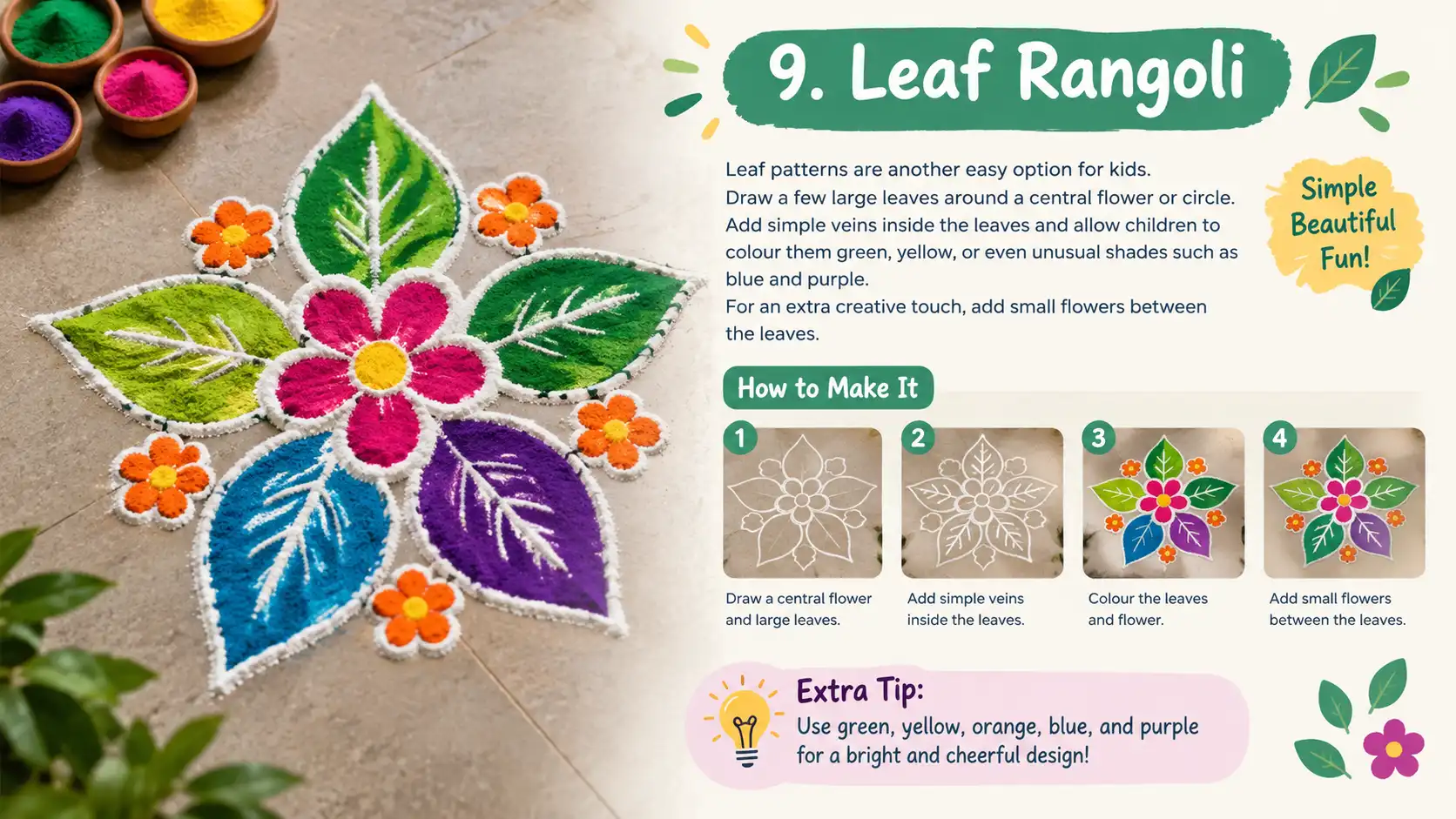
Leaf patterns are another easy option for kids.
Draw a few large leaves around a central flower or circle. Add simple veins inside the leaves and allow children to colour them green, yellow, or even unusual shades such as blue and purple.
For an extra creative touch, add small flowers between the leaves.
10. Geometric Rangoli
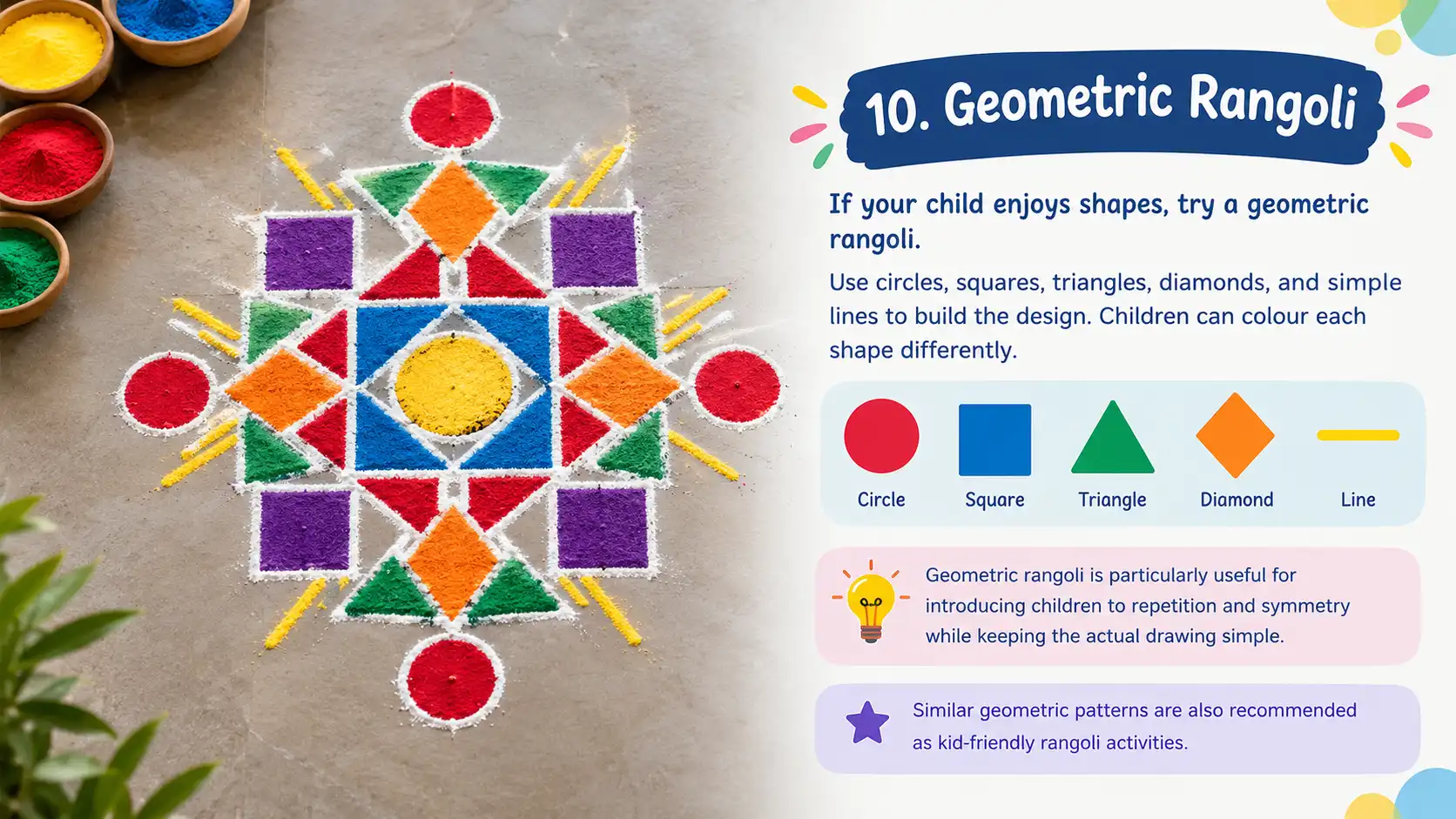
If your child enjoys shapes, try a geometric rangoli.
Use circles, squares, triangles, diamonds, and simple lines to build the design. Children can colour each shape differently.
Geometric rangoli is particularly useful for introducing children to repetition and symmetry while keeping the actual drawing simple. Similar geometric patterns are also recommended as kid-friendly rangoli activities.
11. Sun Rangoli
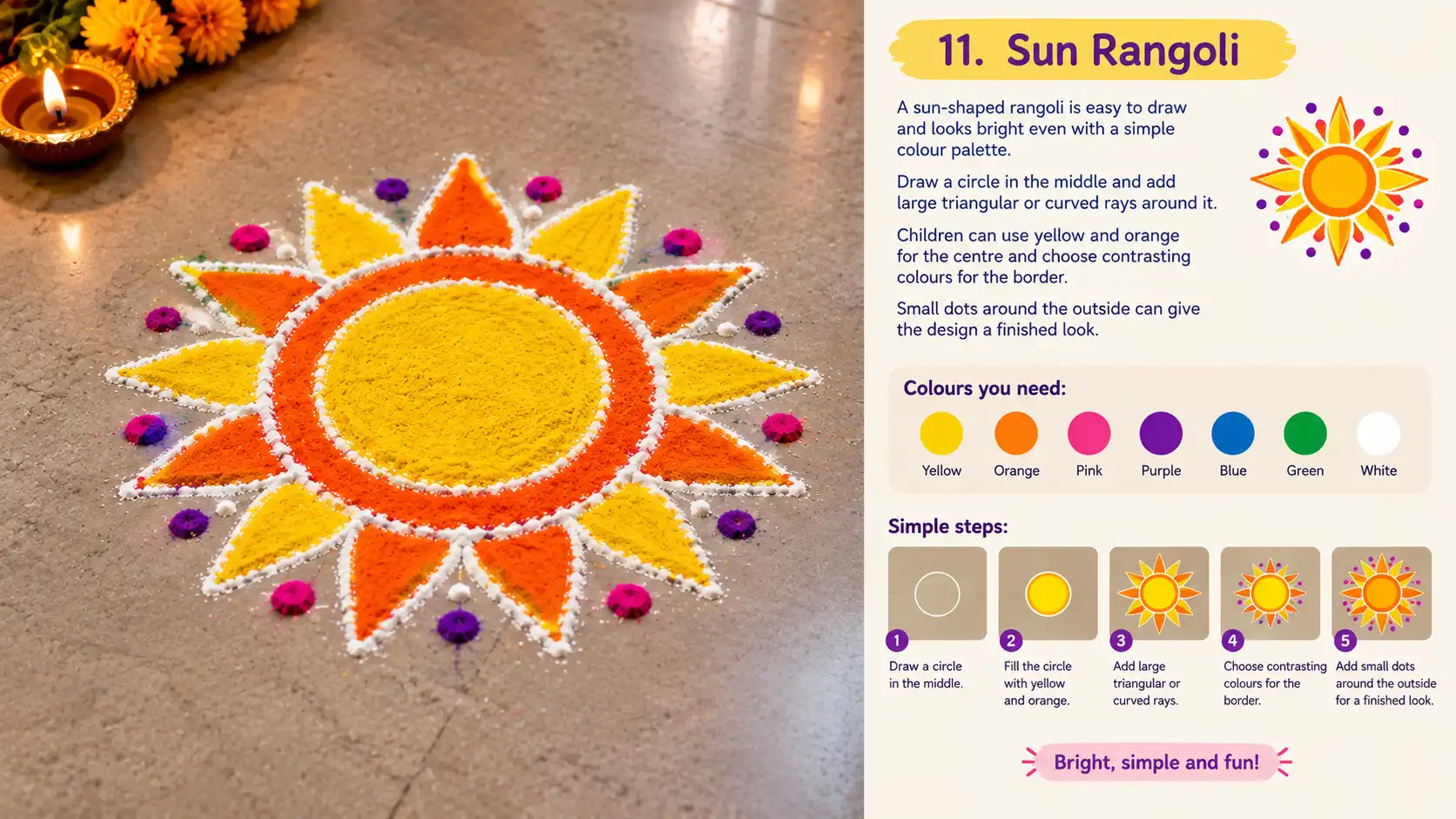
A sun-shaped rangoli is easy to draw and looks bright even with a simple colour palette.
Draw a circle in the middle and add large triangular or curved rays around it. Children can use yellow and orange for the centre and choose contrasting colours for the border.
Small dots around the outside can give the design a finished look.
12. Easy Flower and Dot Rangoli
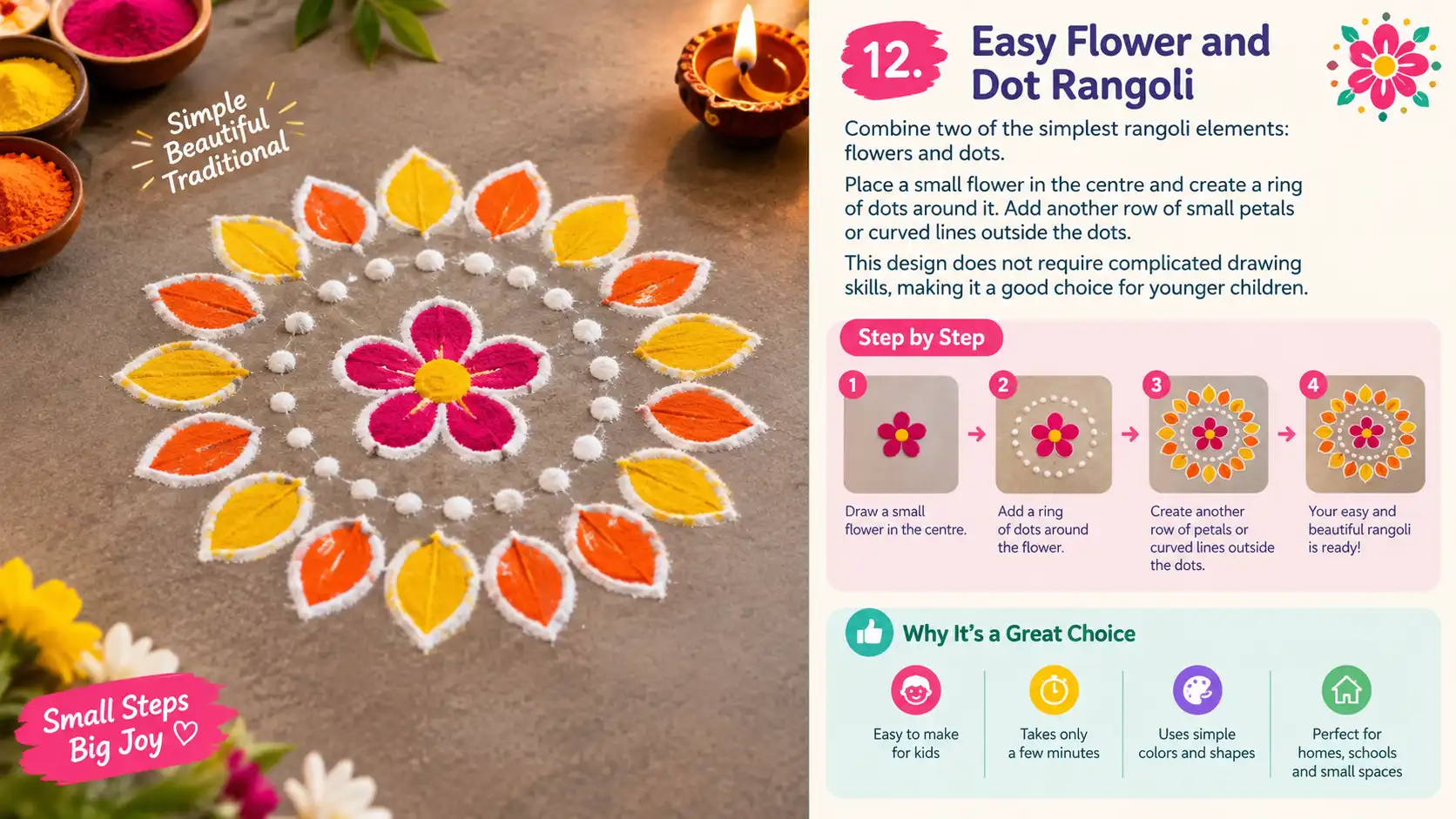
Combine two of the simplest rangoli elements: flowers and dots.
Place a small flower in the centre and create a ring of dots around it. Add another row of small petals or curved lines outside the dots.
This design does not require complicated drawing skills, making it a good choice for younger children.
13. Fish Rangoli
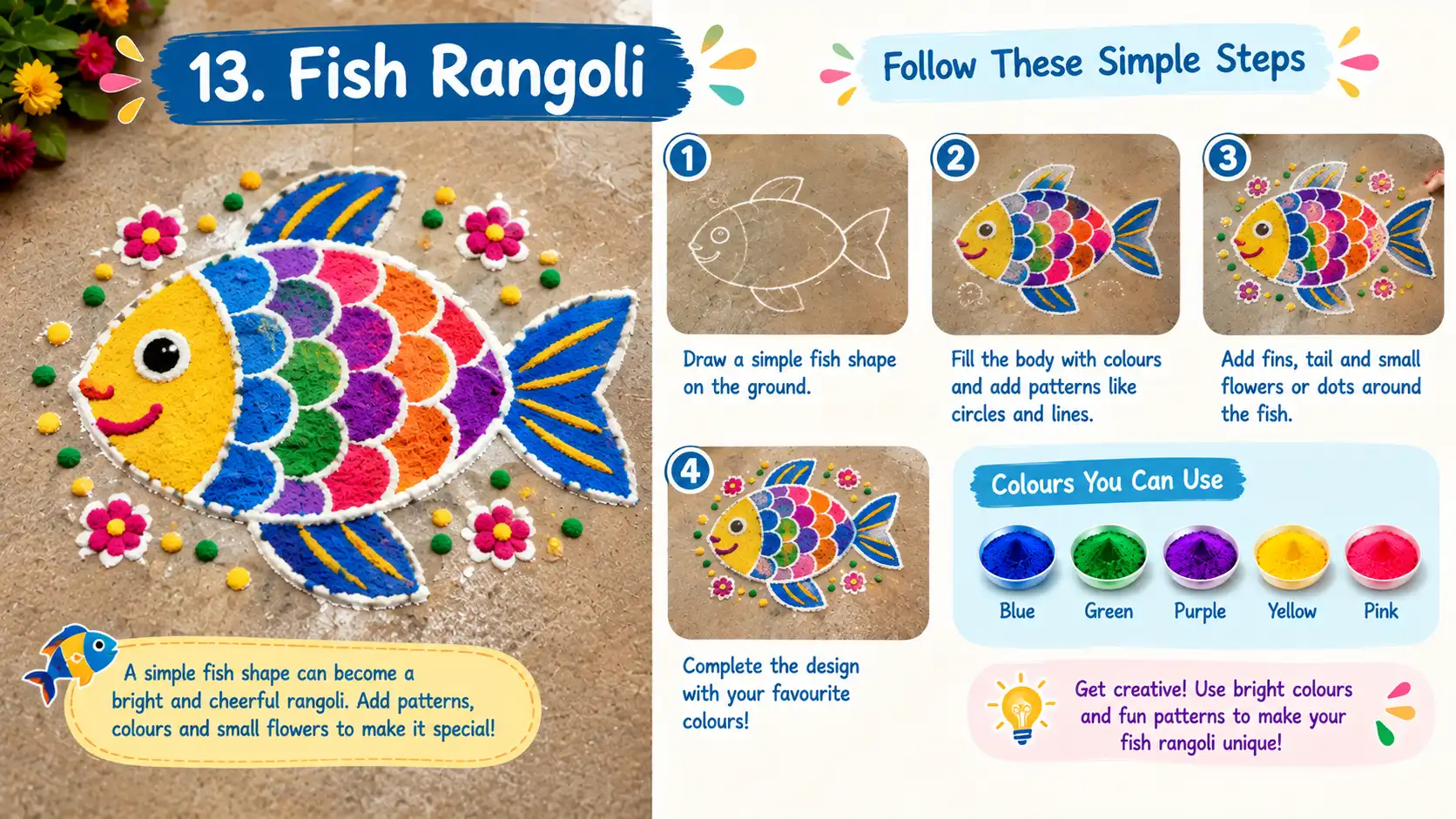
A simple fish shape can become a cute and colourful rangoli design.
Draw one large fish in the centre and decorate its body with circles, lines, and small patterns. Children can choose bright colours for the scales and add tiny flowers or dots around the fish.
This is a great option when you want something different from the usual floral rangoli.
14. Easy Star Rangoli
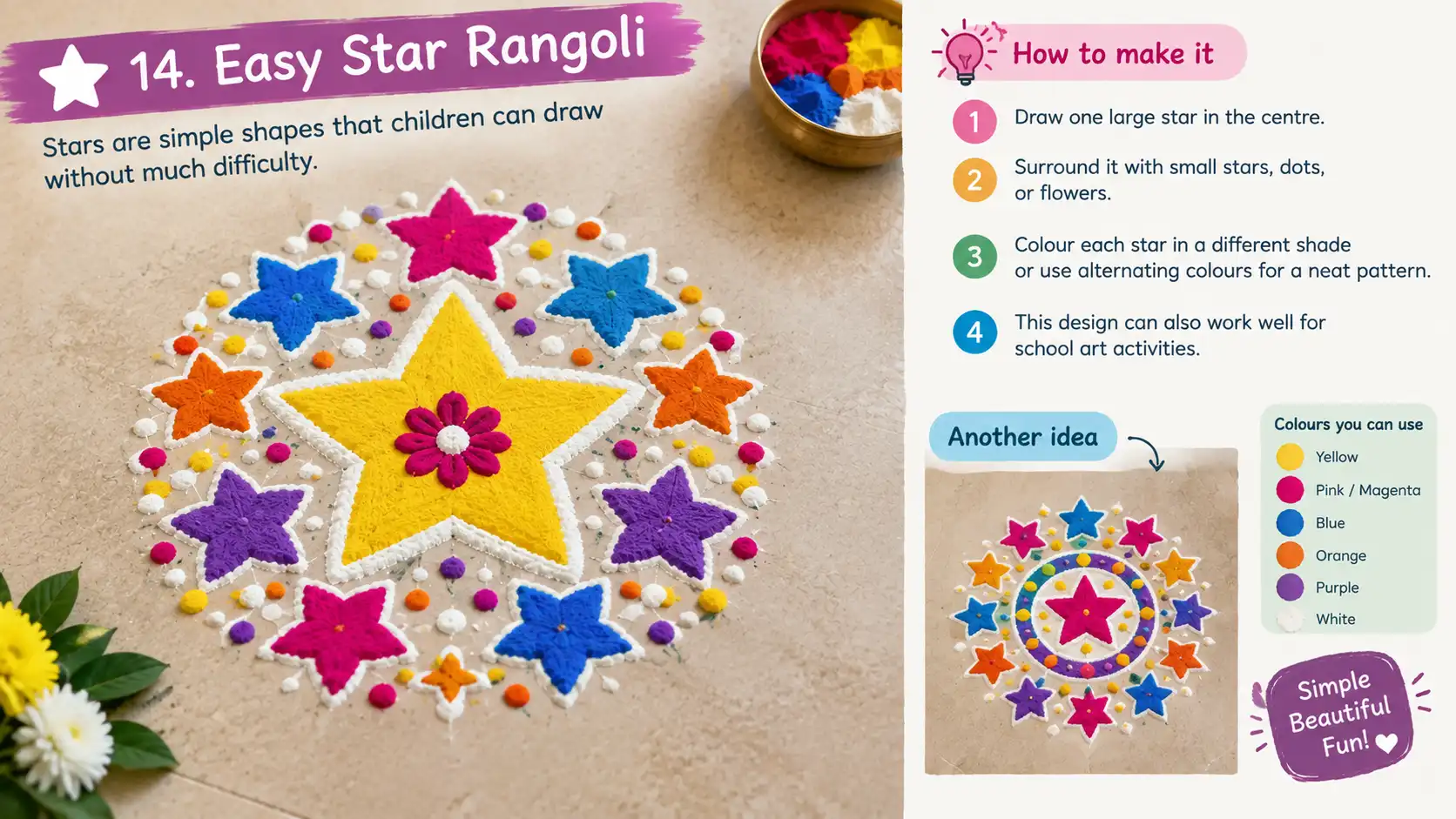
Stars are simple shapes that children can draw without much difficulty.
Create one large star in the middle and surround it with small stars, dots, or flowers. Colour each star in a different shade or use alternating colours for a neat pattern.
This design can also work well for school art activities.
15. Circular Colour Rangoli
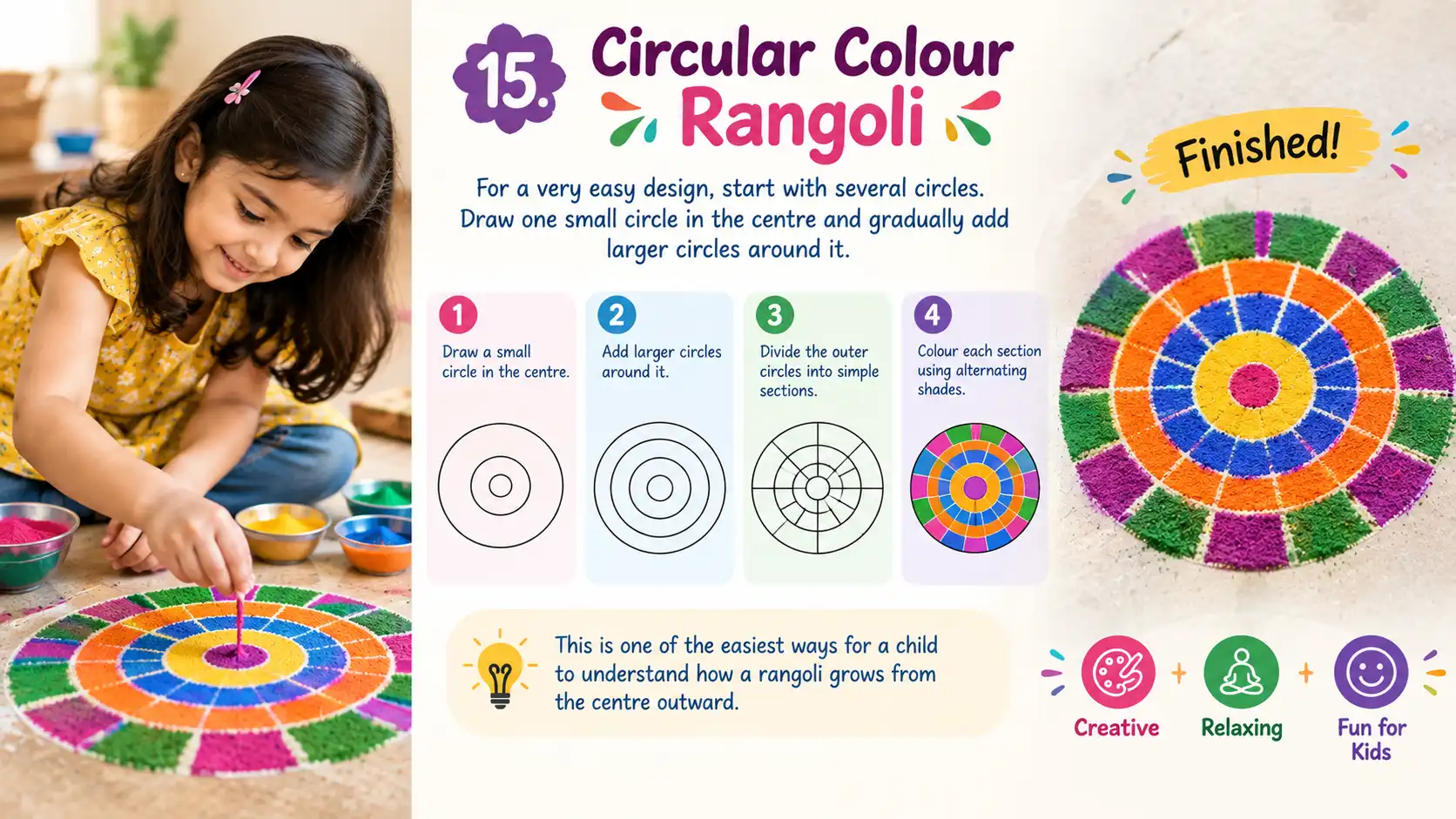
For a very easy design, start with several circles.
Draw one small circle in the centre and gradually add larger circles around it. Divide the outer circles into simple sections and colour them in alternating shades.
This is one of the easiest ways for a child to understand how a rangoli grows from the centre outward.
16. Easy Ganesha Rangoli for Kids
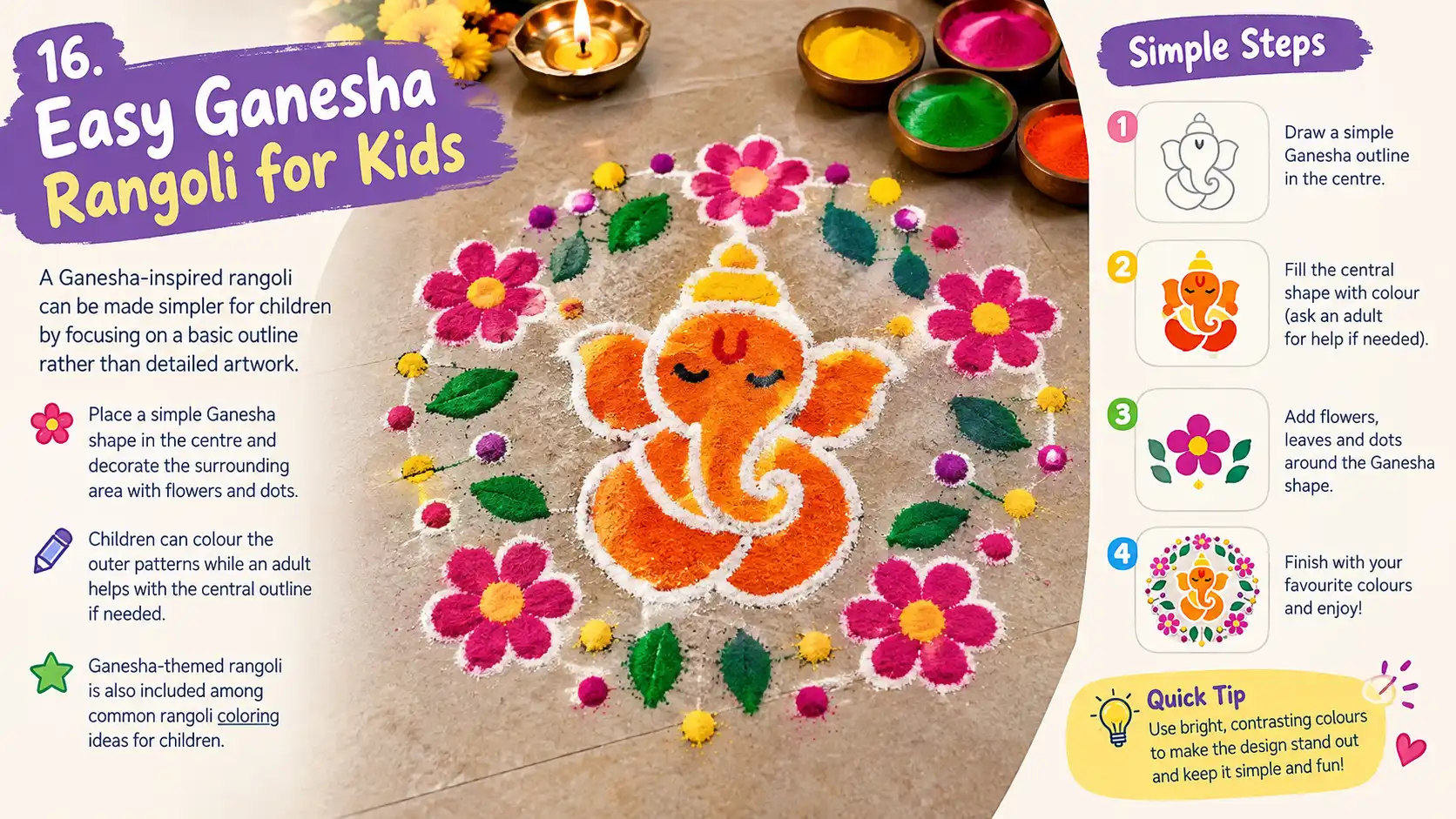
A Ganesha-inspired rangoli can be made simpler for children by focusing on a basic outline rather than detailed artwork.
Place a simple Ganesha shape in the centre and decorate the surrounding area with flowers and dots.
Children can colour the outer patterns while an adult helps with the central outline if needed. Ganesha-themed rangoli is also included among common rangoli coloring ideas for children.
17. Flower Petal Rangoli
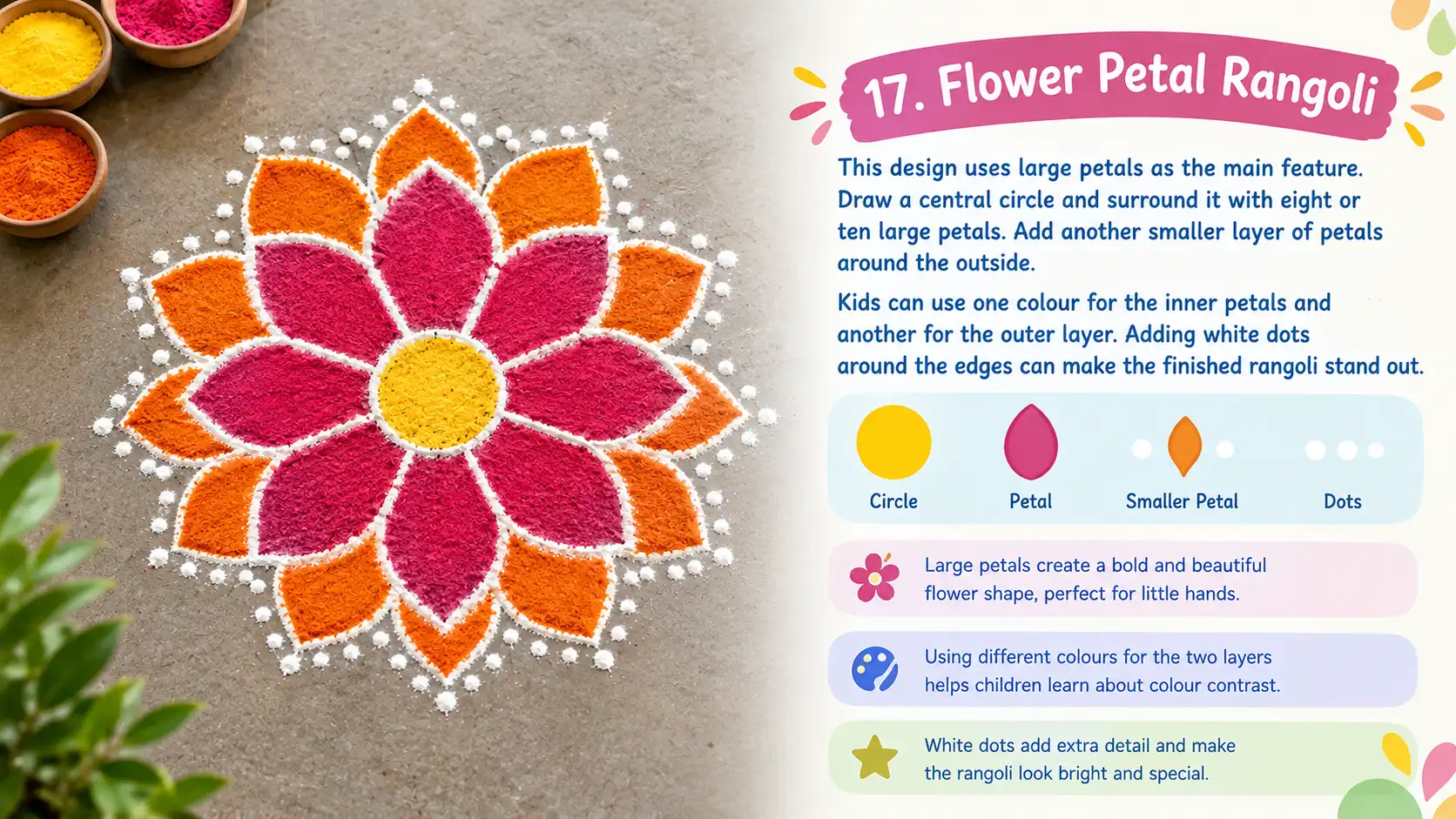
This design uses large petals as the main feature.
Draw a central circle and surround it with eight or ten large petals. Add another smaller layer of petals around the outside.
Kids can use one colour for the inner petals and another for the outer layer. Adding white dots around the edges can make the finished rangoli stand out.
18. Easy Diwali Rangoli for Kids
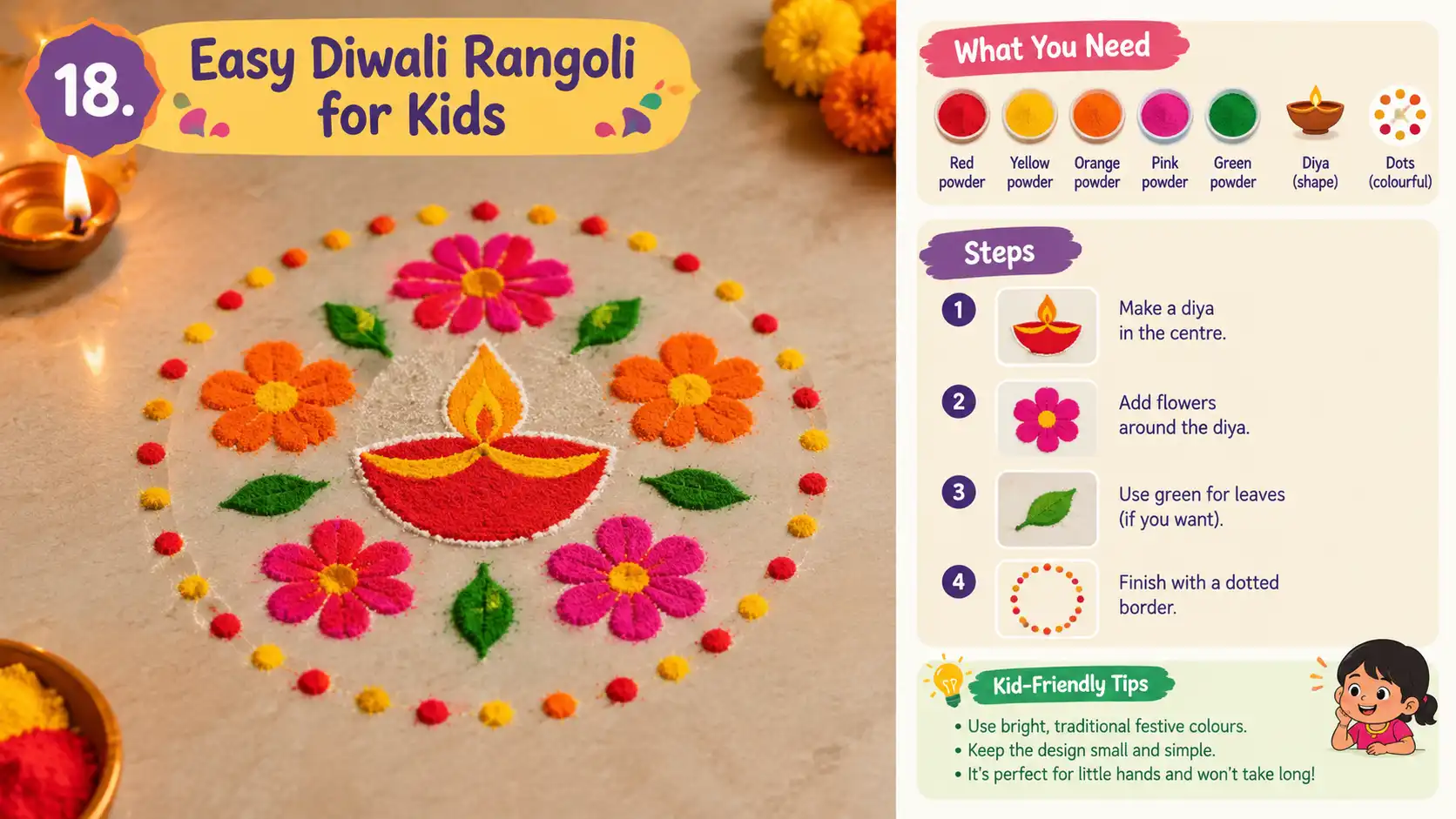
For a simple Diwali rangoli, combine three familiar elements: a diya, flowers, and dots.
Place a diya in the centre, add flowers around it, and finish with a dotted border.
Children can use traditional festive colours such as red, yellow, orange, pink, and green. The design can remain small so that children can complete it without getting tired.
19. Cute Smiley Rangoli
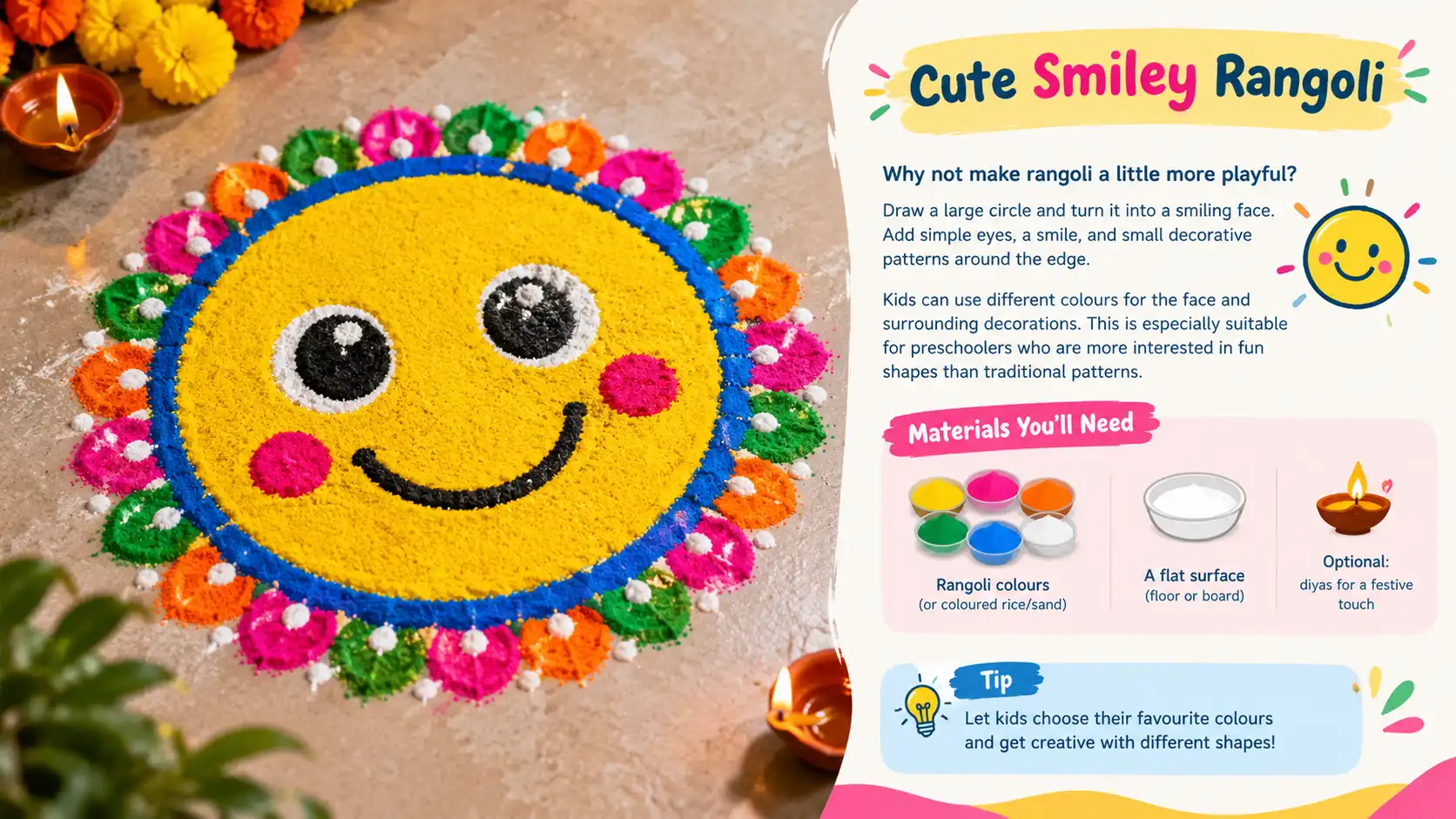
Why not make rangoli a little more playful?
Draw a large circle and turn it into a smiling face. Add simple eyes, a smile, and small decorative patterns around the edge.
Kids can use different colours for the face and surrounding decorations. This is especially suitable for preschoolers who are more interested in fun shapes than traditional patterns.
20. Mix-and-Match Colour Rangoli
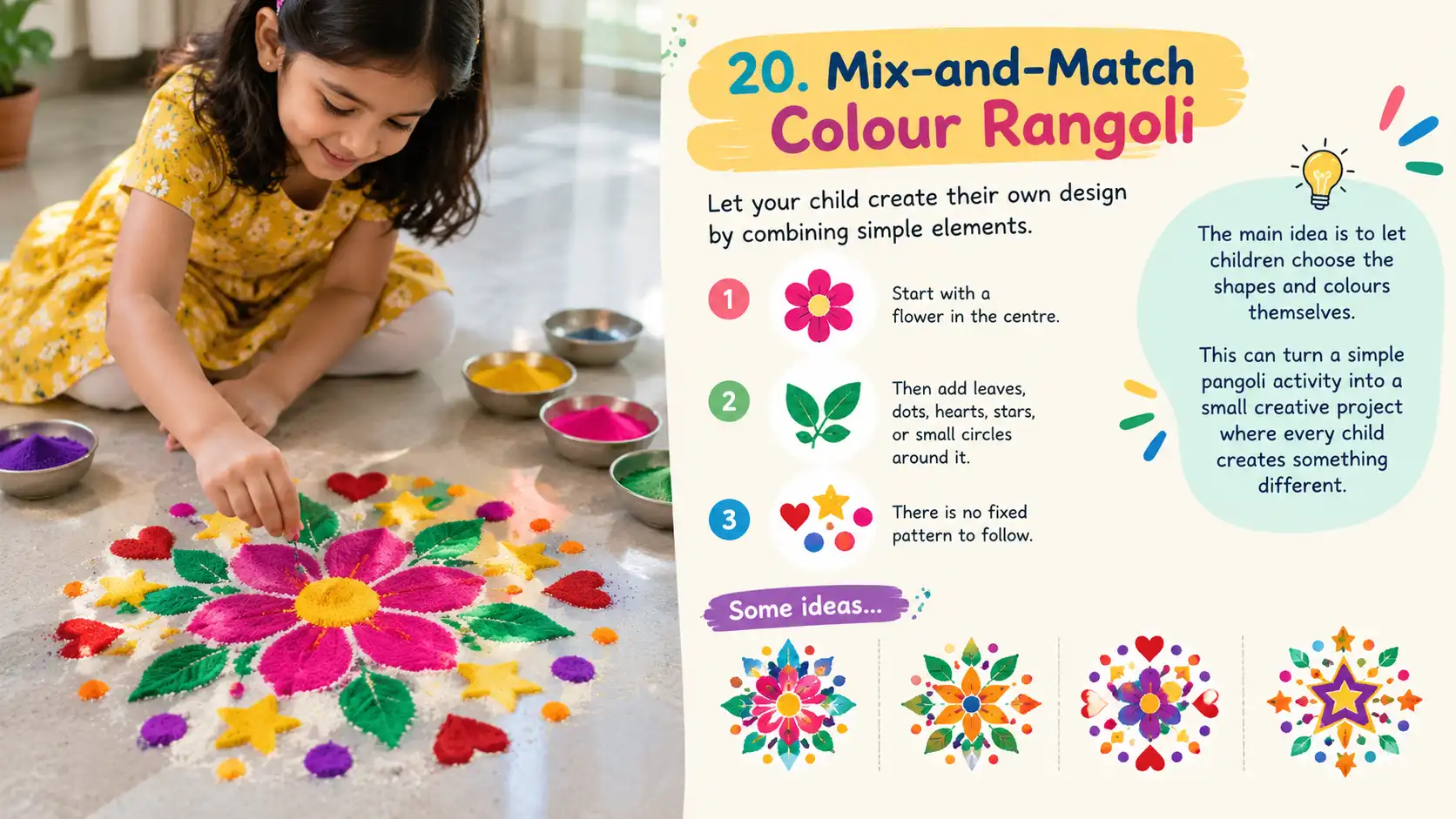
Let your child create their own design by combining simple elements.
Start with a flower in the centre, then add leaves, dots, hearts, stars, or small circles around it. There is no fixed pattern to follow.
The main idea is to let children choose the shapes and colours themselves. This can turn a simple rangoli activity into a small creative project where every child creates something different.
Tips for Making Rangoli Easier for Kids
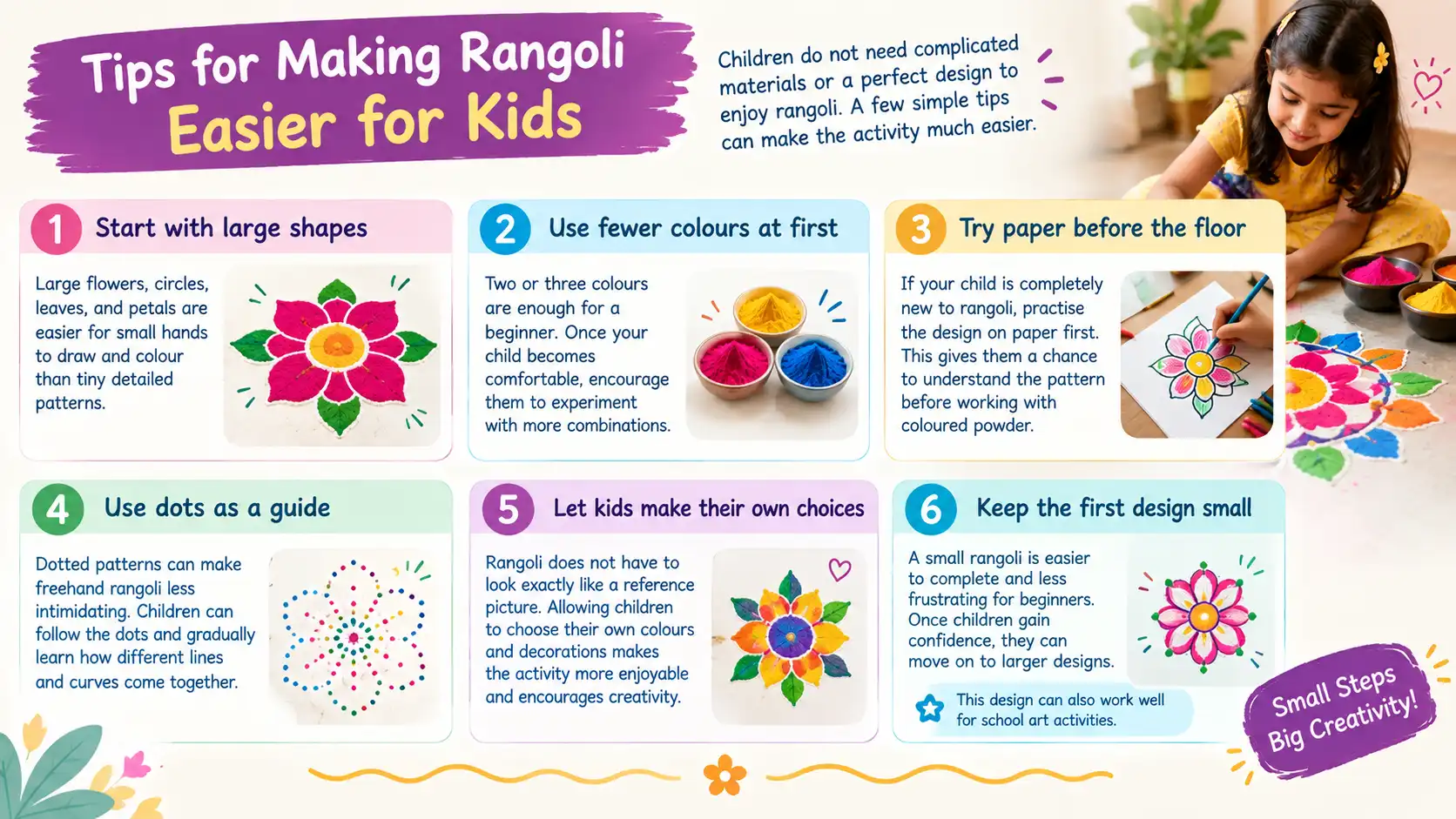
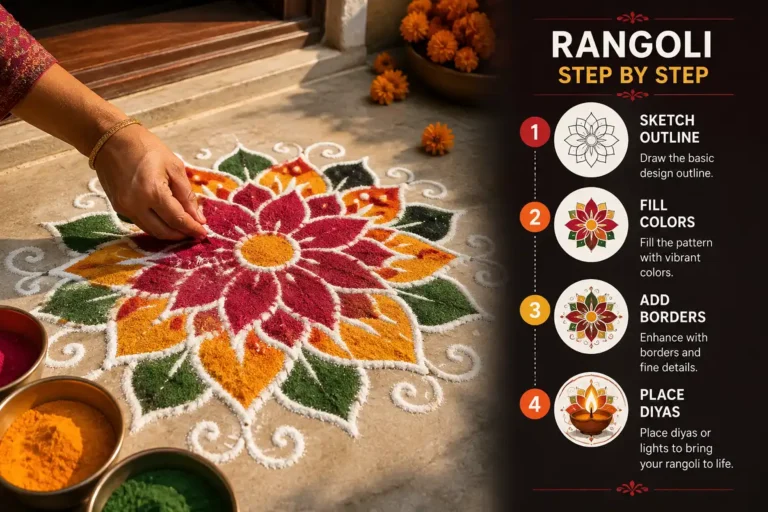
Children do not need complicated materials or a perfect design to enjoy rangoli. A few simple tips can make the activity much easier.
Start with large shapes
Large flowers, circles, leaves, and petals are easier for small hands to draw and colour than tiny detailed patterns.
Use fewer colours at first
Two or three colours are enough for a beginner. Once your child becomes comfortable, encourage them to experiment with more combinations.
Try paper before the floor
If your child is completely new to rangoli, practise the design on paper first. This gives them a chance to understand the pattern before working with coloured powder.
Use dots as a guide
Dotted patterns can make freehand rangoli less intimidating. Children can follow the dots and gradually learn how different lines and curves come together.
Let kids make their own choices
Rangoli does not have to look exactly like a reference picture. Allowing children to choose their own colours and decorations makes the activity more enjoyable and encourages creativity.
Keep the first design small
A small rangoli is easier to complete and less frustrating for beginners. Once children gain confidence, they can move on to larger designs.
Best Colours for Kids’ Rangoli
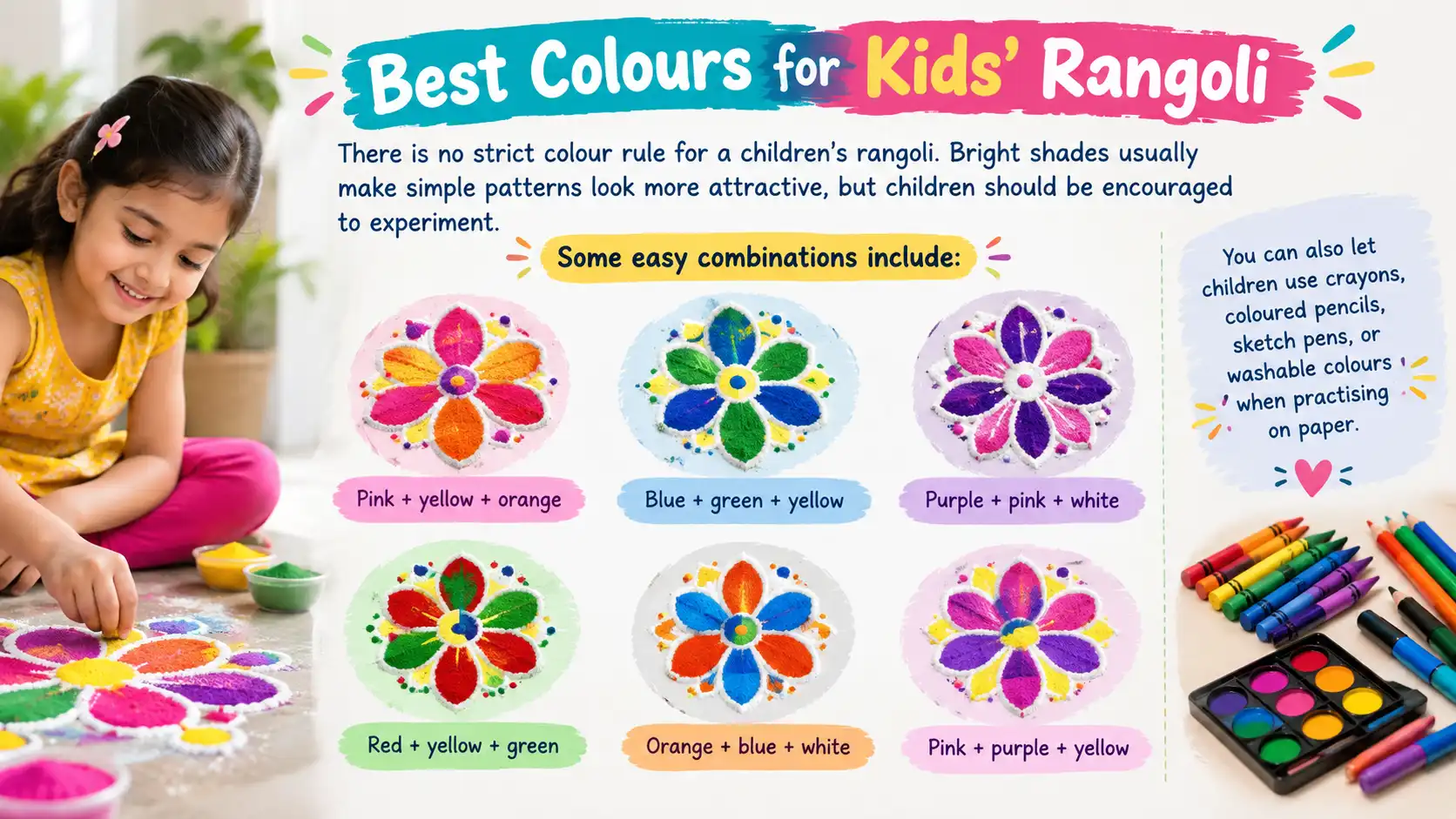
There is no strict colour rule for a children’s rangoli. Bright shades usually make simple patterns look more attractive, but children should be encouraged to experiment.
- Pink + yellow + orange
- Blue + green + yellow
- Purple + pink + white
- Red + yellow + green
- Orange + blue + white
- Pink + purple + yellow
You can also let children use crayons, coloured pencils, sketch pens, or washable colours when practising on paper.
Why Rangoli Is a Fun Activity for Children
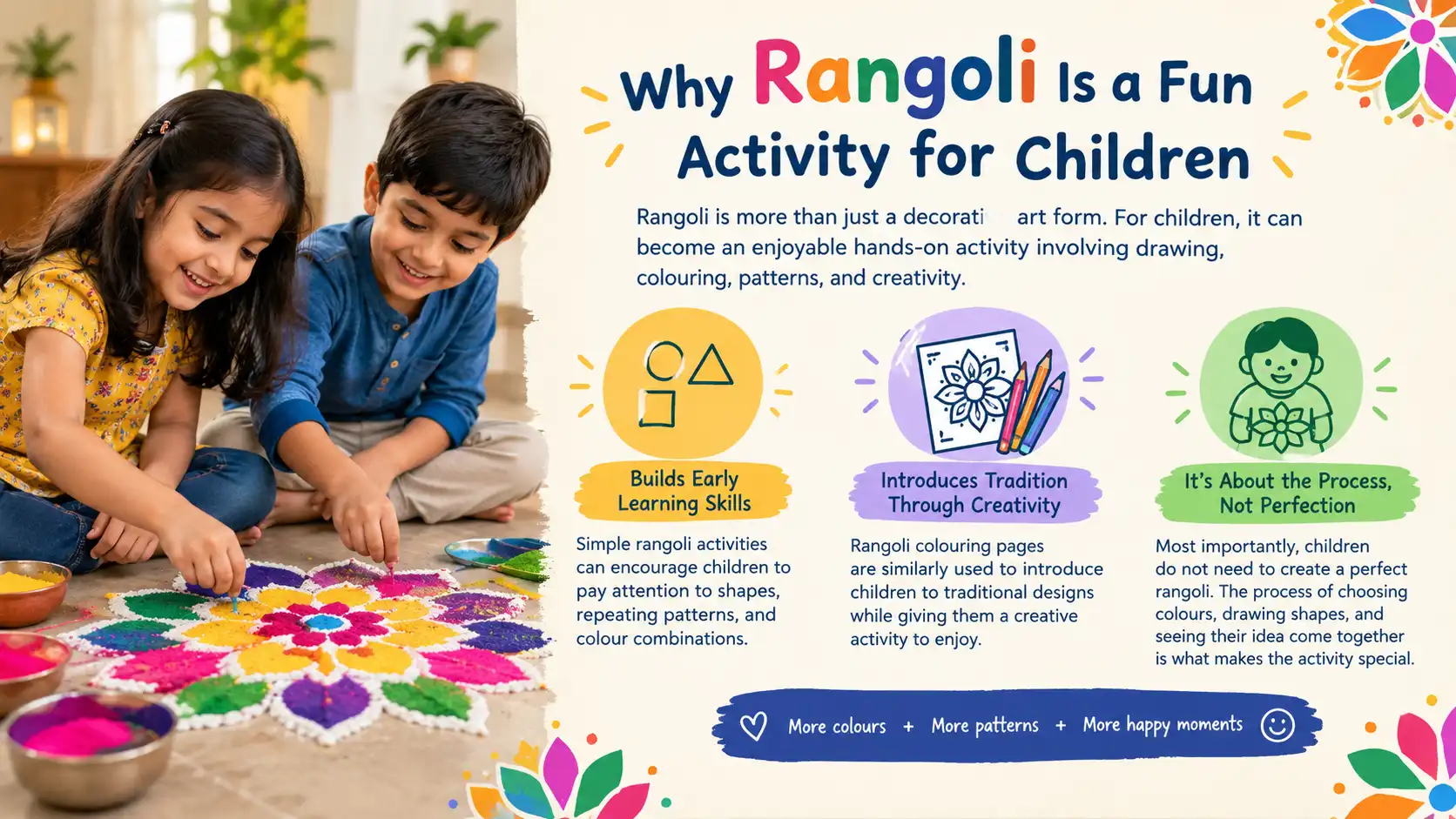
Rangoli is more than just a decorative art form. For children, it can become an enjoyable hands-on activity involving drawing, colouring, patterns, and creativity.
Simple rangoli activities can encourage children to pay attention to shapes, repeating patterns, and colour combinations. Rangoli colouring pages are similarly used to introduce children to traditional designs while giving them a creative activity to enjoy.
Most importantly, children do not need to create a perfect rangoli. The process of choosing colours, drawing shapes, and seeing their idea come together is what makes the activity special.
Create a Colourful Rangoli Together
Creating Rangoli doesn’t have to be difficult, especially when children are just getting started. With a few simple shapes, some bright colours, and a little imagination, they can create something they will be proud of.
These easy rangoli for kids with colour ideas are a great place to begin. From flowers and butterflies to diyas, stars, peacocks, and geometric patterns, each design can be adapted to suit your child’s age and creativity.
If your child enjoys simple patterns, you can also explore these simple rangoli designs for beginners for more easy-to-follow ideas.
For children who particularly enjoy flower patterns, these easy flower rangoli designs can provide more inspiration.
And when you’re preparing for a festival, you may also like these easy Diwali rangoli designs that are suitable for beginners.
So choose a favourite design, gather a few colours, and spend some creative time together. You may be surprised by how beautiful a simple Rangoli can become!
Let Little Hands Create Big Colours
Simple shapes, bright colours, and a little imagination are all children need to begin their colourful Rangoli journey.