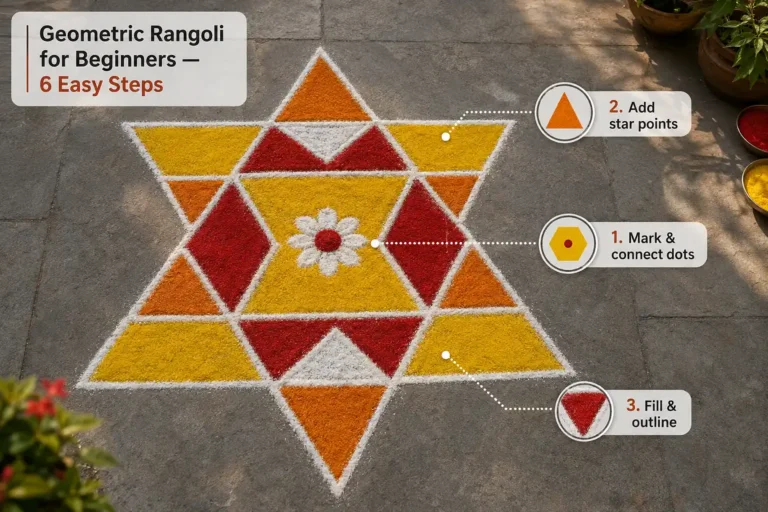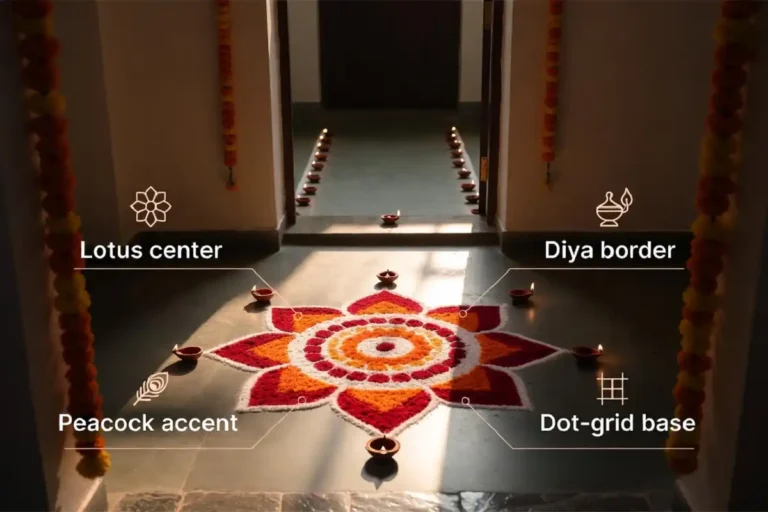
Minimalist Geometric Rangoli: Simple Modern Designs for Every Occasion
Minimalist geometric rangoli gives you a clean, modern floor design without hours of work. You need only a few shapes, two or three colors, and steady hands. This style fits festivals, daily doorways, and modern homes alike.
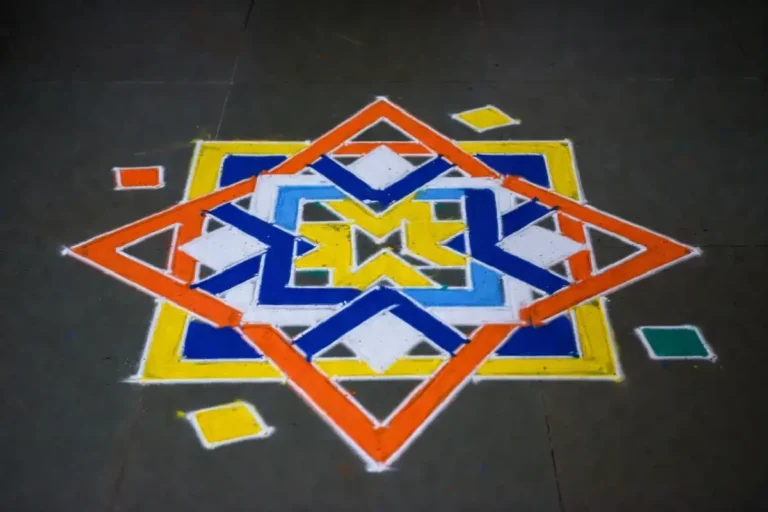
A minimalist geometric rangoli uses basic shapes like triangles, circles, squares, and lines in a spare layout with limited color. You draw fewer elements, keep wide negative space, and let symmetry carry the design. The result looks elegant, takes less time, and suits any occasion.
What Is a Minimalist Geometric Rangoli?
A minimalist geometric rangoli is a floor pattern built from simple shapes and empty space. You skip busy detail and floral fills. Instead, you use straight lines, angles, and a few repeating forms.
The core idea is restraint. Fewer strokes, fewer colors, more breathing room. A single hexagon with a dot grid can hold a whole doorway. So can four triangles rotating around a center point.
This look grew popular in modern Indian homes and apartments. People wanted quick floor art that matched clean interiors. Traditional rangoli often fills every inch. A minimalist geometric rangoli does the opposite and lets each shape stand alone.
Why Choose Minimalist Over Traditional Rangoli?
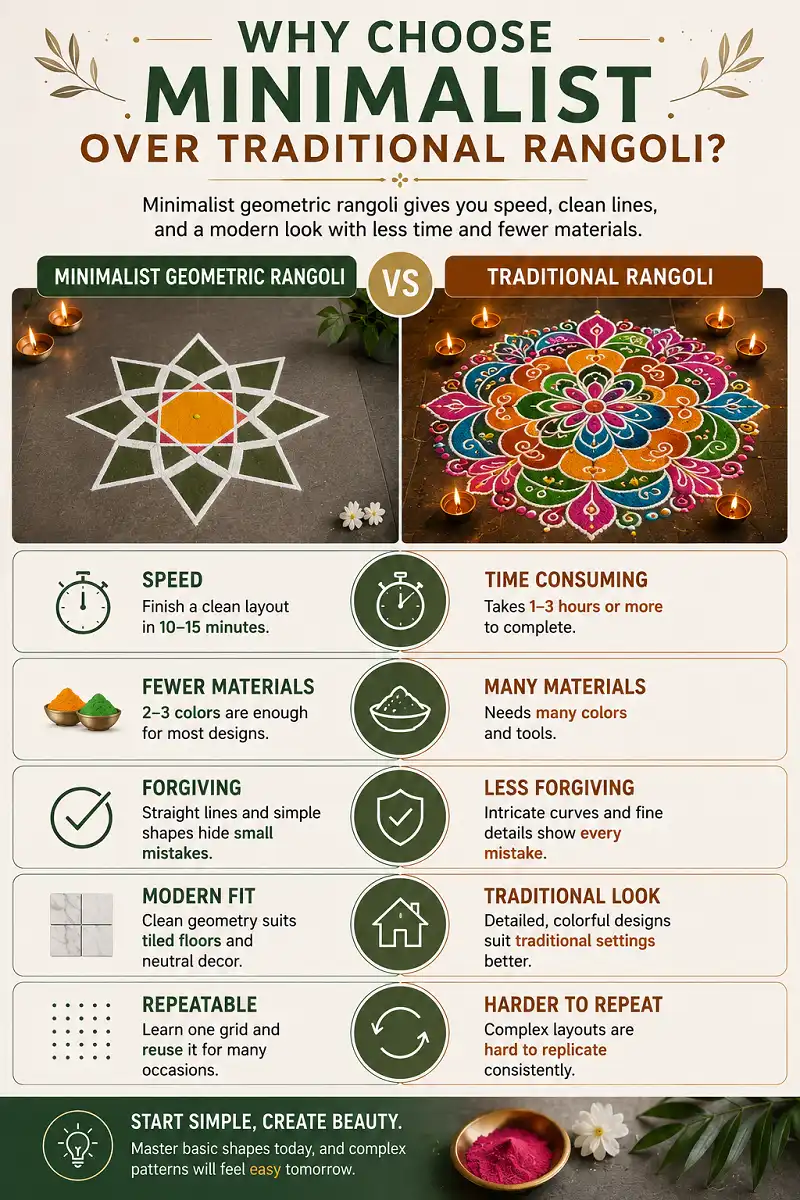
You choose minimalist geometric rangoli when you want speed, clean lines, and a modern feel. Traditional designs demand time, many colors, and dense detail. Minimalist work strips that down.
Here is what makes it worth trying:
- Speed. You finish a clean layout in ten to fifteen minutes.
- Fewer materials. Two or three colors handle most designs.
- Forgiving. Straight lines and simple shapes hide small mistakes.
- Modern fit. Clean geometry suits tiled floors and neutral decor.
- Repeatable. You learn one grid and reuse it for many occasions.
I teach beginners this style first. It builds confidence fast. Once you control basic shapes, complex patterns feel easy. If you want a broader look at pared-down floor art, my guide to clean and elegant minimal rangoli covers more starting points.
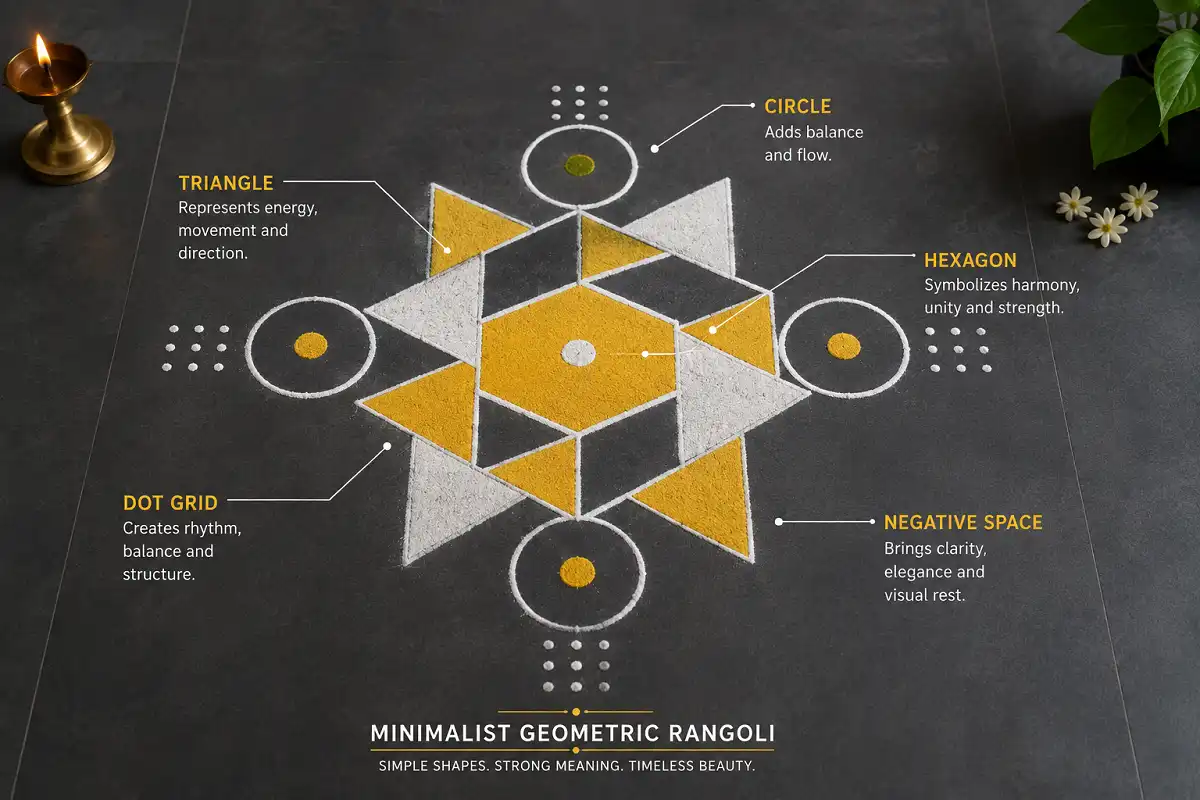
Core Shapes Behind Every Minimalist Geometric Rangoli
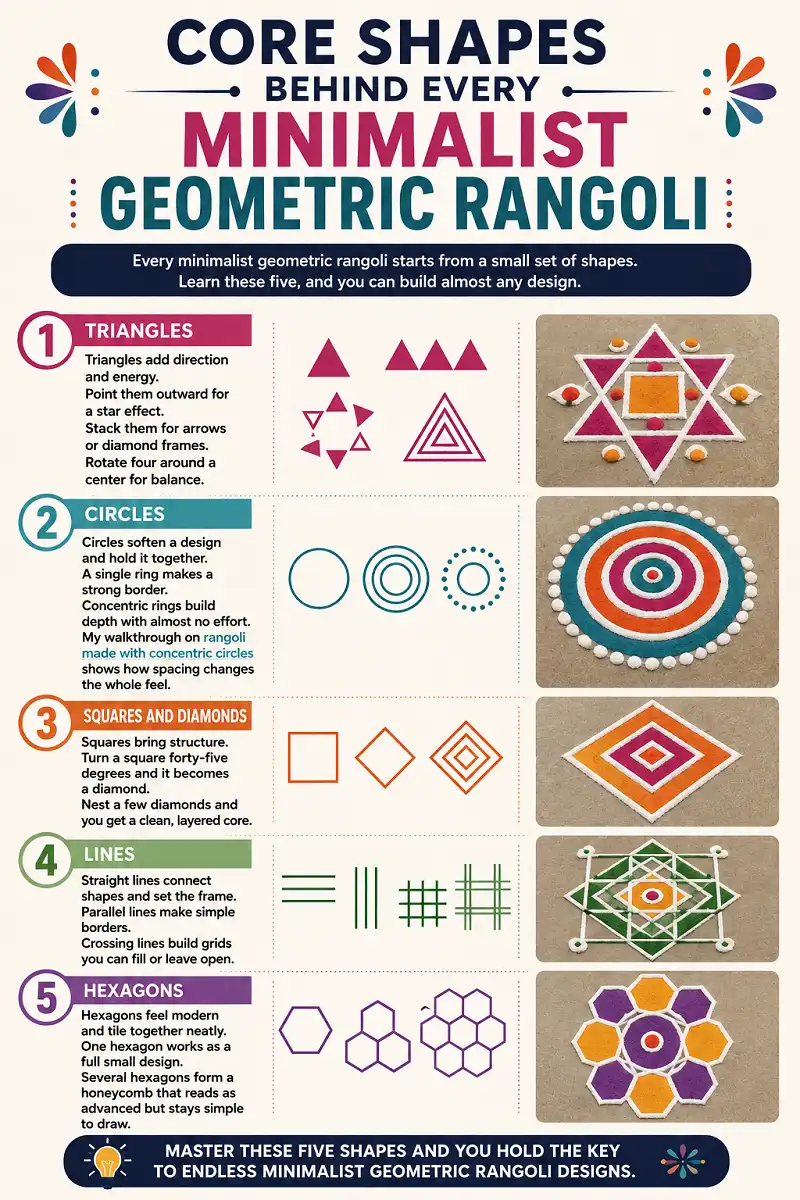
Every minimalist geometric rangoli starts from a small set of shapes. Learn these five, and you can build almost any design.
Triangles
Triangles add direction and energy. Point them outward for a star effect. Stack them for arrows or diamond frames. Rotate four around a center for balance.
Circles
Circles soften a design and hold it together. A single ring makes a strong border. Concentric rings build depth with almost no effort. My walkthrough on rangoli made with concentric circles shows how spacing changes the whole feel.
Squares and Diamonds
Squares bring structure. Turn a square forty-five degrees and it becomes a diamond. Nest a few diamonds and you get a clean, layered core.
Lines
Straight lines connect shapes and set the frame. Parallel lines make simple borders. Crossing lines build grids you can fill or leave open.
Hexagons
Hexagons feel modern and tile together neatly. One hexagon works as a full small design. Several hexagons form a honeycomb that reads as advanced but stays simple to draw.
Understanding Symmetry and the Dot Grid
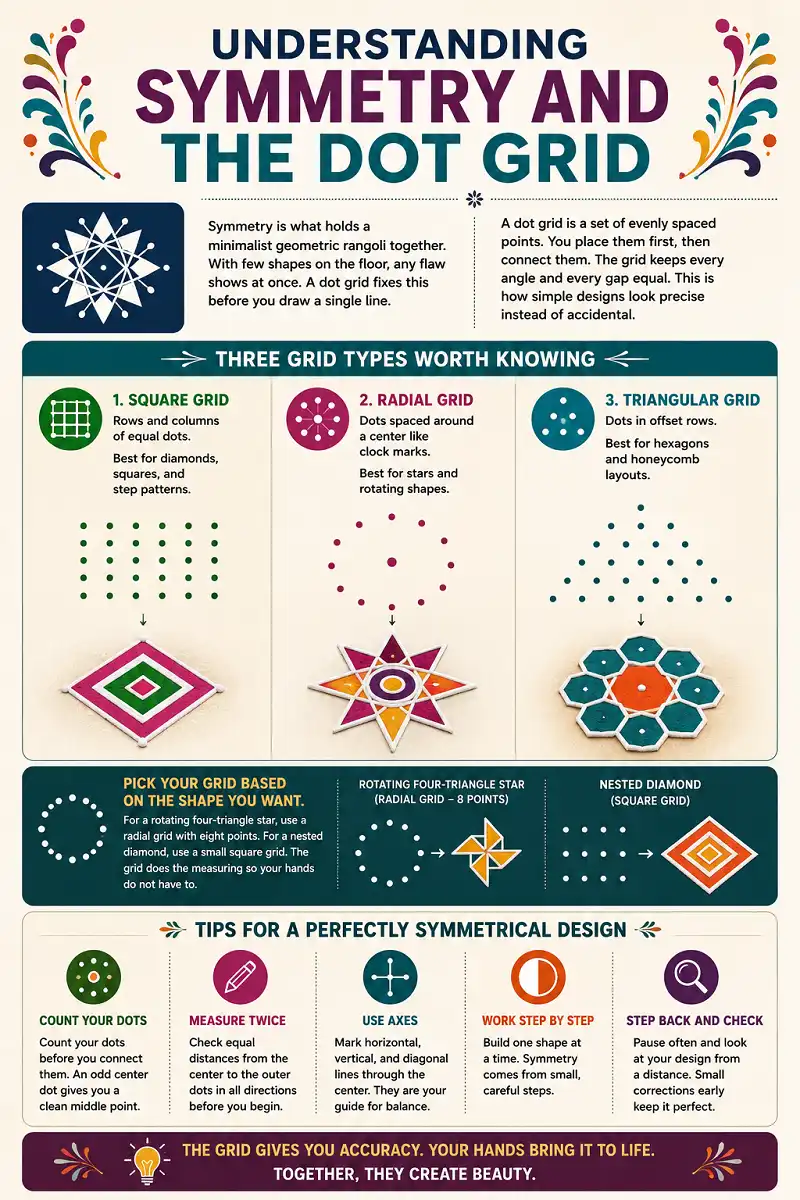
Symmetry is what holds a minimalist geometric rangoli together. With few shapes on the floor, any flaw shows at once. A dot grid fixes this before you draw a single line.
A dot grid is a set of evenly spaced points. You place them first, then connect them. The grid keeps every angle and every gap equal. This is how simple designs look precise instead of accidental.
There are three grid types worth knowing:
- Square grid. Rows and columns of equal dots. Best for diamonds, squares, and step patterns.
- Radial grid. Dots spaced around a center like clock marks. Best for stars and rotating shapes.
- Triangular grid. Dots in offset rows. Best for hexagons and honeycomb layouts.
Pick your grid based on the shape you want. For a rotating four-triangle star, use a radial grid with eight points. For a nested diamond, use a small square grid. The grid does the measuring so your hands do not have to.
Colors That Suit a Minimalist Geometric Rangoli
A minimalist geometric rangoli works best with a tight color palette. Two or three shades keep the look clean. Too many colors break the calm feel.
Try these combinations:
- White on a dark floor for sharp contrast.
- One bold color plus white outlines.
- Two tones of the same color, like light and deep blue.
- Black outlines with a single warm fill, such as mustard or terracotta.
Negative space matters as much as color here. The empty floor around each shape is part of the design. Leave it clear. That space is what makes the pattern feel modern and light.
How to Make a Minimalist Geometric Rangoli Step by Step
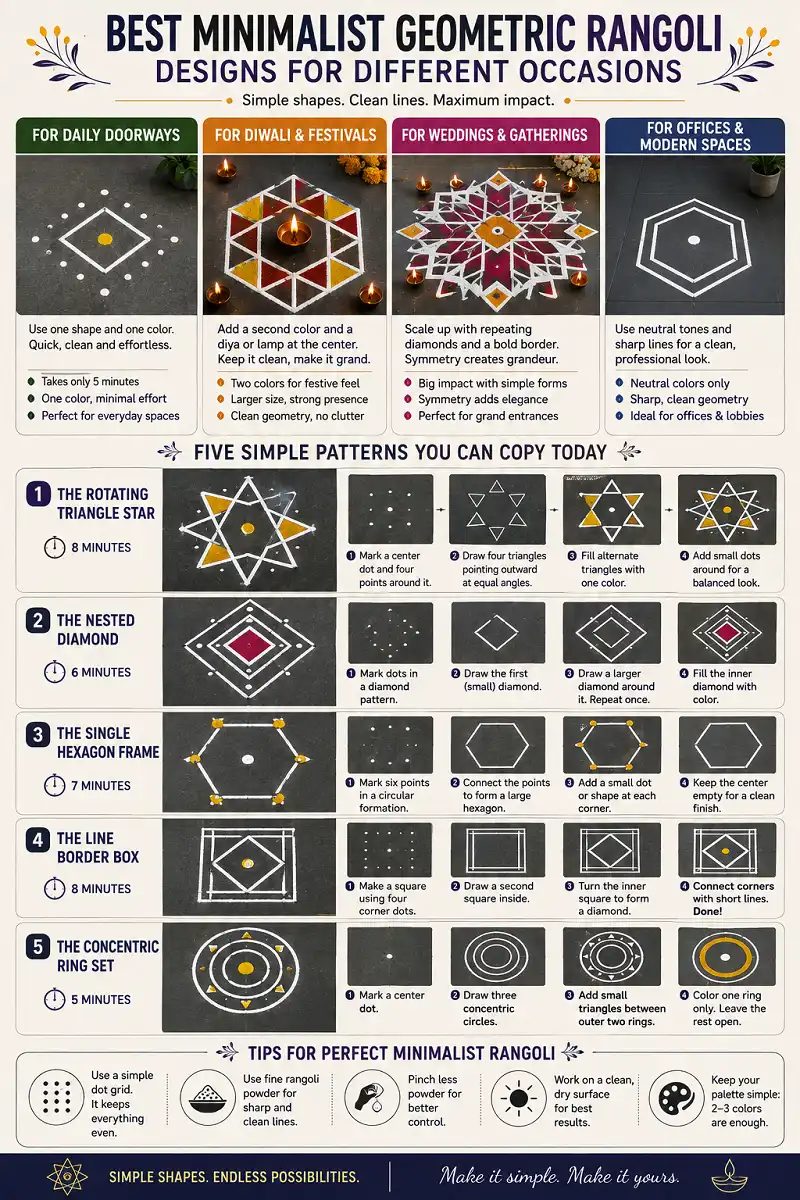
Start with a center point, build a shape grid, then draw and fill. This method works for any minimalist geometric rangoli, from a four-triangle star to a full hexagon lattice.
Follow these steps:
Clean the floor.
Wipe the surface so lines stay crisp.
Mark the center.
Place one dot where the design will center.
Set a light grid.
Add faint dots or pencil guides for symmetry.
Draw the main shape.
Start with your central form, like a hexagon or diamond.
Repeat outward.
Add matching shapes around the center in even steps.
Add the border.
Frame the design with a ring or straight lines.
Fill with restraint.
Color only key areas. Leave space open.
Clean the edges.
Sweep loose powder so lines stay sharp.
Work slowly on the first shape. Once the center is right, the rest follows. If a beginner wants an even gentler start, my easy geometric rangoli patterns for anyone breaks the first shapes down further.
Best Minimalist Geometric Rangoli Designs for Different Occasions
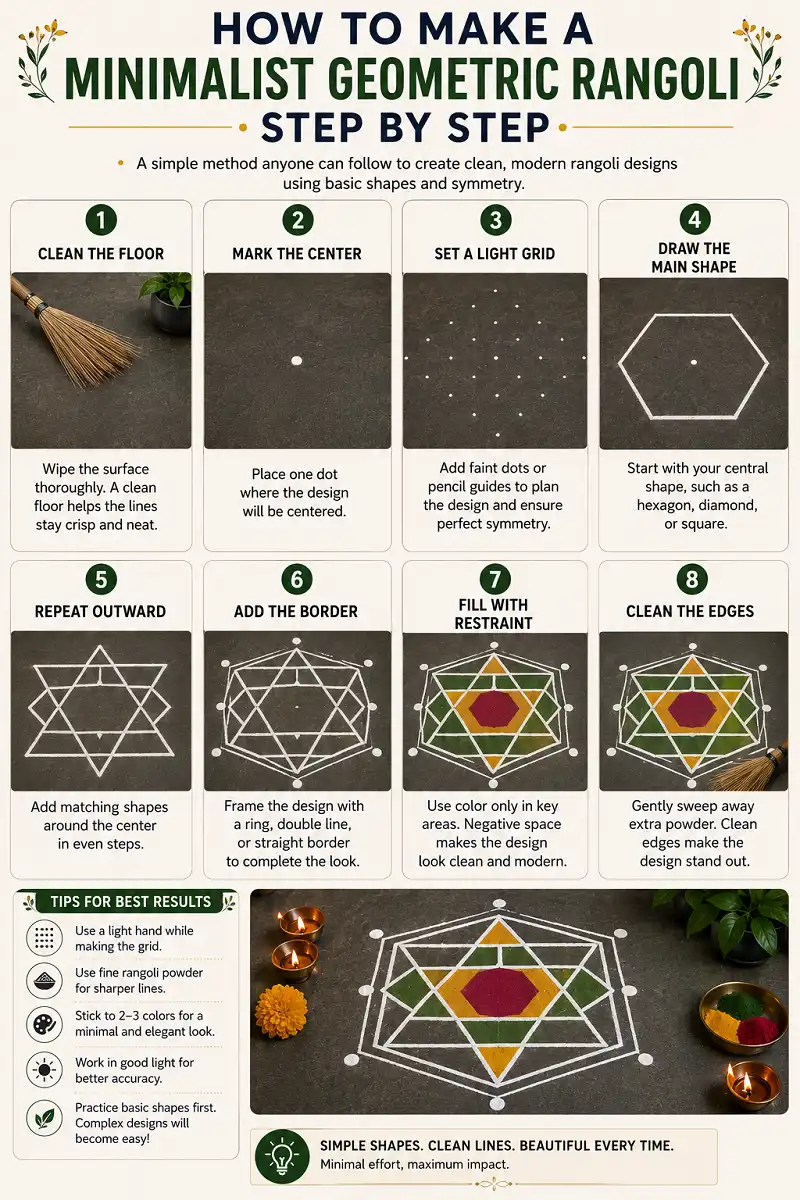
The right minimalist geometric rangoli depends on the occasion. A festival needs more presence. A daily doorway needs speed. Here is how I match design to moment.
For Daily Doorways
Use one shape and one color. A single ring of dots around a small diamond works every morning. It takes five minutes and still looks intentional.
For Diwali and Festivals
Add a second color and a diya or lamp shape at the center. Keep the geometry clean but let the size grow. A large hexagon frame with corner triangles reads festive without clutter.
For Weddings and Gatherings
Scale up with repeating diamonds and a bold border. Symmetry does the heavy lifting. You get a grand look from simple, repeated forms.
For Offices and Modern Spaces
Stick to neutral tones and sharp lines. A grid of squares or a single large hexagon fits a professional setting. This style also suits modern geometric rangoli for office entrances and reception areas.
Five Simple Patterns You Can Copy Today
These five layouts give you a starting point for any minimalist geometric rangoli. Each uses basic shapes and a tight palette. Copy them exactly, then change colors to make them yours.
The Rotating Triangle Star
Draw four triangles pointing outward from a center dot. Space them at equal angles. Fill alternate triangles with one color. Leave the rest as clean outlines. This design takes eight minutes and reads as bold.
The Nested Diamond
Draw one small diamond, then a larger one around it, then a third. Keep the gaps between them equal. Color only the inner diamond. The layered outlines carry the rest. This works well for daily doorways.
The Single Hexagon Frame
Draw one large hexagon. Add a small dot or shape at each corner. Fill nothing in the center. The open middle is the whole point. This is the cleanest festive option I teach.
The Line Border Box
Draw a square from parallel lines. Add a second square inside, turned to form a diamond. Connect the corners with short straight lines. This grid design suits offices and modern entrances.
The Concentric Ring Set
Draw three evenly spaced circles around one center. Add small triangles between the outer two rings. Color one ring only. The rest stays open. This is the fastest design on the list.
Each pattern scales up or down. Shrink it for a small doorway or enlarge it for a festival. The shapes stay the same, so the method never changes.
Common Mistakes to Avoid
Most design errors here come from adding too much. Restraint is the whole point. Watch for these slips.
- Overfilling. Empty space is the design. Do not color every gap.
- Too many colors. Three shades is usually the ceiling.
- Uneven symmetry. A weak center throws off the whole pattern.
- Shaky borders. A wobbly frame ruins a clean look. Use a guide.
- Crowded shapes. Give each form room to breathe.
Fix symmetry first. A clean center point and a light grid solve most problems before they start. Rangoli itself has a long cultural history, and you can read more about its origins on the Wikipedia page for rangoli.
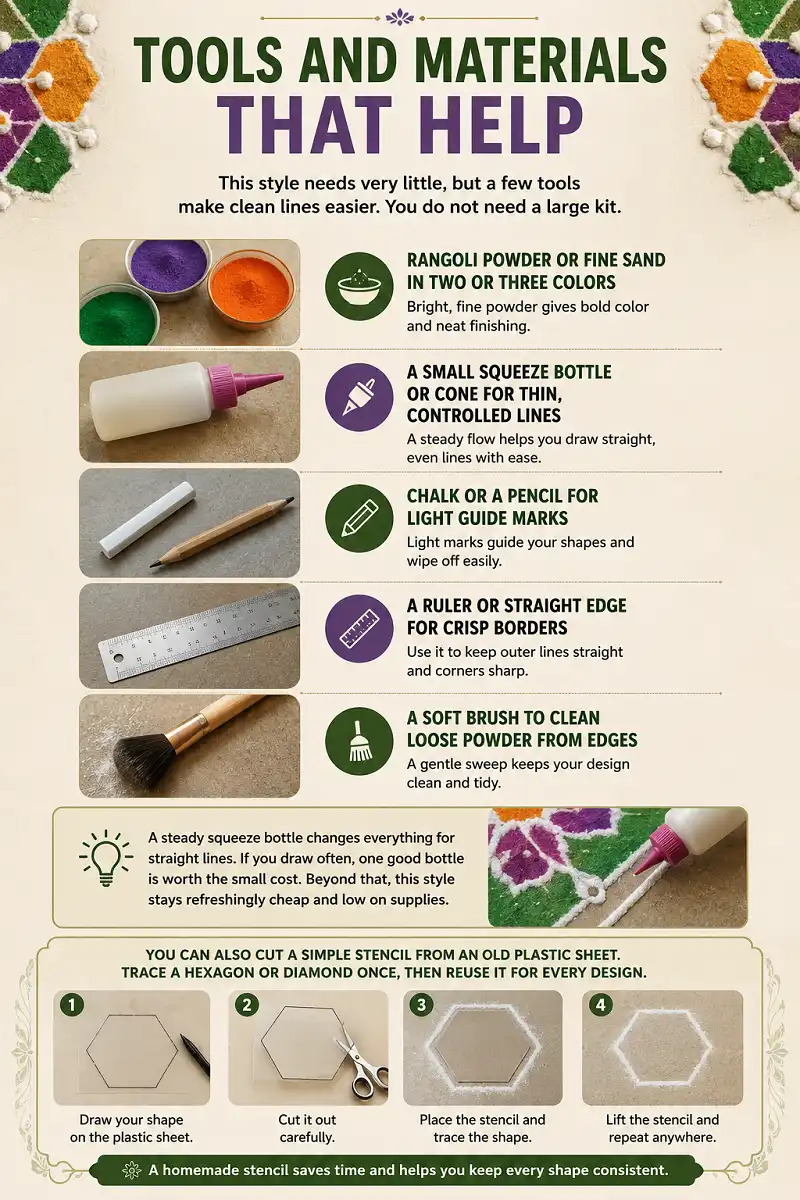
Tools and Materials That Help
This style needs very little, but a few tools make clean lines easier. You do not need a large kit.
Keep these on hand:
- Rangoli powder or fine sand in two or three colors.
- A small squeeze bottle or cone for thin, controlled lines.
- Chalk or a pencil for light guide marks.
- A ruler or straight edge for crisp borders.
- A soft brush to clean loose powder from edges.
A steady squeeze bottle changes everything for straight lines. If you draw often, one good bottle is worth the small cost. Beyond that, this style stays refreshingly cheap and low on supplies.
You can also cut a simple stencil from an old plastic sheet. Trace a hexagon or diamond once, then reuse it for every design. A homemade stencil keeps your shapes identical across many attempts. It saves time and removes the guesswork from repeated patterns.
Tips to Make Your Design Look Professional
A few habits lift any clean design from plain to polished. These are the details I focus on when I teach.
First, keep line weight even. Thin, steady lines read as skilled. Second, protect your negative space. The clean floor is what makes minimal work look modern. Third, align every repeat exactly. Even spacing signals control.
Finally, choose one focal point. A single strong center, one bold color, or one clean border gives the eye somewhere to rest. That focus is what separates a polished design from one that just looks empty.
Final Words
A minimalist geometric rangoli proves that less really does more. A few shapes, two or three colors, and clean negative space give you floor art that fits any occasion. Start with one central form, build outward with even symmetry, and protect the empty space around it. Master that, and you can dress any doorway in minutes, from a quiet weekday to a full festival. Start small, trust the grid, and let the empty space do its work.
FAQs
How long does a minimalist geometric rangoli take?
Most take ten to fifteen minutes once you know the shapes. A very simple daily design can take five. The limited color and open space cut your time sharply compared to dense traditional work.
Do I need special tools to start?
No. You can start with basic rangoli powder and a steady hand. A squeeze bottle and a ruler help with clean lines, but they are optional for your first designs.
Is minimalist geometric rangoli good for beginners?
Yes. Simple shapes and forgiving lines make it one of the best starting styles. You learn symmetry and control without the pressure of heavy detail.