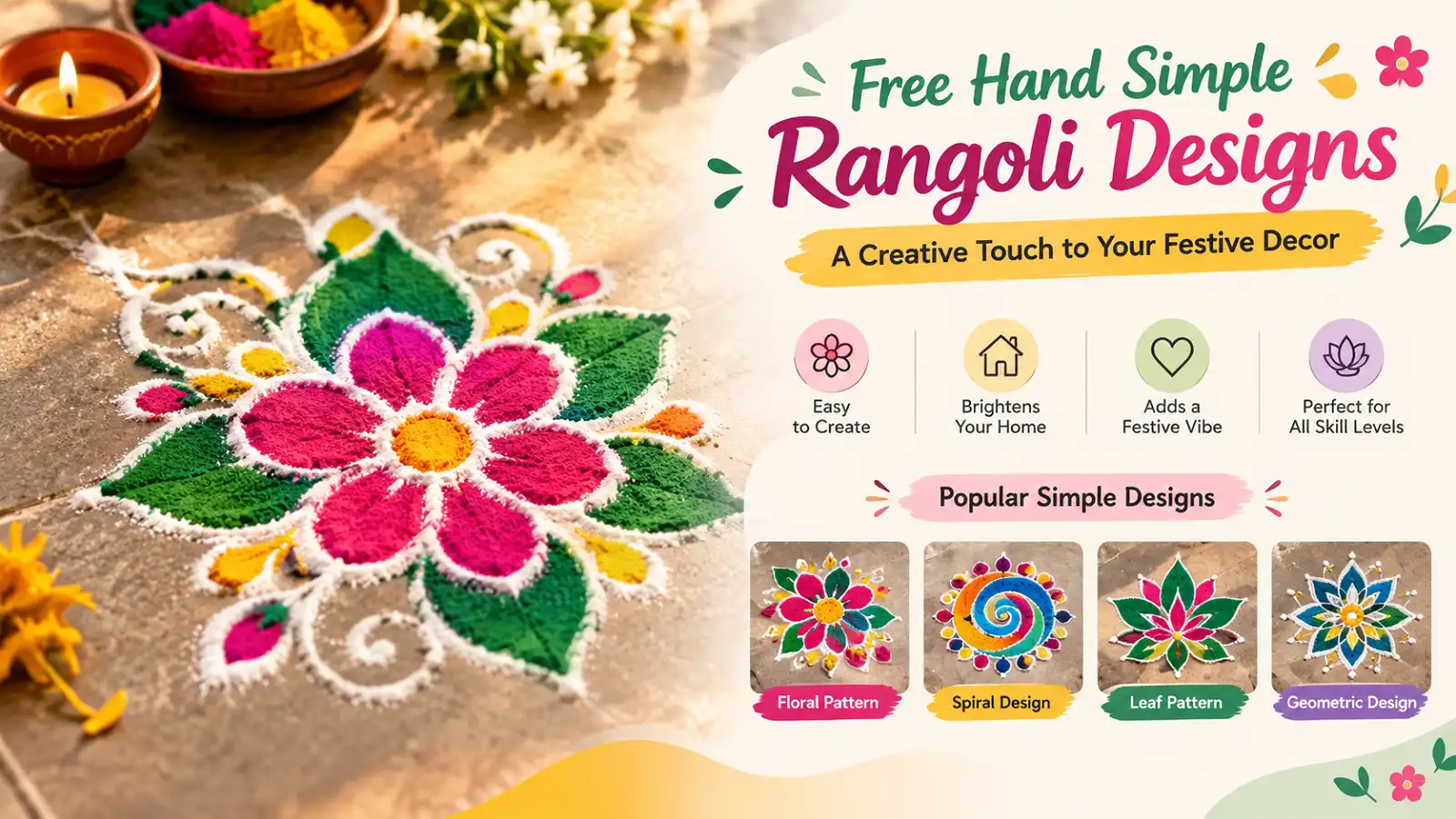
Free Hand Simple Rangoli Designs: A Creative Touch to Your Festive Decor
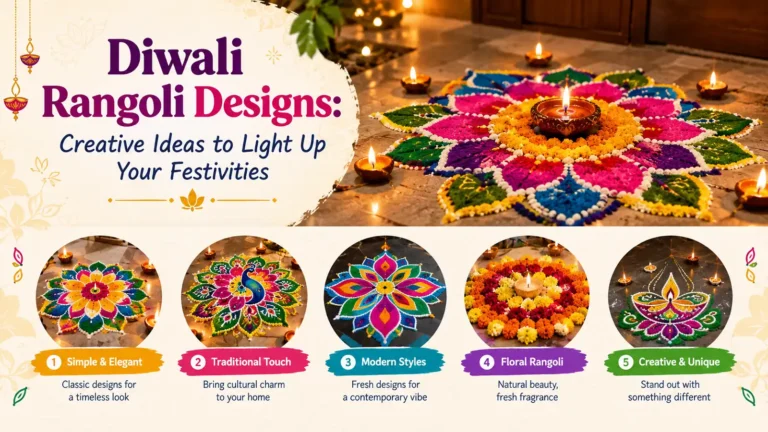
Rangoli is a lovely practice in many regions of India and beyond. It involves using colorful powders, flowers, and other materials to create elaborate patterns on the floor.
Rangoli’s origins can be found in antiquity, when it was thought to bring happiness, wealth, and good fortune to households.
Rangoli has evolved into a year-round decorative art, with free hand simple rangoli designs ranging from the most intricate to the most basic, despite being frequently seen during significant festivals like Diwali, Onam, and Pongal.
We will explore the realm of freehand easy free hand simple rangoli designs in this blog article, giving you the inspiration, methods, and ideas you need to make stunning patterns using only your creativity and a few simple instruments.
For people who wish to produce something original without being limited by stencils or templates, free hand simple rangoli designs are ideal.
These patterns can help you add originality to your celebrations or simply everyday décor, regardless of your level of Rangoli artistry.
Overview of Basic Freehand Rangoli Designs
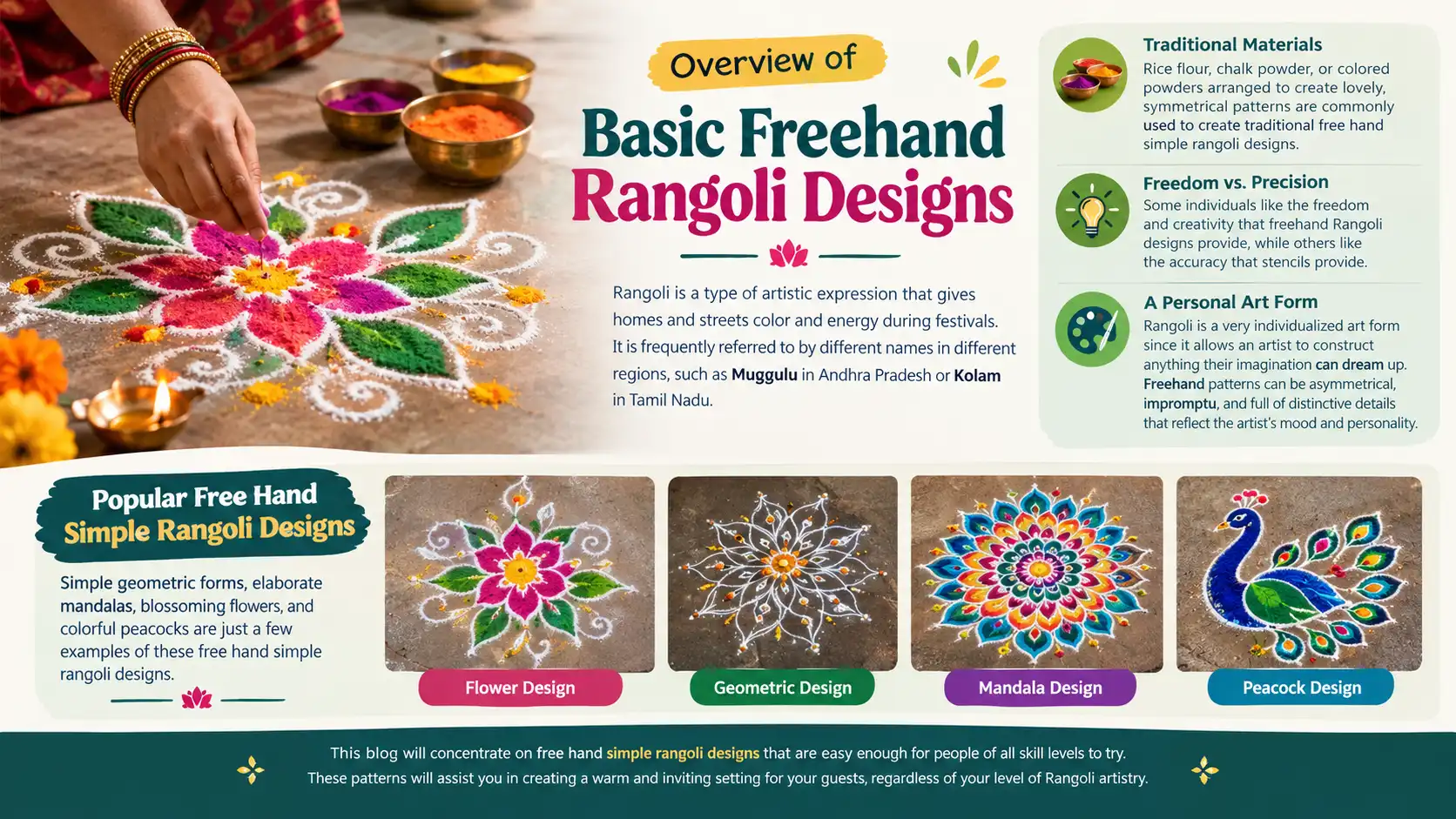
Rangoli is a type of artistic expression that gives homes and streets color and energy during festivals. It is frequently referred to by different names in different regions, such as Muggulu in Andhra Pradesh or Kolam in Tamil Nadu.
Rice flour, chalk powder, or colored powders arranged to create lovely, symmetrical patterns are commonly used to create traditional free hand simple rangoli designs.
Some individuals like the freedom and creativity that freehand Rangoli designs provide, while others like the accuracy that stencils provide.
Freehand patterns allow an artist to create something personal, spontaneous, and expressive rather than following a fixed stencil or template.
Rangoli is a very individualized art form since it allows an artist to construct anything their imagination can dream up. Freehand patterns, in contrast to stenciled designs, can be asymmetrical, impromptu, and full of distinctive details that reflect the artist’s mood and personality.
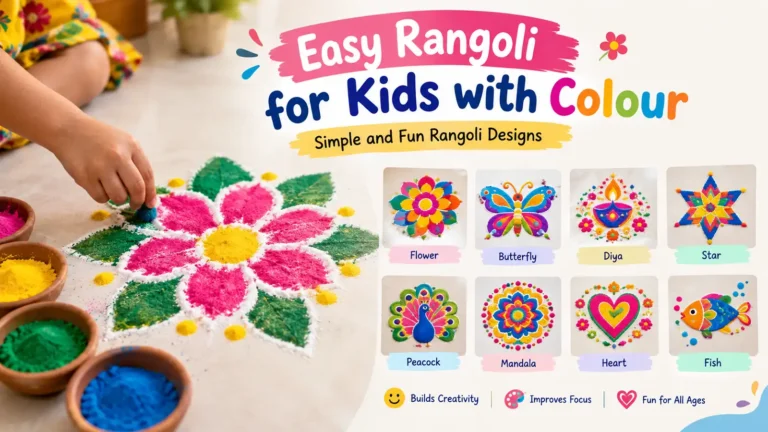
Simple geometric forms, elaborate mandalas, blossoming flowers, and colorful peacocks are just a few examples of these free hand simple rangoli designs.
This blog will concentrate on free hand simple rangoli designs that are easy enough for people of all skill levels to try. These patterns will assist you in creating a warm and inviting setting for your guests, regardless of your level of Rangoli artistry.
Freehand Rangoli: Why Choose It?
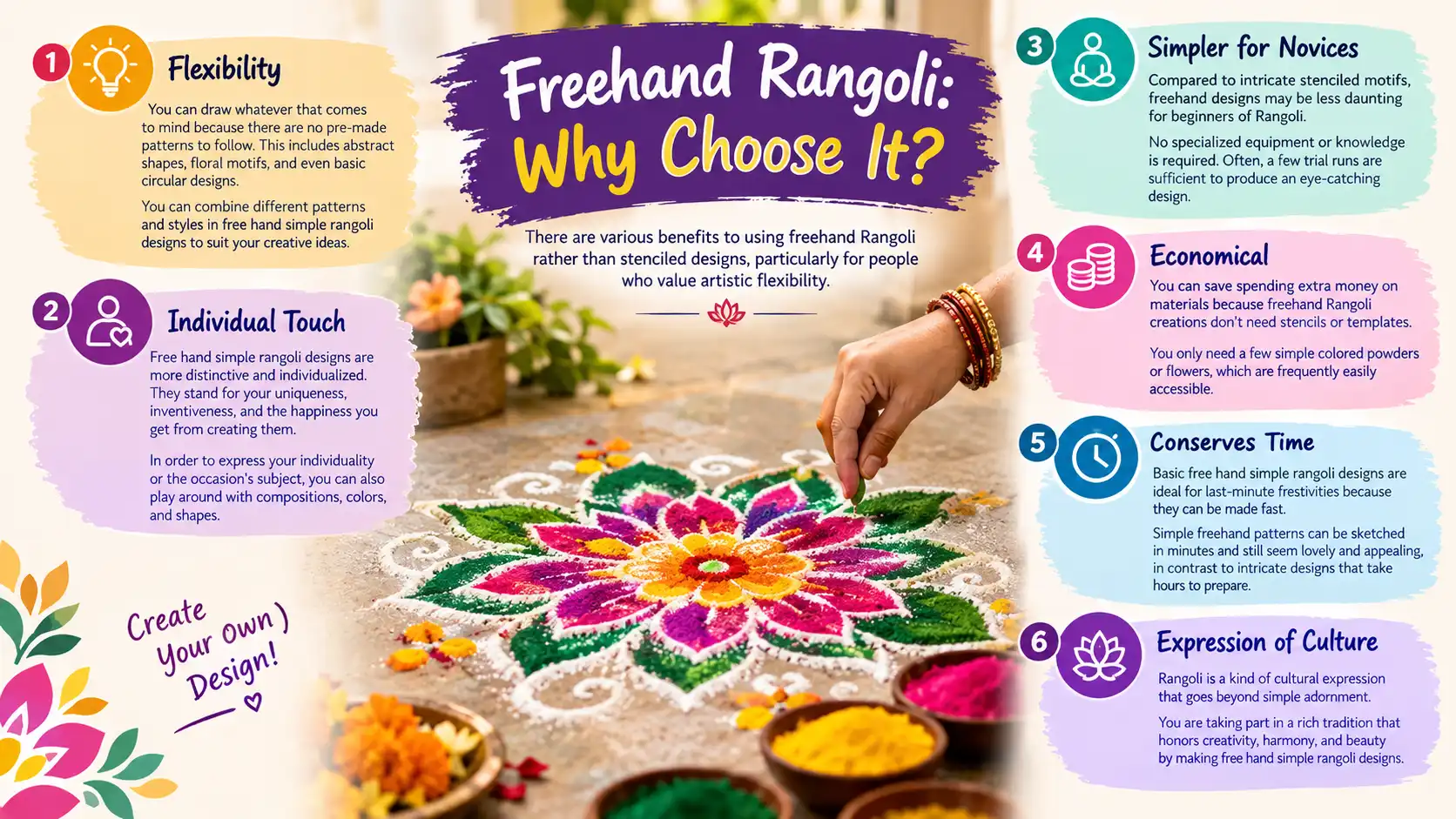
There are various benefits to using freehand Rangoli rather than stenciled designs, particularly for people who value artistic flexibility.
Here are a few reasons why you might want to choose for free hand simple rangoli designs:
Flexibility
You can draw whatever comes to mind because there are no pre-made patterns to follow. This includes abstract shapes, floral motifs, and even basic circular designs. You can combine different patterns and styles to suit your creative ideas.
Individual Touch
Free hand simple rangoli designs are more distinctive and individualized. They stand for your uniqueness, inventiveness, and the happiness you get from creating them.
You can also play around with compositions, colors, and shapes to express your individuality or the occasion’s subject.
Simpler for Novices
Compared to intricate stenciled motifs, freehand designs may be less daunting for beginners. No specialized equipment or knowledge is required. Often, a few trial runs are sufficient to produce an eye-catching design.
Economical
You can save spending extra money on materials because freehand Rangoli creations don’t need stencils or templates. You only need a few simple colored powders or flowers, which are frequently easily accessible.
Conserves Time
Basic free hand simple rangoli designs are ideal for last-minute festivities because they can be made fast. Simple freehand patterns can be sketched in minutes and still seem lovely and appealing.
Expression of Culture
Rangoli is a kind of cultural expression that goes beyond simple adornment. You are taking part in a rich tradition that honors creativity, harmony, and beauty by making free hand simple rangoli designs.
Essential Tools for Freehand Rangoli
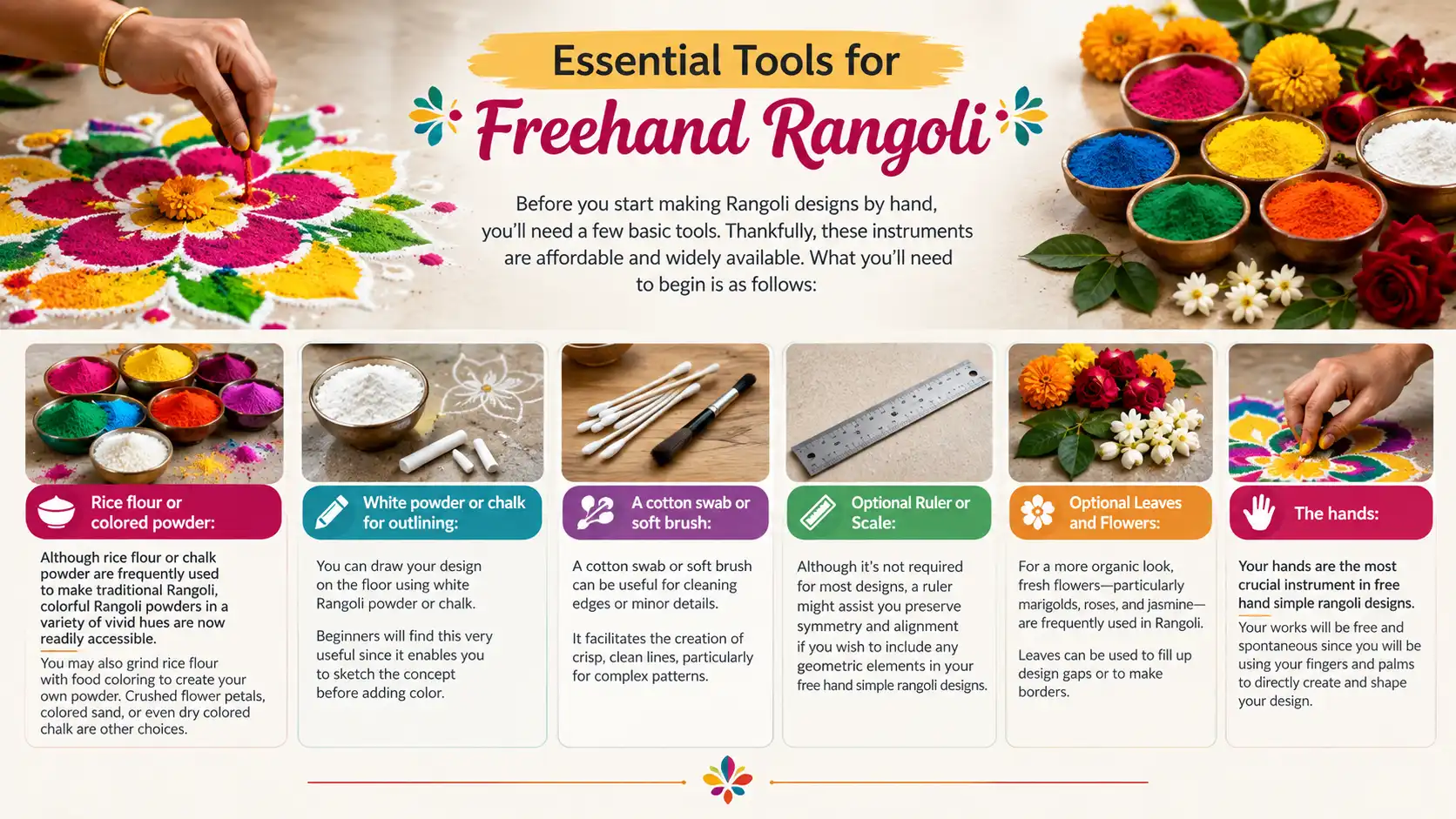
Before you start making Rangoli designs by hand, you’ll need a few basic tools.
Thankfully, these instruments are affordable and widely available. What you’ll need to begin is as follows:
Rice Flour or Colored Powder
Although rice flour or chalk powder are frequently used to make traditional Rangoli, colorful Rangoli powders in a variety of vivid hues are now readily accessible. You may also grind rice flour with food coloring. Crushed flower petals, colored sand, or dry colored chalk are other choices.
White Powder or Chalk for Outlining
You can draw your design on the floor using white Rangoli powder or chalk. Beginners will find this very useful since it enables you to sketch the concept before adding color.
A Cotton Swab or Soft Brush
A cotton swab or soft brush can be useful for cleaning edges or minor details. It facilitates the creation of crisp, clean lines, particularly for complex patterns.
Optional Ruler or Scale
Although it’s not required for most designs, a ruler might assist you preserve symmetry and alignment if you wish to include any geometric elements in your free hand simple rangoli designs.
Optional Leaves and Flowers
For a more organic look, fresh flowers—particularly marigolds, roses, and jasmine—are frequently used in Rangoli. Leaves can be used to fill up design gaps or to make borders.
The Hands
Your hands are the most crucial instrument in free hand simple rangoli designs. Your works will be free and spontaneous since you will be using your fingers and palms to directly create and shape your design.
Beginner tip: Start with white chalk or powder outlines, then add color gradually. This makes it easier to maintain balance and clean edges.
Common Simple Freehand Rangoli Designs
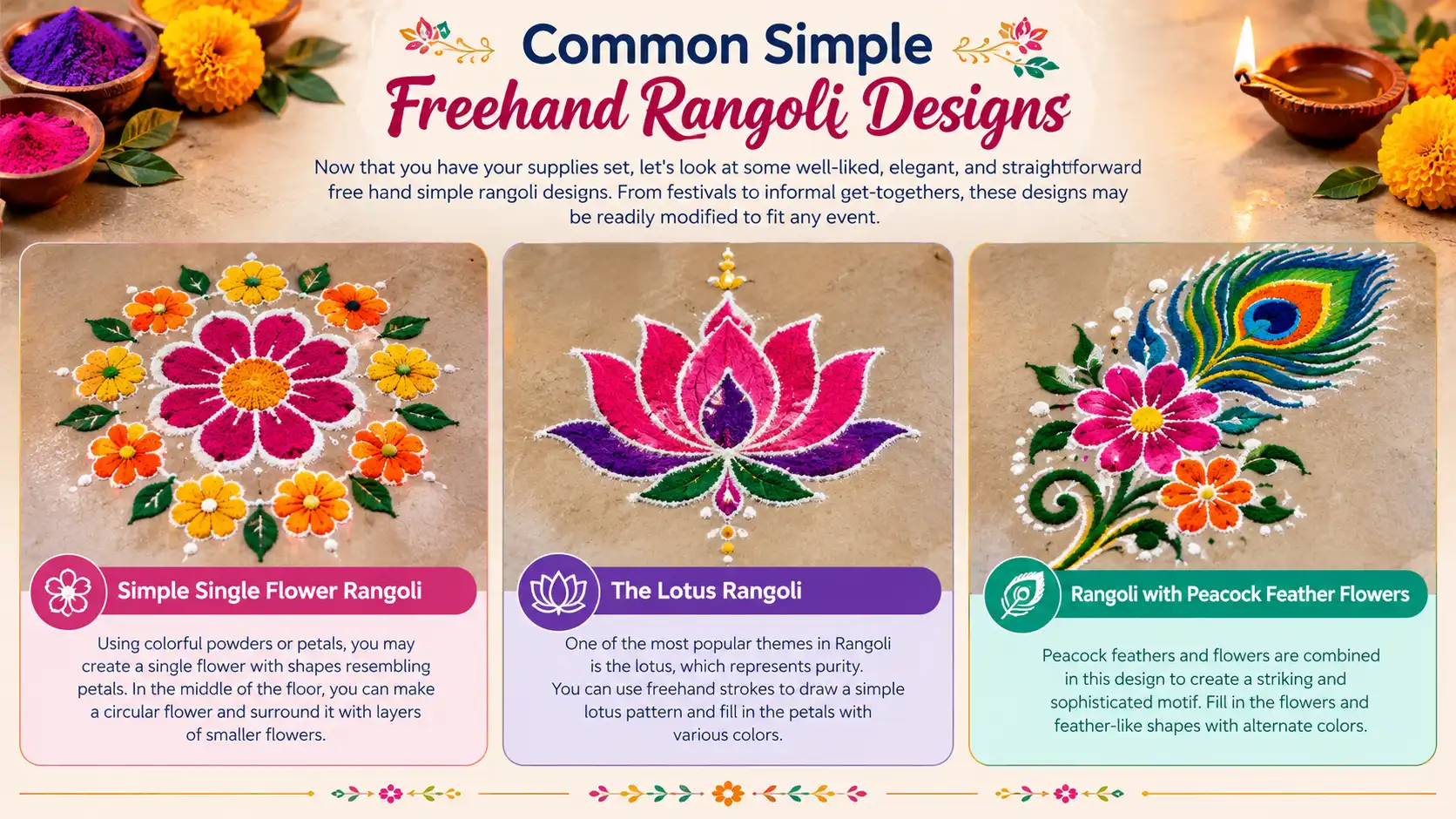
Now that you have your supplies set, let’s look at some well-liked, elegant, and straightforward free hand simple rangoli designs. From festivals to informal get-togethers, these designs may be readily modified to fit any event.
Designs for Flowers
For Rangoli, floral patterns are a classic option. Flowers are the ideal theme for every celebration since they represent beauty, development, and optimism.
Simple Single Flower Rangoli
Using colorful powders or petals, you may create a single flower with shapes resembling petals. In the middle of the floor, you can make a circular flower and surround it with layers of smaller flowers.
The Lotus Rangoli
One of the most popular themes in Rangoli is the lotus, which represents purity. You can use freehand strokes to draw a simple lotus pattern and fill in the petals with various colors. Explore lotus flower Rangoli patterns for more inspiration.
Rangoli with Peacock Feather Flowers
Peacock feathers and flowers are combined in this design to create a striking and sophisticated motif. Fill in the flowers and feather-like shapes with alternate colors.
Designs in Geometry
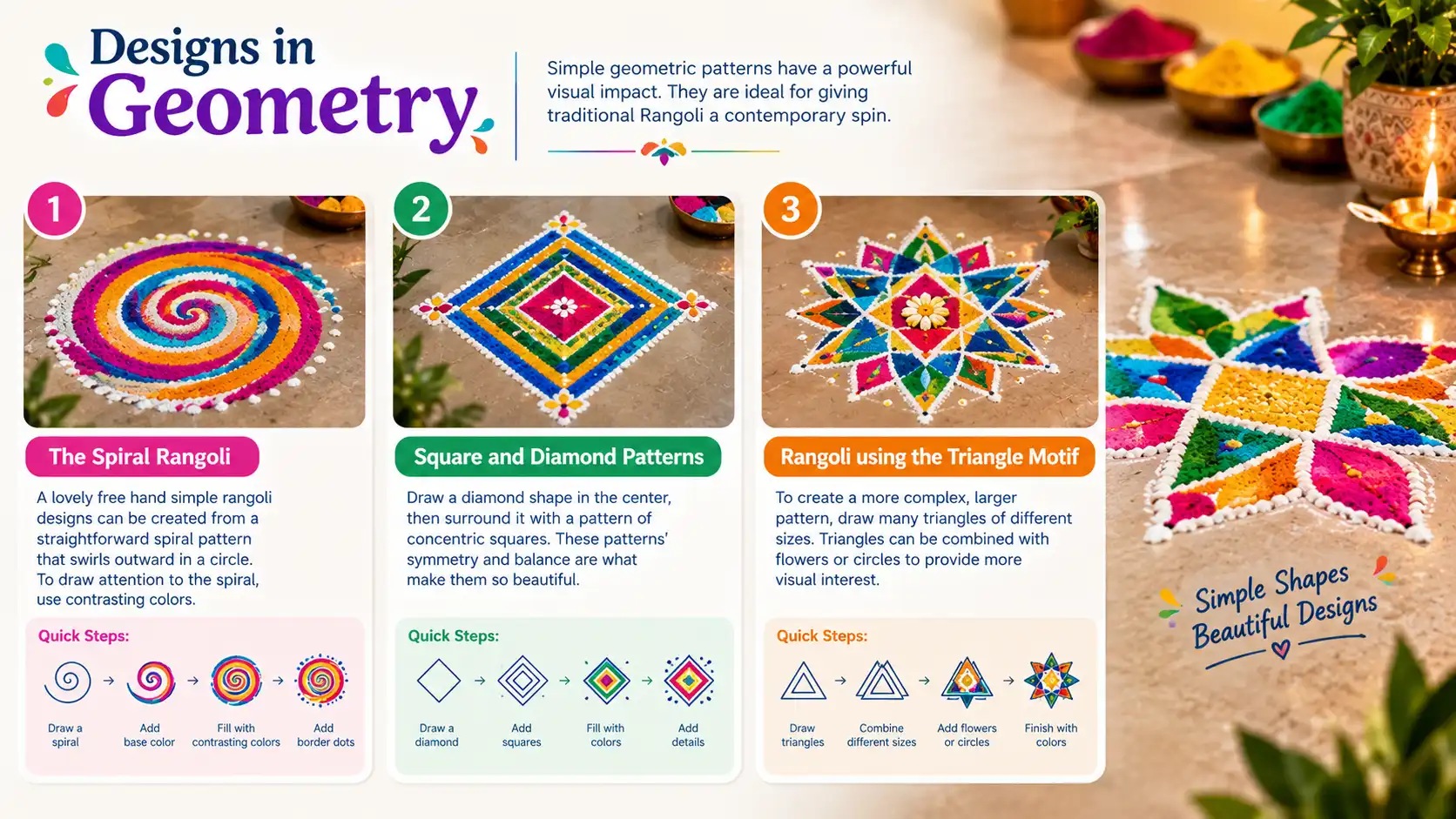
Simple geometric patterns have a powerful visual impact. They are ideal for giving traditional Rangoli a contemporary spin.
The Spiral Rangoli
A lovely free hand simple rangoli design can be created from a straightforward spiral pattern that swirls outward in a circle. To draw attention to the spiral, use contrasting colors.
Square and Diamond Patterns
Draw a diamond shape in the center, then surround it with a pattern of concentric squares. These patterns’ symmetry and balance are what make them so beautiful.
Rangoli Using the Triangle Motif
To create a more complex, larger pattern, draw many triangles of different sizes. Triangles can be combined with flowers or circles to provide more visual interest.
Designs of Animals and Birds
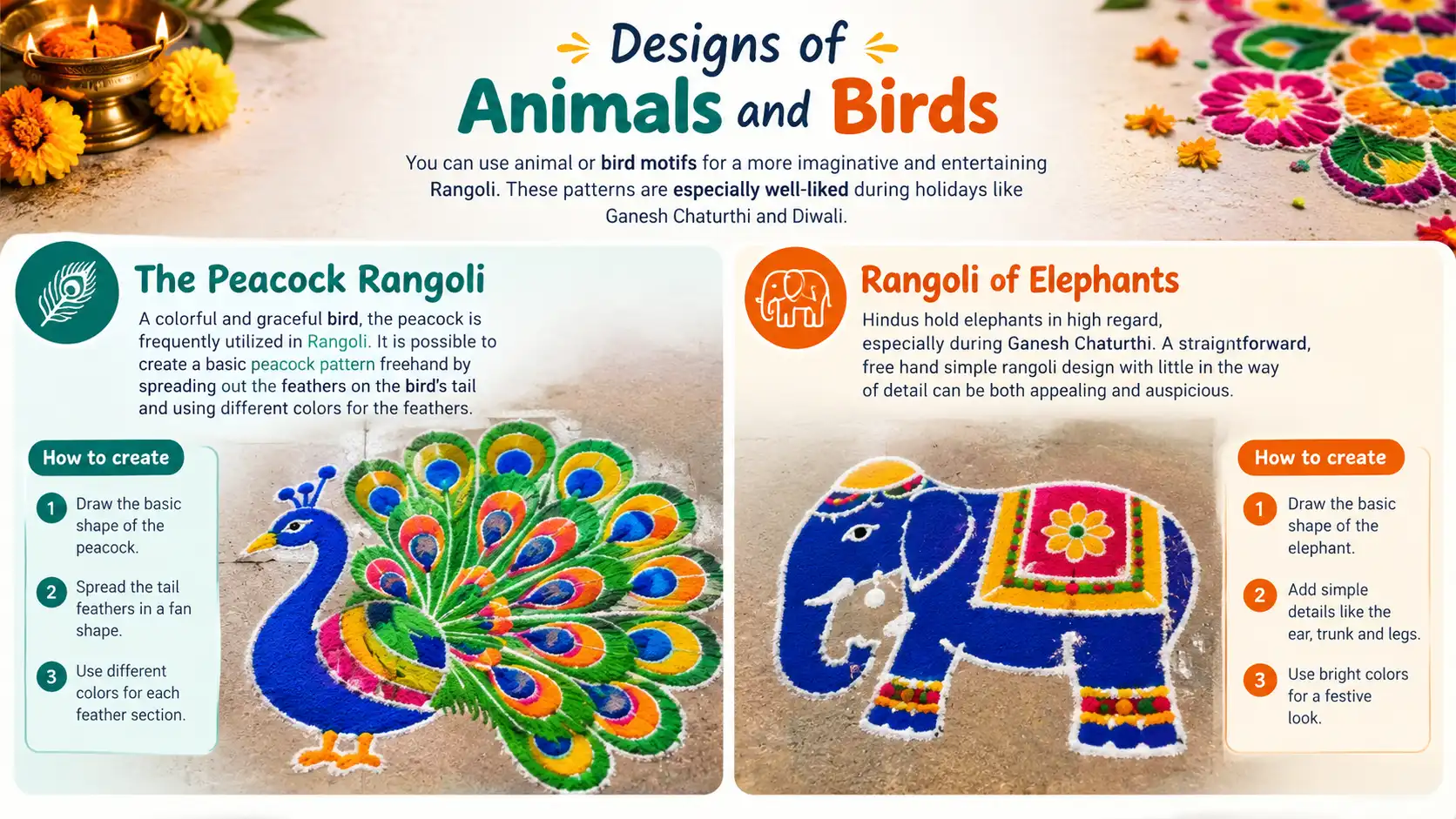
You can use animal or bird motifs for a more imaginative and entertaining Rangoli. These patterns are especially well-liked during holidays like Ganesh Chaturthi and Diwali.
The Peacock Rangoli
A colorful and graceful bird, the peacock is frequently utilized in Rangoli. It is possible to create a basic peacock pattern freehand by spreading out the feathers on the bird’s tail and using different colors for the feathers.
Rangoli of Elephants
Hindus hold elephants in high regard, especially during Ganesh Chaturthi. A straightforward, free hand simple rangoli design with little in the way of detail can be both appealing and auspicious.
Detailed Instructions for Creating a Freehand Rangoli
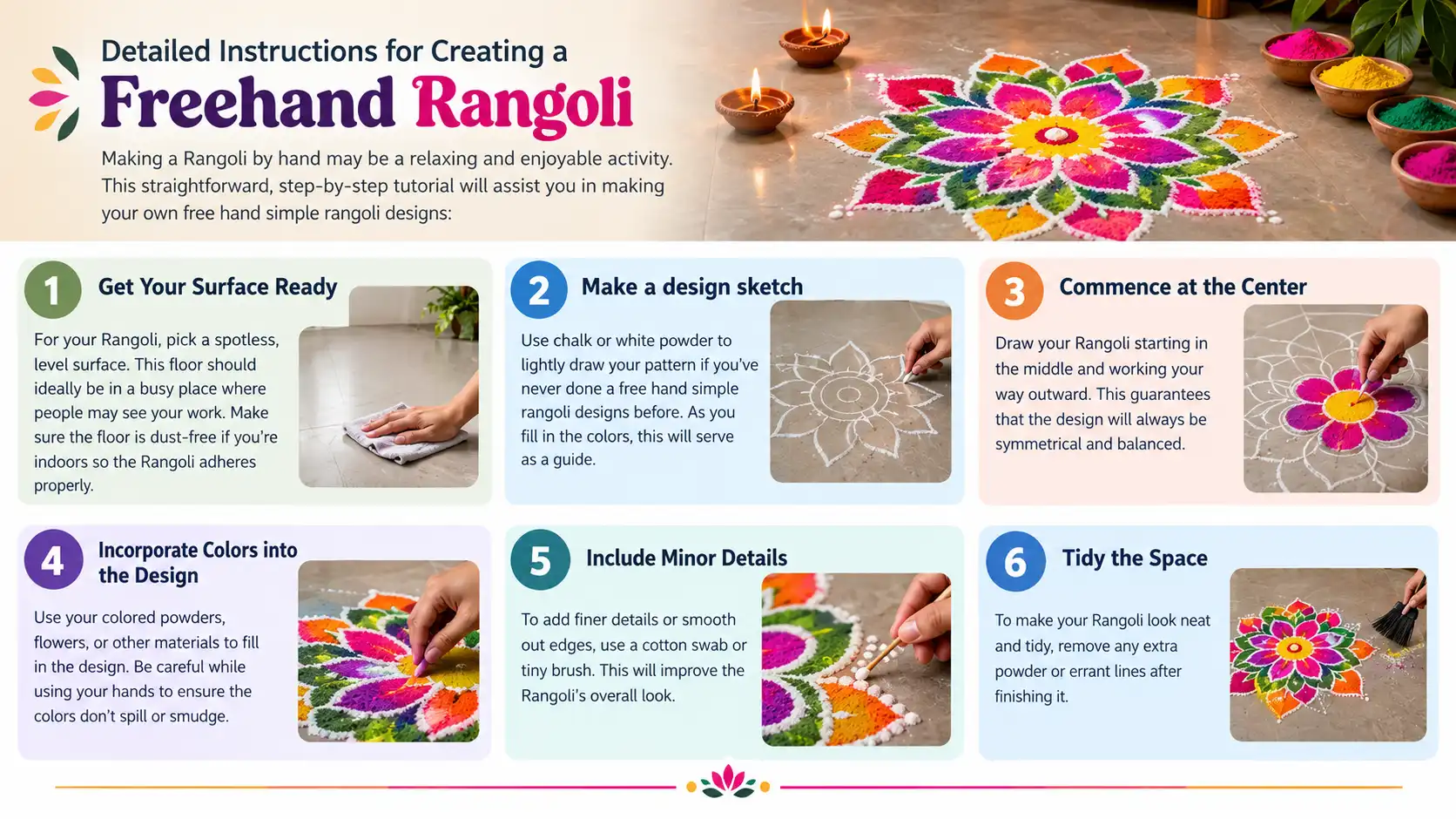
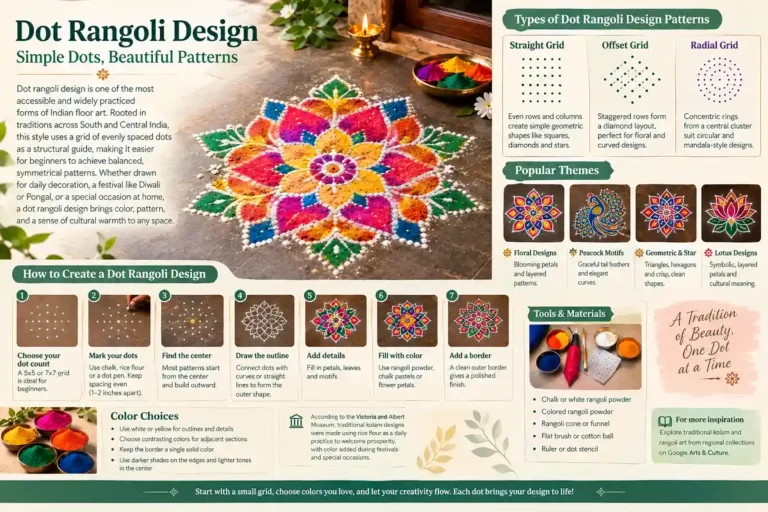
Making a Rangoli by hand may be a relaxing and enjoyable activity. This straightforward, step-by-step tutorial will assist you in making your own free hand simple rangoli designs:
Get Your Surface Ready
For your Rangoli, pick a spotless, level surface. This floor should ideally be in a busy place where people may see your work. Make sure the floor is dust-free if you’re indoors so the Rangoli adheres properly.
Make a Design Sketch
Use chalk or white powder to lightly draw your pattern if you’ve never done a free hand simple rangoli design before. As you fill in the colors, this will serve as a guide.
Commence at the Center
Draw your Rangoli starting in the middle and working your way outward. This guarantees that the design will always be symmetrical and balanced.
Incorporate Colors into the Design
Use your colored powders, flowers, or other materials to fill in the design. Be careful while using your hands to ensure the colors don’t spill or smudge.
Include Minor Information
To add finer details or smooth out edges, use a cotton swab or tiny brush. This will improve the Rangoli’s overall look.
Tidy the Space
To make your Rangoli look neat and tidy, remove any extra powder or errant lines after finishing it.
Without a script, free hand simple rangoli designs patterns are a fun way to add color to your celebrations and express your creativity.
They offer a personal touch to your decor, are inexpensive, and are simple to construct.
Rangoli is a great opportunity to display your artistic abilities and create a cozy, welcoming ambiance, whether you’re celebrating Diwali, Onam, or any other event.
Let your creativity guide your next Rangoli design.FAQs
Rangoli: What is it?
Rangoli is a classic Indian folk art form in which colorful powders, flowers, or other materials are used to create decorative patterns on the ground. It is frequently carried out on auspicious occasions and at festivals.
Can I use a carpet to make Rangoli?
Rangoli is best made on a level surface, such as a clean floor, concrete, or tiles. Rangoli made of fabric or flower petals can be used in place of colorful powder if you’re indoors on a carpet.
How can I extend the life of my Rangoli?
Lightly mist your Rangoli with water to help it set and prolong its shelf life. Avoid places with a lot of foot traffic as well.
Is Rangoli hard to do by hand?
Freehand Rangoli is easy, especially if you start with basic designs. Your designs will get increasingly complex and detailed as you practice.
What supplies are needed to make Rangoli?
Colored powders, rice flour, flower petals, chalk powder, and even colored sand or stone are common ingredients for Rangoli.